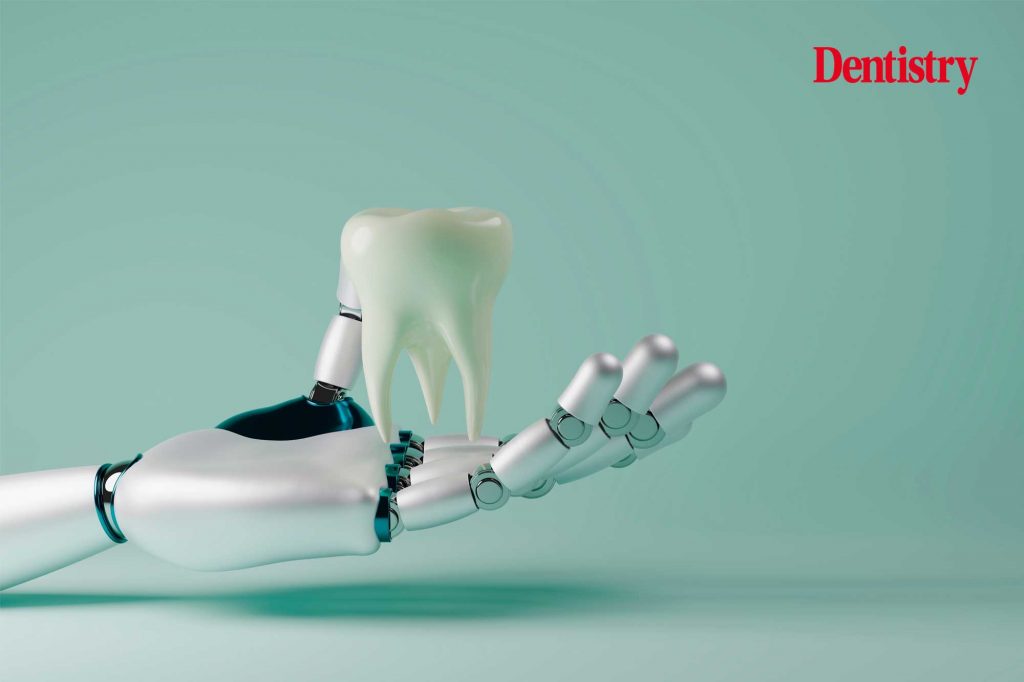
An autonomous robot prepared tooth transplant sockets more precisely than a conventional static guide-assisted approach, with the greatest improvements seen in complex double-rooted anatomy.
Researchers at the Fourth Military Medical University in Xi’an, China, tested the two methods on 40 3D-printed mandibular models. Researchers said the robotic device displayed ‘superior accuracy and geometric fidelity’ compared to existing methods.
Tooth autotransplantation – replacement of a diseased tooth with a healthy but superfluous one from elsewhere in the mouth – is often seen as a preferable alternative to dental implants as it preserves natural tooth function and supports continued jaw development in younger patients.
Success in tooth transplant procedures requires precise preparation of the socket, as it must match the donor tooth as closely as possible while preserving the periodontal ligament and surrounding bone.
Currently, the most common approach to tooth transplants uses a static guide, a custom template fitted to the teeth to guide socket preparation. Study leader Shizhu Bai said the study aimed to determine whether a robot could achieve more precise socket preparation than a dentist assisted by a static guide.
What are the benefits of robot tooth transplant preparation?
While both the robot and the static guide achieved similar levels of accuracy at the socket entry point, the robot was found to significantly reduce deviations at the deepest part of the socket and produce more precise drilling angles. The robot-prepared sockets also matched the planned root morphology more closely.
Co-leader Yimin Zhao said: ‘The technology enables the creation of recipient sockets that closely replicate donor root anatomy while minimising unnecessary bone removal, potentially preserving surrounding bone, reducing repeated trial insertions, and creating more favourable conditions for periodontal ligament healing and primary stability.’
The greatest difference between human and robotic preparation was seen in double-rooted teeth, meaning the new robot may be most useful for complex root anatomy.
The research team noted that further clinical trials would be needed to measure long-term success in comparison with existing methods.
Follow Dentistry.co.uk on Instagram to keep up with all the latest dental news and trends.