
Months into what turned out to be one of Ireland’s longest fitness to practise cases, principal Tom Munroe was at breaking point, delivering parcels to make ends meet, wondering whether he would ever be allowed to return to dentistry.
‘I had no income. My practice was taken from me. I didn’t know if I was ever going to get back to work again,’ he tells Dentistry.
Speaking during November’s Movember campaign, which promotes men’s health, including mental health, Tom wants colleagues to seek support before isolation becomes a crisis. He also wants scrutiny of what happens after a dentist asks for help. He says the Dental Council of Ireland (DCI) had medical evidence of his depression and anxiety, yet he remained uncertain about when his case would be heard or how it would end.
The Irish and UK systems differ, but the experience of Tom, who once owned two Dublin practices, raises questions dental professionals on both sides of the Irish sea can understand.
Why did reaching an outcome take four years, why did nobody check on his wellbeing, and why did he have to arrange treatment for 41 patients while known to be seriously unwell? Were the DCI’s decisions actually the best outcome for his patients?
His account comes as both Irish and UK dentists are being asked to pay more towards their respective regulatory systems struggling to resolve cases promptly. The General Dental Council (GDC) has cited growing fitness to practise demands in raising UK-based dentists’ annual retention fee to £720 for 2027, acknowledging that the increased caseload is slowing improvements to the time proceedings take.
‘I had no income. My practice was taken from me. I didn’t know if I was ever going to get back to work again’
From practice ownership to isolation
Tom qualified in Dublin in 2001, worked in England for two years and returned to establish practices in Tallaght and Milltown. Following the breakdown of his marriage, he left his Tallaght practice and became increasingly isolated working in Milltown. A serious mental health crisis led to inpatient psychiatric treatment in 2019.
Time away from dentistry brought relief, but the need for money drew him back.
He initially worked a reduced week. But as his workload increased, he struggled again, taking on treatment plans he felt uncomfortable with to generate income, cancelling appointments and falling behind with communications. He had laid off his receptionist because he could no longer afford the role.
The council’s published notice records admitted misconduct involving seven patients, including delayed treatment, failures concerning patients reporting pain, inadequate records and false claims that he had cancer. Tom has previously apologised and acknowledged that he should have stopped practising and arranged cover earlier.
‘I said to four patients, after repeated cancellations, that I had cancer as I felt telling these patients that I had a mental illness was worse as there is a huge stigma around mental health in the medical profession. I was embarrassed to tell the truth.’
Closing Milltown while unwell
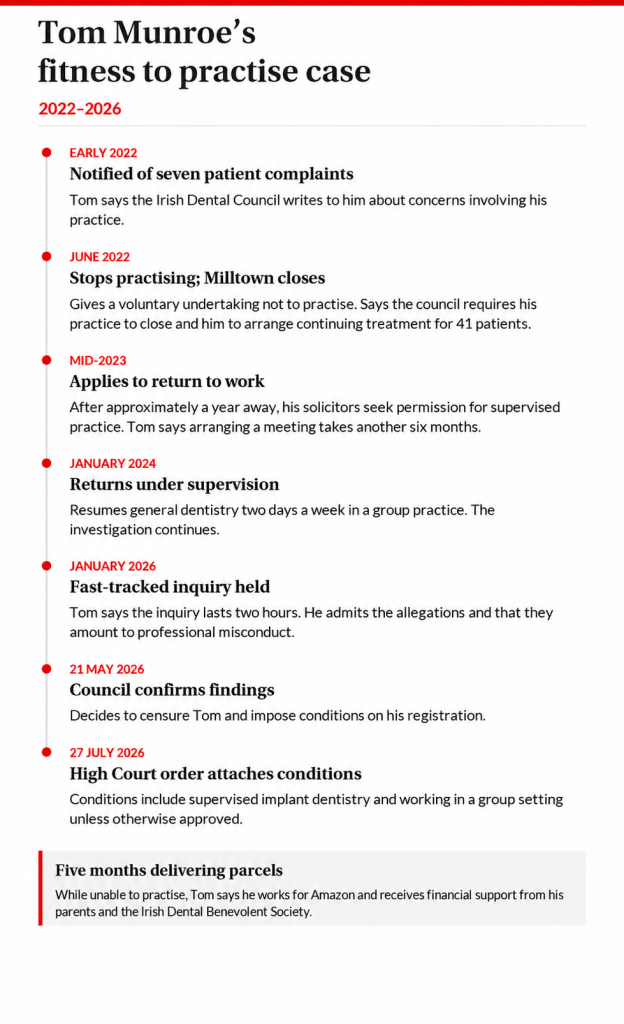
He says he followed advice to accept a voluntary undertaking not to practise in June 2022. According to Tom, the council also required his Milltown practice to close without permitting a locum, instructing him to leave an answerphone message directing patients to the council. Dentistry contacted the DCI about this and other conerns raised by Tom but they are yet to reply.
He says the council already had medical evidence of his depression and anxiety. Three further psychiatric assessments, he says, subsequently confirmed his consultant’s diagnosis. He was then tasked with finding continuing care for the 41 patients he was unable to treat.
‘I had to write to all of those 41 patients, I had to go and source a practitioner who would take those 41 patients on, finish their treatment, and pay for that treatment to be finished. All while I was in a mental health crisis and took a voluntary undertaking to step down, so I had to go and beg in Dublin.’
Dr Eddie Cotter eventually agreed to help. Tom’s partner and parents organised records, laboratory work and patient communications while he struggled to manage.
Waiting to return to dentistry
With no dental income, his savings dwindled.
‘I was down to fumes,’ he said. ‘I had no income coming in. I had to reach out to the Irish Dental Benevolent Society, who were very, very good to me.
‘I reached out to my parents. I worked in the evening. I worked for Amazon as a driver, just to keep money coming in. I had no other choice. I did that for five months.’
The cost of proceedings has also reached other dentists through registration fees. The DCI recorded €216,954 in fitness to practise costs in 2024, up 20.3% on 2023.
Explaining its dentist retention fee increase from €380 to €450 for 2026, it said these costs had exceeded budget for three consecutive years, mainly because of High Court suspension applications.
After a year away, Tom and his solicitors applied for a supervised return. He says another six months passed before approval, allowing him to resume work in January 2024 while the fitness to practise proceedings continued.
Returning brought an income, but he says he still received little reassurance about when the case would end or support for his wellbeing.
‘They weren’t checking in on me. They didn’t care what I was doing. They were just focusing on fitness to practise.’
Eventually, he was contacted by the DCI to be told that his case would be fast-tracked. The inquiry took place in January 2026, the council confirmed its findings in May, and a High Court order followed in July.
Censured and conditions imposed
‘It was done in two hours,’ Tom said.
‘If it’s not that important, what was the last three-and-a-half years that I’m looking back at here, and the wreckage that’s behind me?’
Having admitted the allegations and that they amounted to professional misconduct, Tom was censured and had conditions imposed on his registration. These included supervised implant dentistry, additional training and working in a group setting unless otherwise approved. The conditions will remain in place for at least three years.
Tom describes feeling presumed guilty before the inquiry and living without a clear endpoint.
Having worked in England earlier in his career, Tom wants change in both countries. Although their regulatory systems differ, UK figures offer evidence of the prolonged waits dental professionals can face during fitness to practise investigations, and the financial pressure of running those processes.
The GDC 2025 figures show that the average time from receiving a concern to reaching a final assessment decision was 78 working weeks, compared with 76 in 2024. At the end of the year, 761 cases remained open at that stage, an increase of 35%. One FTP case reportedly took nine years to conclude.
The GDC also reported an additional £2.8 million spent on fitness to practise and hearings in 2025, including staffing, legal fees and hearing delivery. Neither regulator’s expenditure figures capture the lost earnings and personal financial pressures described by Tom. His account puts those consequences alongside the institutional cost of investigating concerns.
Do fitness to practise processes needs to change ?
He praises Practitioner Health Matters, to which he says the council referred him, but wants earlier consideration of medical evidence, patient safeguards and how cases can be resolved.
‘They should triage it, have a screening team, and just triage complaints, improve efficiency, try and take the meat out of these cases, break them down before they go in into layers of bullshit and years down the road.’
In the UK, the GDC already has early assessment stages and has reported faster handling of certain cases. However, its September research found most respondents remained dissatisfied.
For Tom, returning within a team has eased some of the isolation that preceded his illness. Having colleagues nearby has changed how he manages the pressures of treating patients.
‘I felt more secure because I was in a group setting. I wasn’t isolated. If I had a problem with a patient, I could go next door and knock on the door. I was in a team.’
He now works in general dentistry and supervised implant dentistry. Although the inquiry has concluded, he is still working towards the next stage of his return, and finds it difficult to imagine how he will feel when those immediate goals are behind him.
‘Now it’s a whole new type of stress, so I’m still in fight mode. It’s a question I’ve asked myself, and I haven’t had much time to think about what will I be like when I come out of fight mode.’
Seeking support during Movember
Tom wants colleagues in the UK and Ireland to seek help before isolation and ill health begin affecting their lives and patient care. He is also willing to hear from dental professionals experiencing similar difficulties, drawing on his own experience of struggling to speak openly and finding support.
For him, sharing an experience he finds difficult to revisit has a clear purpose.
‘Even if it helps one other person with the article, if it gets out there, it’s done its job.’
Colleagues wishing to contact Tom can do so via his social media profile.
Other support options include Practitioner Health in Ireland and Support for Dental Teams in the UK.
Create a free account for unlimited access — plus the Dentistry Bulletin delivered to your inbox.


