
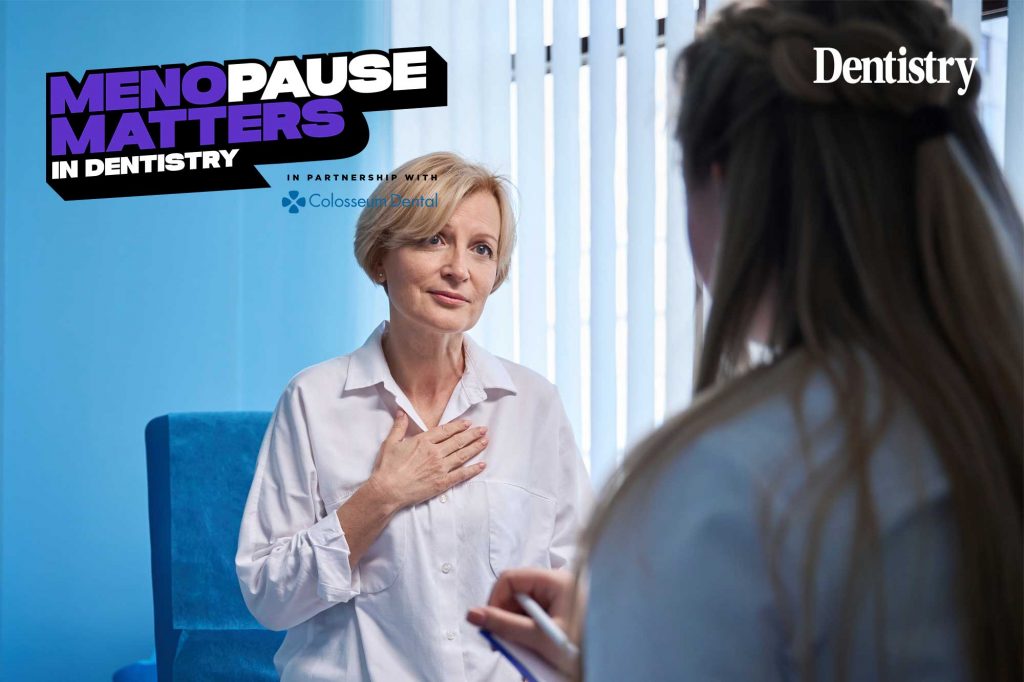
Agata Ciukiewicz examines the evidence linking menopause to dry mouth, burning mouth and periodontal changes, explaining why dental teams must take symptoms seriously without assuming falling oestrogen is the cause.
Oral symptoms during the menopausal transition are real and deserve recognition. However, the evidence does not support blaming every oral change on falling oestrogen: most of it is possible rather than scientifically proven. That distinction between association and causation runs through every section of this article. This article examines what dental teams can say with confidence about falling oestrogen levels and oral health, and where the claims have outrun the evidence. Throughout, the distinction between association and causation is the main test because it should shape how clinicians talk to patients and what they recommend.
Going through perimenopause myself, I noticed that my mouth felt different: dry, tender, and troubled by temporomandibular joint (TMJ) pain. It made me want to ask whether that confidence was earned: do falling oestrogen levels actually cause dry mouth, gum disease, burning mouth, and bone loss, or is that a claim that has outrun its evidence?
These symptoms deserve recognition, but recognising a pattern is not the same as proving its cause, and receptor evidence is a good example of where that line gets blurred. Women’s hormones fluctuate during perimenopause, while sustained lower oestrogen is more characteristic after the final menstrual period (Santoro and Randolph, 2011). Age, medicines, systemic health, smoking, and previous dental disease all contribute to these symptoms too.
Plausible does not mean proven
Oestrogen receptor beta has been identified in oral epithelium and salivary gland cells, which suggests a hormonal effect on oral health is plausible, but that is not the same as showing that falling levels cause these symptoms (Välimaa et al, 2004).
This means oral tissues are capable of responding to oestrogen, so an influence is biologically plausible, but a plausible mechanism is not the same as evidence that falling levels cause a specific symptom or disease.
Receptor evidence shows only that oral tissues can respond to oestrogen, not that falling levels produce a particular symptom or disease. Attributing these symptoms to oestrogen alone goes further than the data support, and longitudinal data on salivary flow found no consistent effect of menopause (Ghezzi et al, 2000).
Dry mouth is not one finding
Xerostomia is the subjective feeling of dryness. Hyposalivation is an objectively reduced salivary flow. A patient may feel dry mouth even when measured flow remains within the reference range, and reduced flow is not experienced the same way by everyone (Villa et al, 2015).
A 2025 survey of 3,211 perimenopausal and postmenopausal women found that 71.2% reported xerostomia (García-Alfaro et al, 2025), but this tells us only how common the symptom is, not what causes it. Without a premenopausal comparison group, the figure shows only how common the symptom is in this population, not that menopause causes it, and that same limitation runs through much of this evidence.
By contrast, a longitudinal study found no consistent effect of menopause or hormone therapy on stimulated parotid flow, while xerogenic medicines had a greater influence (Ghezzi et al, 2000); both bodies of evidence agree the symptom is real, but they disagree on cause, and the longitudinal data shifts the question from hormonal change to prescribing history, making a medicine review the more useful first step in dental assessment.
A medicine review may therefore be more useful than a hormonal assumption, since medicines are the more likely driver. Antidepressants, antihypertensives and antihistamines can contribute, as can dehydration, diabetes, Sjögren disease, anxiety and previous cancer treatment. When salivary flow is genuinely reduced, prevention should respond to the resulting caries risk.
Burning needs a diagnosis
The feeling of burning mouth is reported around menopause, but burning mouth syndrome is not the same as the feeling of burning mouth. A 2024 systematic review found only four controlled studies, with contradictory hormonal findings and no clear relationship with symptom severity (Brauwers et al, 2024).
Burning mouth feeling may also accompany candidiasis, dry mouth, nutritional deficiency, diabetes, thyroid disease, reflux, medication effects or local irritation. Primary burning mouth syndrome should be diagnosed by exclusion of other causes. Claiming too early that the symptom is hormonal risks missing a treatable cause.
Gums, bone and the limits of association
A recent periodontal review included nine observational studies, eight of which were cross-sectional, so the data can show associations but cannot establish that menopause causes periodontal damage; therefore, any claim about causation should be treated with caution (Martín et al, 2026). Although postmenopausal groups generally showed greater attachment loss, probing depths, and inflammation, the authors judged the evidence weak because important confounders were poorly controlled, which limits what the findings actually show.
Periodontitis is an inflammatory, biofilm-associated, host-mediated disease. Menopause may be a relevant systemic modifier, but because most studies cannot separate it from age and accumulated risk, it is not an independent explanation for inflammation, attachment loss or recession. Most studies compare older postmenopausal women with younger premenopausal women at one point in time, making age and accumulated risk difficult to separate from hormonal status (Martín et al, 2026). Any periodontal differences found could just as easily reflect longer disease exposure as any effect of menopause.
Systemic bone loss also needs separate consideration. In a five-year cohort, osteoporosis was associated with more teeth showing periodontitis progression in a postmenopausal subgroup (Khunthananithi et al, 2024). It is a useful signal, although not proof of causation. Systemic bone density, alveolar bone loss, periodontal attachment loss and tooth loss are not interchangeable outcomes. Evidence on hormone therapy remains inconsistent, largely because trials differ in design, duration and the populations studied. That inconsistency alone is enough reason not to prescribe it for periodontal or implant benefit (Chaves et al, 2020).
What the evidence still cannot tell us about cause
Most of the evidence on cause remains cross-sectional. We are still looking for the study which would follow women through perimenopause and beyond, with repeated hormone measures, salivary flow testing and periodontal charting, alongside medication records. Until then, biological plausibility, lived experience and observed association remain different kinds of evidence, and none of them adds up to proof of cause. We shouldn’t dismiss them, but none can substitute for the others. That distinction is central to an honest clinical conversation.
What this changes in practice
When a woman says her mouth suddenly feels different, listen first and then investigate. We need to take into account her medications and general health. Ask your patient about dryness, burning and taste change. Examine the soft tissues; assess and properly chart the periodontium, plaque control, diet, and fluoride exposure; and measure salivary flow when the result would alter management.
The fact that the patient is menopausal may justify closer prevention or monitoring, but it should not close the differential diagnosis. Diabetes, Sjögren disease, thyroid or nutritional problems and unexplained oral pain may require liaison or referral. A changing or non-healing lesion still follows the usual urgent pathway.
The mouth may change during the menopausal transition, but because xerostomia, burning, and taste changes also point to diabetes, Sjögren disease, and thyroid dysfunction, those changes should be properly assessed before any assumptions are made. Our role is to take those changes seriously, investigate them where the evidence supports it, and not reach for a single hormone when the research does not justify that. Validating the woman while investigating the symptom properly is where dental teams can make the greatest difference, even when menopause turns out not to be the cause.
Menopause Matters in Dentistry
In partnership with Colosseum Dental, Dentistry is recognising October’s Menopause Awareness Month.
Through expert insight, evidence-based information and the real experiences of dental professionals, the month-long campaign will focus on education, visibility and practical support, exploring the different ways menopause can affect those working across dentistry – as well as its potential implications for oral health.
Read more from the campaign:
References
- Santoro N, Randolph JF Jr. Reproductive hormones and the menopause transition. Obstet Gynecol Clin North Am. 2011 Sep;38(3):455-66. doi: 10.1016/j.ogc.2011.05.004. PMID: 21961713; PMCID: PMC3197715.
- American Dental Association. Xerostomia (dry mouth). ADA Library: Oral Health Topics. Accessed 6 September 2026.
- Martín FC, Rus MJ, de la Cruz Gándara Alvarez A, Simon-Soro A, Cantiga-Silva C. Impact of menopause on clinical periodontal outcomes: a systematic review. Clin Oral Investig. 2026 Mar 23;30(4):143. doi: 10.1007/s00784-026-06813-y. PMID: 41870718; PMCID: PMC13009112.
- Sanz M, Herrera D, Kebschull M, et al. Treatment of stage I-III periodontitis-The EFP S3 level clinical practice guideline. J Clin Periodontol. 2020;47(Suppl 22):4-60. doi:10.1111/jcpe.13290. PMID: 32383274.
- Välimaa H, Savolainen S, Soukka T, et al. Estrogen receptor-beta is the predominant estrogen receptor subtype in human oral epithelium and salivary glands. J Endocrinol. 2004;180(1):55-62. doi:10.1677/joe.0.1800055. PMID: 14709144.
- Ghezzi EM, Wagner-Lange LA, Schork MA, Metter EJ, Baum BJ, Streckfus CF, et al. Longitudinal influence of age, menopause, hormone replacement therapy, and other medications on parotid flow rates in healthy women. J Gerontol A Biol Sci Med Sci. 2000;55(1). doi:10.1093/gerona/55.1.M34. PMID: 10719771.
- Villa A, Connell CL, Abati S. Diagnosis and management of xerostomia and hyposalivation. Ther Clin Risk Manag. 2015;11:45-51. doi:10.2147/TCRM.S76282. PMID: 25653532.
- García-Alfaro P, Pérez-López FR, Martínez SG, Rodríguez I. Xerostomia and oral health-related quality of life in peri- and postmenopausal women. Maturitas. 2025;197:108268. doi:10.1016/j.maturitas.2025.108268. PMID: 40239612.
- Wolff A, Joshi RK, Ekström J, et al. A guide to medications inducing salivary gland dysfunction, xerostomia, and subjective sialorrhea: a systematic review sponsored by the World Workshop on Oral Medicine VI. Drugs R D. 2017;17(1):1-28. doi:10.1007/s40268-016-0153-9. PMID: 27853957.
- Department of Health and Social Care, Welsh Government, Department of Health Northern Ireland, NHS England. Delivering better oral health: an evidence-based toolkit for prevention. Chapter 4: dental caries; Chapter 5: periodontal diseases. Updated 10 September 2025. Accessed 6 September 2026.
- International Classification of Orofacial Pain, 1st edition (ICOP). Cephalalgia. 2020;40(2):129-221. doi:10.1177/0333102419893823. PMID: 32103673.
- Brauwers KG, Bueno VM, Calcia TBB, Daroit NB. Sexual hormones changes in burning mouth syndrome: a systematic review. J Oral Rehabil. 2024;51(11):2475-2483. doi:10.1111/joor.13831. PMID: 3916488.
- Gurvits GE, Tan A. Burning mouth syndrome. World J Gastroenterol. 2013;19(5):665-672. doi:10.3748/wjg.v19.i5.665. PMID: 23429751.
- Khunthananithi P, Lertpimonchai A, Sritara C, et al. Decreased bone mineral density is associated with an increased number of teeth with periodontitis progression: a 5-year retrospective cohort study. Clin Oral Investig. 2024;28(1):51. doi:10.1007/s00784-023-05463-8. PMID: 38153562.
- Chaves JDP, Figueredo TFM, Warnavin SVSC, Pannuti CM, Steffens JP. Sex hormone replacement therapy in periodontology: a systematic review. Oral Dis. 2020;26(2):270-284. doi:10.1111/odi.13059. PMID: 30739380.
- National Institute for Health and Care Excellence. Suspected cancer: recognition and referral. NICE guideline NG12. Recommendations 1.8.2-1.8.4: oral cancer. 2015. Guideline; NCBI Bookshelf text. Accessed 6 September 2026.
Create a free account for unlimited access — plus the Dentistry Bulletin delivered to your inbox.


