As his son enters the profession 30 years after he qualified, Jaswinder Jandu reflects on how dentistry has changed, the pressures facing the newly qualified dentist today and the foundations that still matter.
1996. The Spice Girls were telling us what they really, really wanted, England was gripped by Euro 96 and most of us had never heard of Google. It was also the year I qualified as a dentist.
After 30 years, in 2026 – the world of AI and Instagram – my son has graduated into the same profession. We may share the same qualification, but the expectations, technology, and pressures have changed beyond recognition.
So, has dentistry changed for the better? Are the next generation facing challenges that mine could not have imagined?
Entering dentistry 30 years ago
When I qualified, dentistry was more straightforward in many respects. The technology was relatively basic, treatment options were more limited, and patients generally accepted the clinical recommendations made by their dentist.
However, being newly qualified was daunting. Dental school gave us the foundations, but much of our confidence developed through experience. We had fewer formal support systems, so young dentists often learned by observing experienced colleagues, asking questions and occasionally learning from their mistakes.
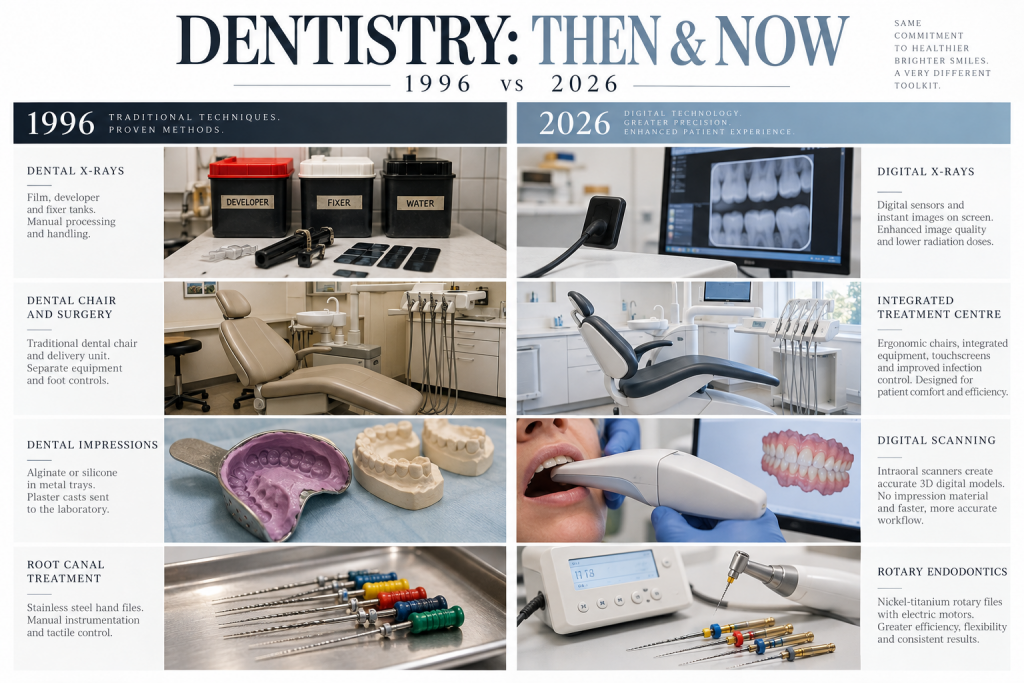
There were no digital scanners, 3D treatment planning systems or instant access to online clinical resources. Radiographs were developed manually, records were written by hand and communication with laboratories took considerably longer. Diagnosis and treatment depended heavily on clinical judgement and traditional practical skills.
The professional environment was also different. Regulation and compliance existed, but the administrative burden was significantly lighter. Dentists were generally able to concentrate more of their time on treating patients and developing their clinical ability.
The principal challenges were establishing confidence, improving speed and learning how to manage a busy surgery. We also had to develop communication skills, understand patients and make sound decisions, often without the extensive guidance and protocols available today.
The opportunities facing today’s graduates
My son is entering a profession transformed by technology. Digital radiography, intraoral scanners, CBCT imaging, guided implant surgery, aligner therapy and computer-assisted design have changed what dentists can diagnose and deliver.
These advances offer remarkable opportunities. Modern graduates can plan treatment with greater accuracy, communicate visually with patients and provide care that would have seemed extraordinary when I qualified.
Education is also more accessible. Young dentists can attend webinars, watch clinical demonstrations and connect with specialists across the world. If they encounter an unfamiliar condition or technique, information is immediately available.
Yet this brings a new pressure: the expectation to know more, learn faster and keep up with constant change. Technology can improve dentistry, but it can also make young clinicians feel that they must purchase every new system and master every emerging technique!
The fundamentals remain unchanged. Technology should support clinical judgement, not replace it.
Greater regulation and accountability
Perhaps the most significant difference is the regulatory environment.
Today’s dentists must work within extensive requirements relating to consent, safeguarding, infection control, data protection, clinical governance, record-keeping and continuing professional development. Much of this has improved patient safety and professional standards, but it has also created a considerable administrative and emotional burden.
Modern graduates know that their notes, decisions and communication may be closely examined if a complaint arises. This can encourage good practice, but it may also lead to defensive dentistry and anxiety.
When I qualified, mistakes were taken seriously, but there was less fear that every imperfect outcome could become a formal complaint or legal matter. Dental Protection reported that a UK dentist was nearly twice as likely to receive a clinical negligence claim in 2017 as they had been just 10 years earlier.
My son’s generation must therefore learn not only how to perform dentistry, but also how to document, justify and communicate every decision.
Changing patient expectations
Patients are now better informed and more involved in their care. This is positive, but the internet and social media have also shaped expectations.
Some patients arrive having already researched their symptoms, chosen a treatment or seen an apparently perfect result online. They may compare their outcome with heavily edited images rather than with what is biologically achievable.
Dentists must spend more time discussing options, limitations, risks, costs and realistic outcomes. Technical skill alone is no longer enough. Communication, empathy and expectation management are central to successful practice.
When I qualified, the relationship was often based primarily on trust in the dentist’s judgement. Today, it is more collaborative. That can produce better decisions, but it also requires patience and excellent communication.
The influence of social media
Social media presents an entirely new challenge.
It allows dentists to educate patients, showcase their work and build a professional reputation. However, it can also create unhealthy comparisons. Newly qualified dentists may see impressive cosmetic cases online and feel that they are falling behind before they have mastered the basics.
There can be pressure to appear successful, invest in expensive courses and begin complex procedures too early. A polished online presence is not necessarily evidence of clinical maturity.
Confidence should be built through sound diagnosis, careful treatment planning, appropriate case selection and consistent everyday dentistry. There is no substitute for experience, however impressive the technology or social-media profile may be.
Financial pressures and career expectations
Young dentists also enter the profession carrying greater financial and career pressures. The cost of university education, postgraduate courses, indemnity and professional registration can be considerable.
At the same time, many graduates feel pressure to progress quickly into cosmetic dentistry, orthodontics or implant treatment. These areas can offer rewarding careers, but there is a danger of overlooking the importance of becoming an excellent general dentist first.
When I qualified, career development often happened more gradually. We built experience, confidence and professional relationships over time. Today’s graduates are exposed to more opportunities, but also to more commercial influence and a stronger sense that they should achieve everything immediately.
Dentistry is a long career. There is time to develop.
NHS dentistry and access to care
My son is also beginning work at a difficult time for NHS dentistry. Practices face financial pressures, workforce shortages and increasing patient demand. Dentists must often balance the desire to provide ideal care with contractual and practical limitations.
For a young clinician, this can be frustrating. They enter the profession wanting to help people but may find themselves working within a system that does not always provide enough time or flexibility.
The challenge will be to maintain professional standards and compassion without becoming overwhelmed by the pressures surrounding them.
Mental wellbeing, resilience and a changing culture
One concern I have heard from some experienced trainers is that younger dentists do not always appear as well equipped to cope with stress, demanding workloads or difficult feedback as previous generations. There is sometimes a perception that resilience has declined and that situations once regarded as an ordinary part of professional life can now feel overwhelming.
In a survey of more than 1,100 UK dentists, 77% said that the fear of being sued had caused them stress or anxiety, while 74% said that this fear affected the way they practised dentistry.
However, I believe this deserves a more balanced interpretation.
When I qualified, mental wellbeing was rarely discussed. Young dentists were generally expected to work hard, accept criticism and carry on, even when they were struggling. Asking for help could be regarded as a sign of weakness. We may have appeared more resilient, but that does not necessarily mean we were coping well. Many people simply dealt with stress privately, and problems such as anxiety, exhaustion and burnout were seldom acknowledged.
Today’s graduates are more willing to talk about mental health, personal boundaries and the effects of workplace pressure. This should be seen as progress. At the same time, professional life inevitably involves pressure, responsibility, criticism and occasional disappointment. Supporting wellbeing must therefore go hand in hand with helping young dentists develop resilience, perspective and the confidence to manage difficult situations.
Dental foundation trainers, employers and senior colleagues all have a role to play. Young dentists need supportive environments where they can ask questions and admit uncertainty, but they also need honest feedback and gradually increasing responsibility.
Protecting someone from every uncomfortable experience will not prepare them for the realities of clinical practice. The objective should not be to make dentistry free from pressure, but to give young professionals the skills and support required to manage that pressure safely.
Resilience does not mean struggling alone. It means being able to respond constructively to setbacks, learn from criticism and recognise when it is appropriate to ask for help.
HR, health and safety and attitudes towards risk
There has also been a much wider cultural change in attitudes towards risk, responsibility and health and safety.
This was brought home to me at my son’s graduation ceremony. The graduates were not allowed to throw their mortarboards into the air because of the possibility that one might land on someone and cause an eye injury. When I graduated, we threw ours without a second thought.
It is a small and slightly amusing example, but it represents a much larger change. Modern organisations are increasingly conscious of risk assessments, liability, safeguarding and their duty of care.
Similar changes can be seen within dental practices, where HR policies and formal procedures now influence recruitment, induction, performance management, complaints, staff wellbeing and almost every aspect of employment.
Much of this provides essential protection for employees, patients and employers. It creates clearer standards, helps prevent inappropriate behaviour and gives staff formal routes through which to raise legitimate concerns.
Nevertheless, it can also create a more cautious working culture in which managers feel they must document every conversation and anticipate every possible risk. Situations that might once have been resolved through an informal conversation may now require a formal meeting, written records and an HR process.
When I qualified, workplace relationships were often managed more informally. That had advantages, but it could also leave individuals without adequate protection or support. The modern approach is more structured and accountable, although it can sometimes feel less personal and more defensive.
The challenge is to find the correct balance. We should protect people without making them fearful of ordinary risk, support mental wellbeing without lowering reasonable professional expectations, and encourage openness without removing personal responsibility.
The younger generation should not be criticised simply for working within the culture they have inherited. Equally, they must be prepared for the reality that dentistry remains a demanding profession and that resilience can only be developed through experience, reflection and appropriate exposure to challenge.
Perhaps the best approach is to combine the strengths of both generations: the openness and awareness of today with the determination, perspective and practical resilience that characterised the profession when I qualified.
Different challenges the same foundations
Although dentistry has changed enormously, the qualities that make a good dentist remain remarkably consistent.
Patients still want to be listened to. They want honesty, kindness and reassurance. They want a dentist who takes responsibility, explains things clearly and treats them as an individual.
My son will use technology that I could not have imagined when I graduated, but his success will depend on the same foundations: integrity, compassion, clinical judgement, attention to detail and a commitment to lifelong learning.
My generation faced fewer technological and regulatory demands, but often had less structured support and had to learn through experience. His generation has access to extraordinary knowledge and clinical possibilities, but faces greater scrutiny, higher patient expectations and more complex professional pressures.
Neither journey is necessarily easier; they are simply different.
A father’s advice
If I could offer my son and other newly qualified dentists one piece of advice, it would be this: do not rush.
Build strong foundations. Learn from experienced colleagues. Ask questions without embarrassment and never undertake treatment merely because you feel pressured to prove yourself. Choose mentors carefully, reflect honestly when things do not go as planned and treat every patient with the respect you would want for your own family.
Embrace technology, but do not become dependent on it. Develop your career, but do not measure your progress against somebody else’s social media account. Protect your reputation, but also protect your health and happiness.
Accept that there will be difficult days, challenging patients and moments of self-doubt. These experiences do not mean that you are failing. They are part of becoming a more capable and rounded professional.
Thirty years ago, I entered dentistry with enthusiasm, uncertainty and a determination to succeed. My son now begins his career with those same emotions, but in a profession that has changed beyond recognition.
Watching him take this step reminds me that dentistry is not simply passed from one generation to the next. It evolves, challenges and renews itself. I am enormously proud that my son has chosen this profession, and I hope that the lessons of my generation, combined with the knowledge, awareness and opportunities available to his, will help him build a career that is successful, fulfilling and, above all, centred on caring for people.
Create a free account for unlimited access — plus the Dentistry Bulletin delivered to your inbox.