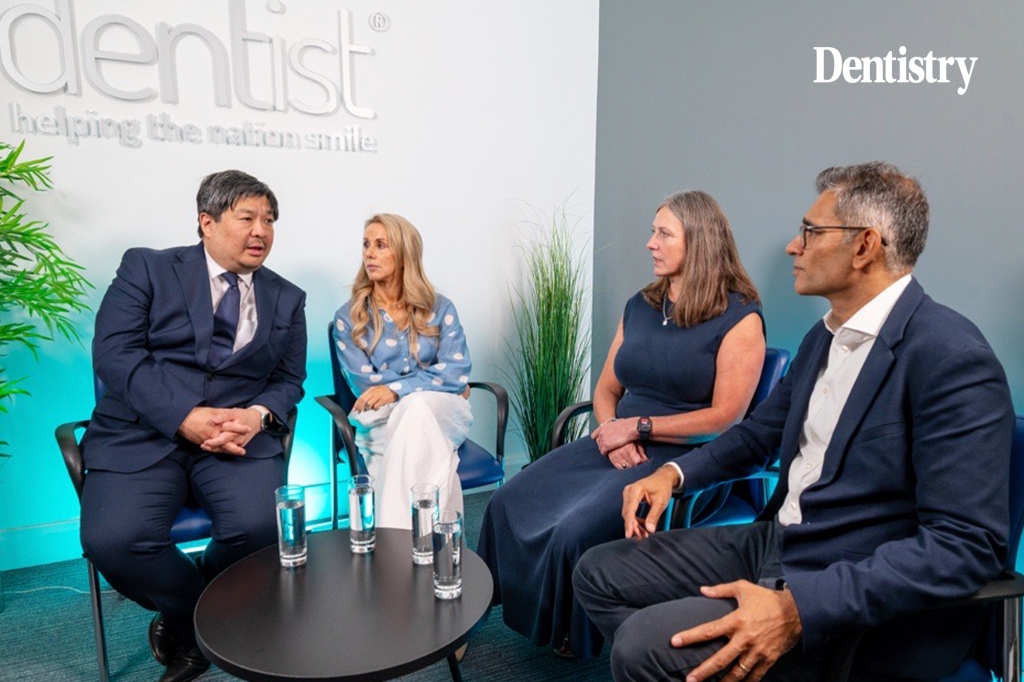
Chief dental officer (CDO) for England Jason Wong has questioned whether current dental school entry requirements reflect the practical and people-centred nature of the profession.
Speaking during a panel discussion hosted by mydentist at its Chesterfield practice, Wong said work was under way to widen participation in dental education.
He also called for dentistry to move away from what he described as a ‘fear culture’, arguing that mentoring and professional support should become routine throughout clinicians’ careers.
The discussion, which was shared exclusively with Dentistry, also included mydentist chief executive Nilesh Pandya, chief clinical officer Nyree Whitley and Dentaid head of clinical and policy Catherine Rutland.
Wong said: ‘In terms of how we widen participation, we have got an incredibly academic entry requirement, with an incredibly academic course, with a job that if you learn in general practice, which most do, is really people centred. You know these relationships that you have or in practical skills can be out of kilter.
‘I’ve made the point and there’s some work going on and we’ve got meetings coming up with the Dental Schools Council about how we’re going to address that.’
Competition for dental school places
Competition for UK dental school places remains intense. A recent Dentistry contributor article reported that more than 9,900 people applied for around 1,630 places in 2025. In the same article, Eshaa Hafeez described choosing to study dentistry in Bulgaria after missing the grades required for her UK offer by two marks.
Training capacity is expanding, though. The government has allocated 50 additional dental school places to the University of Portsmouth and the University of East Anglia from 2027. However, the profession continues to debate whether increasing places will widen participation or resolve the geographical distribution of the dental workforce.
Whitley said mydentist planned to establish scholarships through its charitable foundation.
‘These days it’s really, really challenging,’ she said. ‘I don’t want it to be a barrier for entry for people because there are loads of amazing people out there who will make great clinicians.’
Moving away from a ‘fear culture’
Wong called for greater use of mentoring and continuing professional support.
‘As far as the environment’s concerned… maybe more use of mentoring and actually just general development. A learning culture rather than some parts of dentistry that have been stuck a bit in a fear culture,’ he said.
He argued that mentoring should become a routine part of professional development instead of something introduced only when a clinician encountered difficulties.
‘We seem to be in a position where you need mentoring when you need help. But actually, the message I’m trying to communicate, we’ve been going around to all the students and saying it, you should be getting mentoring from the people surrounding you then and, actually, as you progress in your career.’
Pandya said mydentist had invested in a large clinical development network.
‘We’ve invested in well over 500 clinical development advisers and mentors to be working with our dentists to make sure that we are delivering on the ambitions that you have there, Jason,’ he said.
Wong said observing colleagues and receiving career-long support were more established in other parts of healthcare.
‘I think that’s where we’ve got to catch up,’ he said.
‘We could speed up’ skill mix
The chief dental officer also called for faster progress in making use of the wider dental team.
‘The increase of skill mix is on an upward trajectory, but I think we could speed that up,’ Wong said. ‘The other thing is to build on what the workforce actually wants.
‘You’ve talked about upskilling. You’ve talked about the ability to work to the top of their scope. Actually, that’s the other opportunity, which is, giving the simple things that you have for someone else to do, while actually being able to upskill and find different areas.’
From April this year, NHS dental contract reforms introduced a new course of treatment allowing suitably trained dental nurses to apply fluoride varnish to children without an accompanying examination.
Wong said policy changes could only go so far.
‘It’s actually individual practice leadership. I think it’s a great opportunity that you’ve got the reach, whereas an individual practice owner may not have the reach to do that.’
NHS reform and workforce pressures
The panel took place as Andy Burnham’s government had yet to set out its plans for the next stage of NHS dental contract reform.
NHS dental activity increased, with 37.6 million courses of treatment delivered in England during 2025/26, up 6.2% on the previous year. However, only 40% of adults had seen an NHS dentist during the preceding two years.
Pandya said recent contract changes in April had helped mydentist treat more patients.
‘We’ve treated 130,000 extra patients in the last year,’ he said. ‘That’s fundamentally because the contract reform that has been delivered today has been positively received by our dentists who’ve helped them understand it, and they have taken the time and effort to actually see the benefits and treat more patients.’
He added: ‘For us, what we realise is dentists like to do NHS dentistry. They just need to be clear about how they can deliver it in a way that works for them.’
Recent analysis by the Nuffield Trust showed that one in 10 practices that previously offered NHS treatment no longer did so. However, the profession itself is not shrinking.
The General Dental Council register reached 47,022 dentists following the 2026 annual renewal, an increase of 3.2%.
Changes to the Overseas Registration Examination are expected to increase the number of internationally qualified dentists able to join the register. However, registering more dentists does not guarantee that they will work in areas with the greatest access problems or provide NHS care.
Rutland said internationally qualified dentists needed support after arriving in the UK.
‘But I think what we have to remember as well is that support, as we’re all talking about, of when they actually arrive. You know what’s really important because you’re displacing people essentially into different work environments, different social, cultural environments, and actually, how do we make sure we support them?’ she said.
‘If we want to make them feel welcome, it’s can’t just be in the clinical, it’s got to also be in that wider piece around making sure that they feel culturally, socially, that they are encouraged and helped to adapt.’
The place of third-sector dentistry
Dentaid has expanded its work with people experiencing homelessness, addiction, poverty and abuse. The charity delivered 1,244 clinics across the UK in 2025, caring for 8,438 people and providing 30,621 dental treatments for people experiencing health inequalities.
Rutland said: ‘The third sector is there in all areas of healthcare and obviously I’m speaking from a biased perspective, but they are in all areas of healthcare. It’s necessary, it supports the NHS and I think that acceptance again, of the work that is done for vulnerable groups that are never, never going to walk through a practice door.’
Pandya said mydentist had invested £1 million in its charitable foundation and was supporting Dentaid.
‘One of the first things we’re doing is contributing to Dentaid with an environmentally friendly bus because as a corporate, it’s our responsibility to make sure we’re giving access to much needed dentistry to parts of our society that are underserved because they’re in specific situations that are difficult,’ he said.
Wong said third-sector involvement was treated differently in dentistry compared with other parts of healthcare.
‘When it happens in dentistry, suddenly it’s this big political thing that’s been fanned by people around it,’ he said. ‘I think we need to get away from that and just say, look, that each part has its role to play. I think that we should sort of concentrate more on that and the outcomes rather than the sort of the politics around that.’
Follow Dentistry.co.uk on Instagram to keep up with all the latest dental news and trends.