Those who provide their patients with composite fillings have probably already justified this with the fact that it is an aesthetically high-quality and metal-free form of restoration. But is this actually correct?
After all, metal oxides are added to most composites in order to achieve the desired colour. OMNICHROMA, a composite from Japanese manufacturer TOKUYAMA, achieves its shade without added pigments.
Composites are essentially made up of three components: an organic resin matrix, inorganic fillers and a composite phase made of silanes (Bowen and Marjenhoff, 1992). Taking a closer look at the composition of the organic matrix reveals that, in addition to monomers, initiators and stabilisers, it also contains dyes and pigments (Faltermeier, 2008).
These can be various iron oxides, titanium dioxide or aluminium oxide. While pigments based on titanium dioxide and aluminium oxide are used for white colouring, iron oxide pigments can be used to achieve black, red or yellow shades (Janda, 2008). These are the shades that are relevant for the colour space of human teeth.
Just like leaves and chlorophyll
But how exactly does colouring with pigments actually work with composites? In principle, it is the same here as with plants in biology lessons: Here, light with all its wavelength ranges hits the leaf of the plant, where it is largely absorbed by the chlorophyll.
Only the green wavelengths are reflected, which is why we perceive the leaf as green. In this case, the colouring has a chemical cause. This mechanism is also the basis for the colouring of most composites.
The iron oxides they contain, for example, reflect red or yellow wavelengths and thus provide the desired shade. However, studies on experimental composites have also shown that iron oxide pigments cause a reduction in translucency (Azhar et al, 2019) – a factor that dentists should take into account, especially with darker shades.
Colour from structure
However, it is also possible to create colour without the addition of pigments. The key term in this context is structural colour. In contrast to pigment colours, structural colours are not caused by the absorption or non-absorption of certain wavelengths of light, but are created by certain surface structures.
The cause here is therefore not chemical, but physical. These structures interact with the light and create colour through interference or diffraction, for example.
The fact that structural elements are responsible for the colouring of bird feathers, for example, has been known since the first half of the 20th century. Even Isaac Newton had already established a connection between optical interference and ‘iridescent colours’.
In his work Optiks, published in 1704, he described how the colouring of peacock feathers changes depending on the viewing angle, similar to the interference on thin layers. Today, numerous animals and plants are known in which nano- and microscale structures provide the colouring (Gebeshuber, 2008).
Structural colour in the dental practice
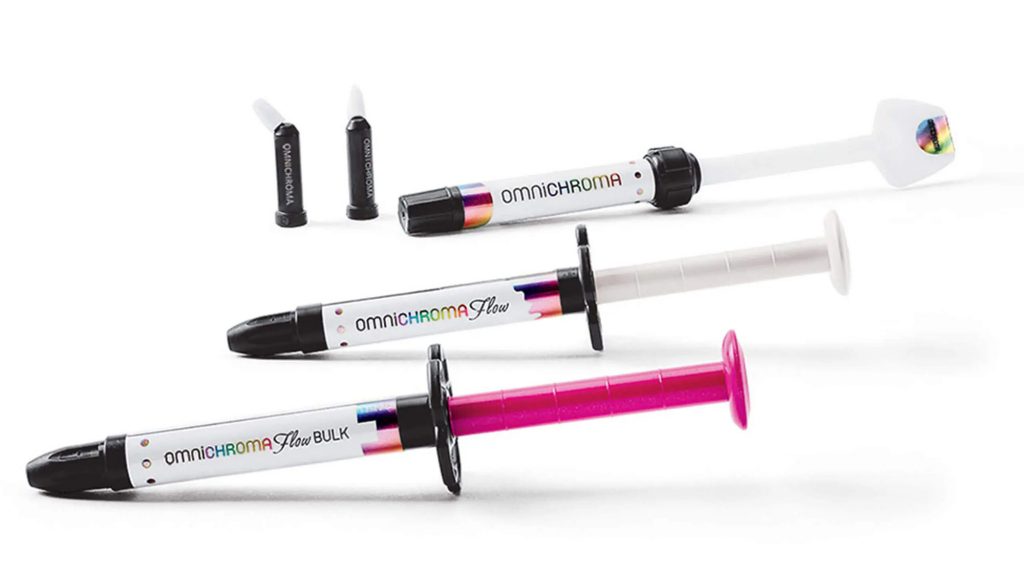
In the field of dental composites, structural colour was used as the primary colour-generating mechanism for the first time in 2019. With the help of Smart Chromatic Technology, the Japanese manufacturer TOKUYAMA DENTAL succeeded in utilising the mechanism for its universal composite OMNICHROMA. The flowable variants of this material, OMNICHROMA FLOW and OMNIHROMA FLOW BULK, are also based on this technology and therefore require no artificially added dyes or pigments.
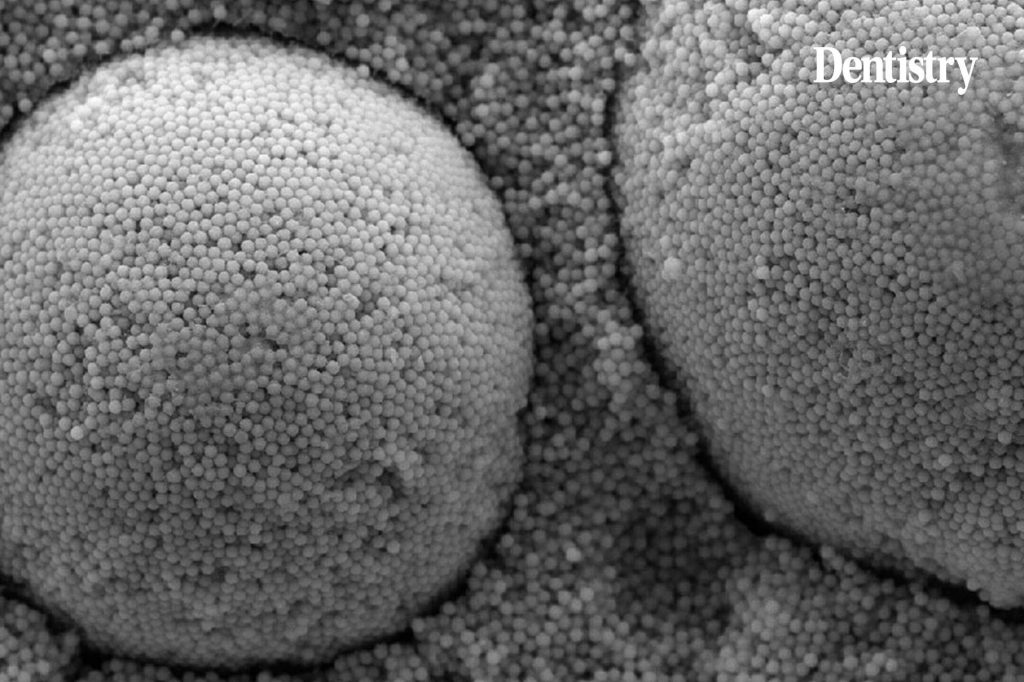
This is made possible by the microstructure of the material. Of particular importance in this context are the spherical filler particles with controlled size and structure. They generate structural colour, which also reflects the surrounding tooth colour.
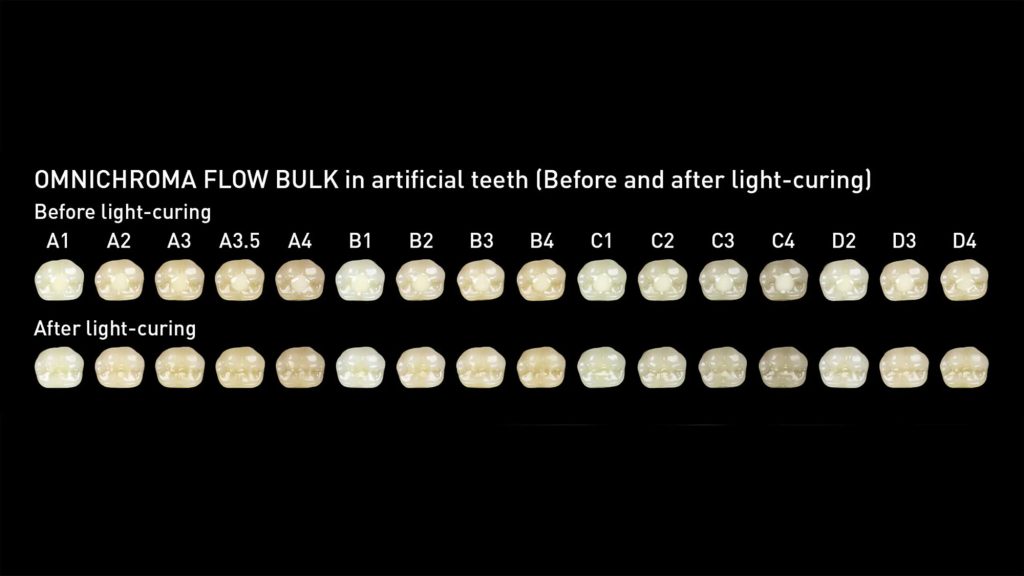
This results in a pronounced chameleon effect with real added value for both dental practices and patients. With just a single shade, the OMNICHROMA composites enable continuous shade matching across all 16 classic VITA tooth shades from A1 to D4. This not only ensures that the right shade is always in stock, but also makes the workflow in restorative therapy simpler and more efficient.
Conclusion for the dental practice
In most cases, the colour of composites is achieved by adding metal oxide pigments. However, it is also possible to create colour through the structural properties of the material.
With OMNICHROMA, a composite that uses structural colour as the main colouring mechanism is available to dental practices for the first time. As an omnichromatic composite, it also allows all 16 classic VITA tooth shades to be matched with just one shade.
For more information on the OMNICHROMA composite range and to request a free trial sample: https://tokuyama-dental.eu/en/omnichroma/.
References
- BOWEN R L, MARJENHOFF W A: Dental composites/glass ionomers: the materials. Adv Dent Res 6: 44-49 (1992).
- Faltermeier A: Werkstoffe in der Zahnmedizin. In: Werkstoffe in der Zahnmedizin. Springer Berlin Heidelberg, Berlin, Heidelberg (2008).
- Janda R: Organische Polymere: Chemie und Physik, Teil III. Quintessenz Zahntech 34: 584-594 (2008).
- Azhar G, Haas K, Wood DJ, van Noort R, Moharamzadeh K. The Effects of Colored Pigments on the Translucency of Experimental Dental Resin Composites. Eur J Prosthodont Restor Dent. 2019 Feb 22;27(1):3-9. doi: 10.1922/EJPRD_01855Azhar08. PMID: 30775872.
- Gebeshuber I.C. (2008): Strukturfarben in der Biologie: Inspirationsquelle für neue technische Entwicklungen. Plus Lucis 1-2/2008, Zeitschrift des Vereins zur Förderung des physikalischen und chemischen Unterrichts. Österreichische Physikalische Gesellschaft – Fachausschuss Lehrkräfte an Höheren Schulen, 44-47.
This article is sponsored by Tokuyama Dental.