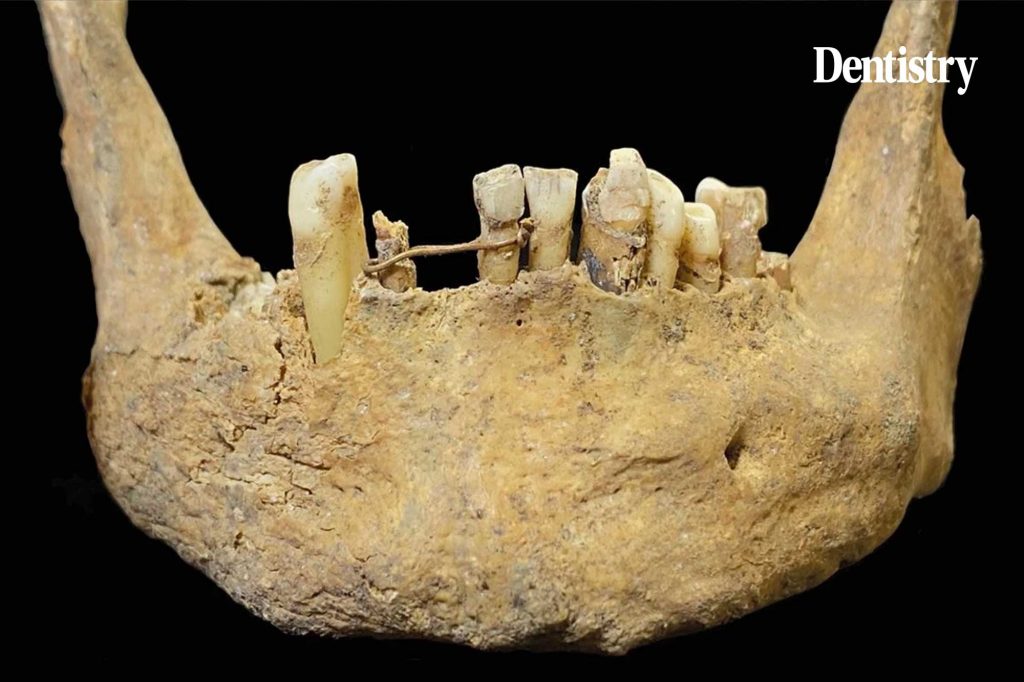
A gold ligature found on the teeth of a Scottish man who lived in roughly the 16th century has been described as the first set of metallic tooth grillz in history.
Discovered at St Nicholas Kirk in Aberdeen, Scotland, the ligature is fixed to the right lateral and left central mandibular incisors to form a bridge for the right central incisor. This tooth was either missing, so the bridge would have held a prosthetic of some kind in place, or loose and being steadied by the ligature.
The device is made of 20-carat gold and was likely placed due to aesthetics rather than preserving oral function. In this sense, the purpose of the bridge is more similar to modern decorative grillz than functional dental interventions.
The researchers note that outward appearance was highly associated with moral character in the middle ages, increasing the demand for aesthetic interventions such as this. They said: ‘The appearance of a person and their perceived health was linked to one’s sins.’
The individual who had the ligature placed was probably a relatively wealthy member of society, as the cost of gold would have been prohibitive. Gold alloy wire was often used for dental intervention due to its resistance to corrosion and tarnishing and biocompatibility.
There is evidence of at least 22 goldsmiths active during this period near Aberdeen, many of whom would be capable of producing the fine gold wire.
Complex dental interventions long before modern dentistry
As dentistry was not established as a standalone profession until the 19th century, the study’s authors theorise that the bridge would have been placed by a jeweller, barber, or an early form of dentatore or tooth puller.
The earliest ligatures ever discovered date back to ancient Egypt, however, the researchers said this was the earliest example found in Scotland.
The authors conclude that this case contributes to growing evidence that complex dental interventions existed long before modern dentistry, including restorative and prosthetic techniques.
This comes as researchers dubbed a drilled out Neanderthal tooth ‘the world’s oldest evidence of successful dental treatment’. The 59,000-year-old molar predates the next oldest evidence of intentional caries treatment by more than 40,000 years.
This finding suggests that Neanderthals had the capacity to identify the source of pain, determine how to treat it, apply the manual dexterity needed for an efficient operation, and endure painful treatment to alleviate future discomfort.
Follow Dentistry.co.uk on Instagram to keep up with all the latest dental news and trends.