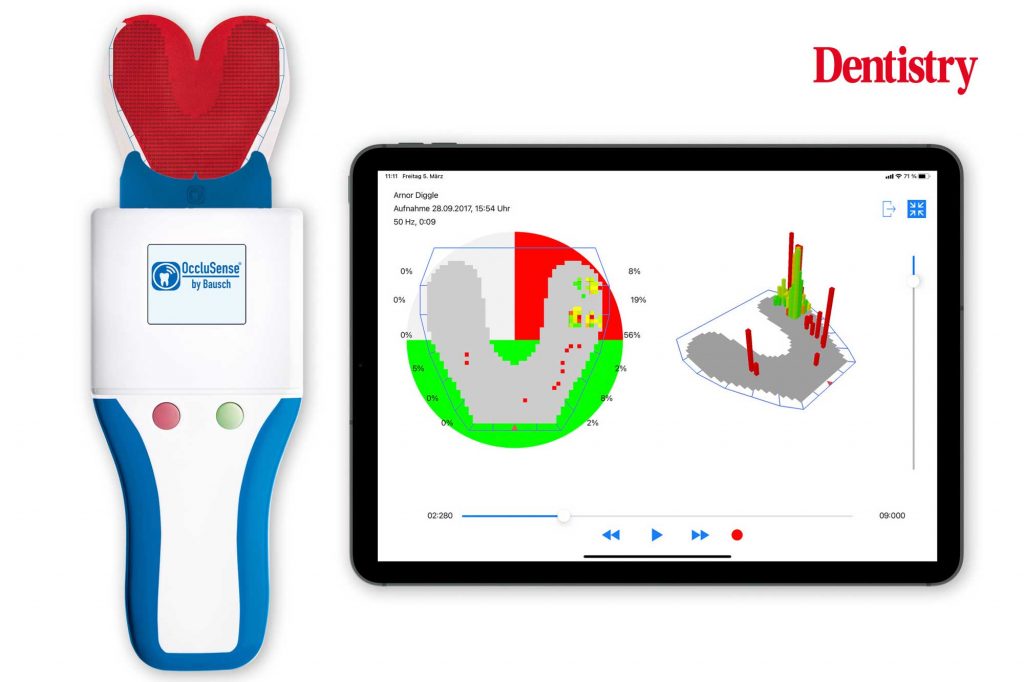
José María Suárez Feito introduces the OccluSense system for digital occlusion analysis and its uses in tooth wear cases.
Accurate occlusal assessment is essential in the adhesive rehabilitation of patients with tooth wear. Conventional methods using articulating paper are limited and subjective, as they record only static end contacts without information on force magnitude or contact sequence. Digital occlusion analysis systems overcome these limitations by capturing timing and relative force distribution throughout the entire closure process.
This article presents the clinical application of the OccluSense digital occlusion analyser, recent improvements in recording accuracy, and a practical protocol for its use in occlusal splints and full adhesive rehabilitations.
Introduction
Ideal occlusion is classically defined as simultaneous bilateral contacts of equal intensity in maximum intercuspation (MI). Clinically, articulating paper is used to assess this condition, assuming uniform mark size reflects balanced occlusion. However, articulating paper provides only a static snapshot and fails to represent the dynamic sequence of occlusal contact. True simultaneity is biomechanically impossible, and studies report error rates exceeding 80% when occlusion is assessed visually alone.
Digital occlusion analysers address these shortcomings by recording contact location, timing, and relative force distribution during closure. Among these systems, OccluSense (Bausch, Germany) offers a clinically reliable and cost-effective solution suitable for daily practice.
The OccluSense system
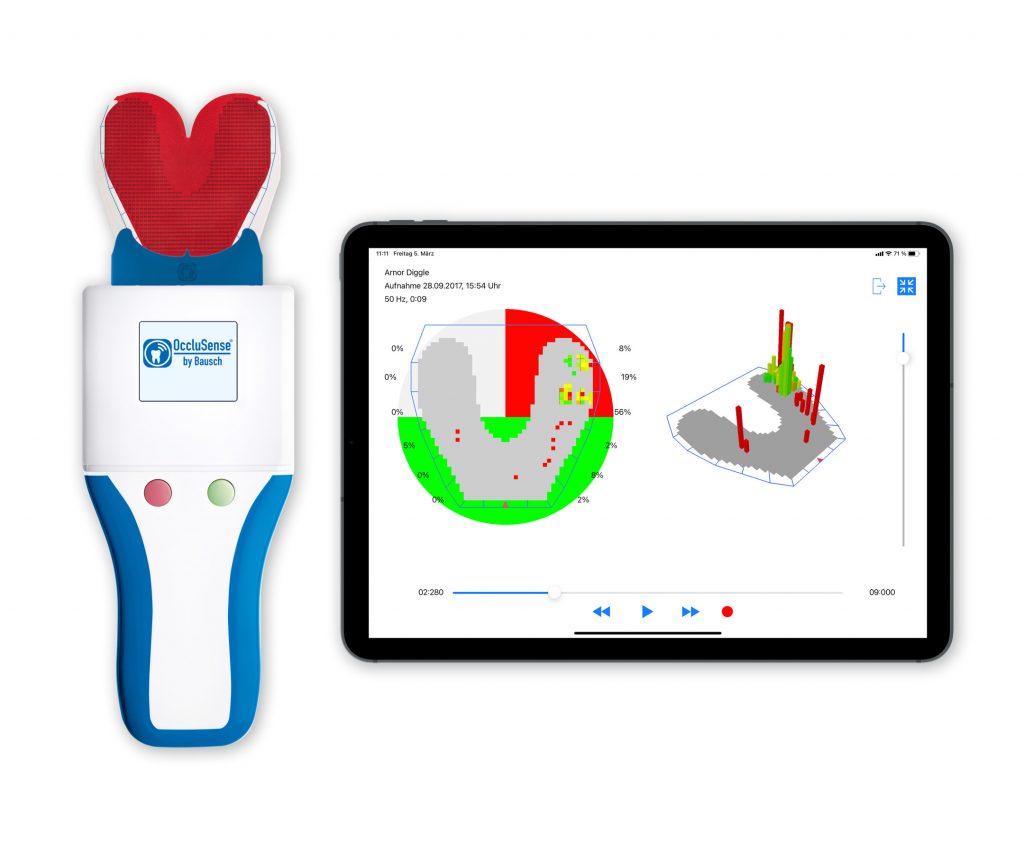
OccluSense comprises a wireless handpiece and a thin (60 μm) pressure-sensitive sensor with over 1,000 sensing cells, capable of recording up to 256 relative pressure levels. Data are transmitted wirelessly to an iPad application, where occlusal contacts are displayed in two- and three-dimensional formats.
The sensor measures changes in electrical resistance rather than absolute force values. Its minimal thickness allows reliable detection of both static and dynamic contacts while simultaneously marking contact points in red.
A key recent innovation is the CenterFix accessory, which aligns the sensor with the maxillary interincisal line. This standardisation significantly improves reproducibility between recordings and facilitates inter-arch comparison.
Recording protocol
After a daily functionality test, recordings are taken in MI and during lateral and protrusive movements. MI recordings of approximately four seconds are sufficient, while excursive movements require longer recordings. A recording frequency of 50 Hz enables smooth real-time playback.
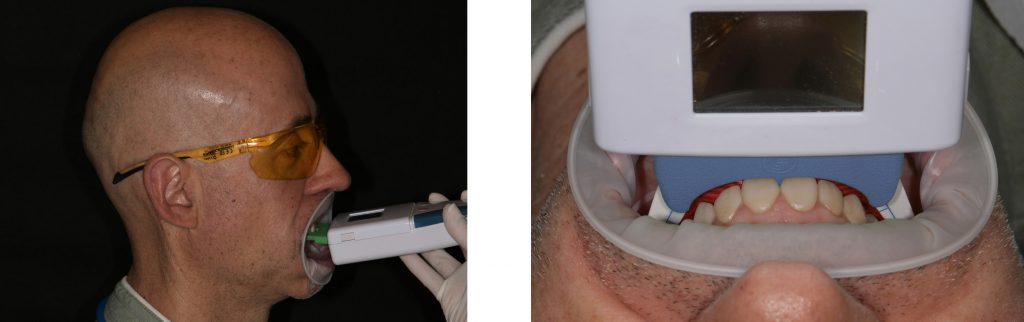
Patients are positioned upright for restorative cases and receive brief training to reduce movement artefacts. Each movement – MI, right laterality, left laterality, and protrusion – is recorded separately to ensure precise analysis.
Data interpretation
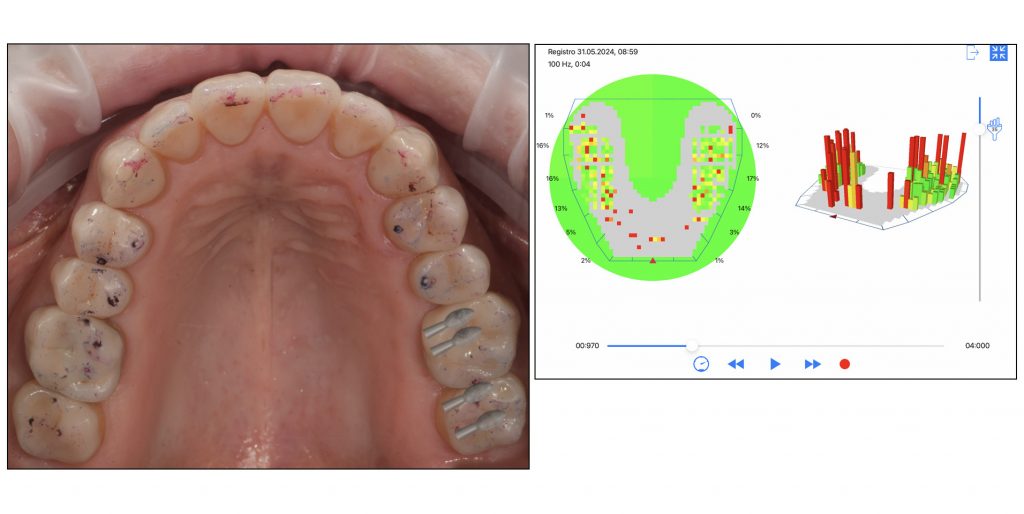
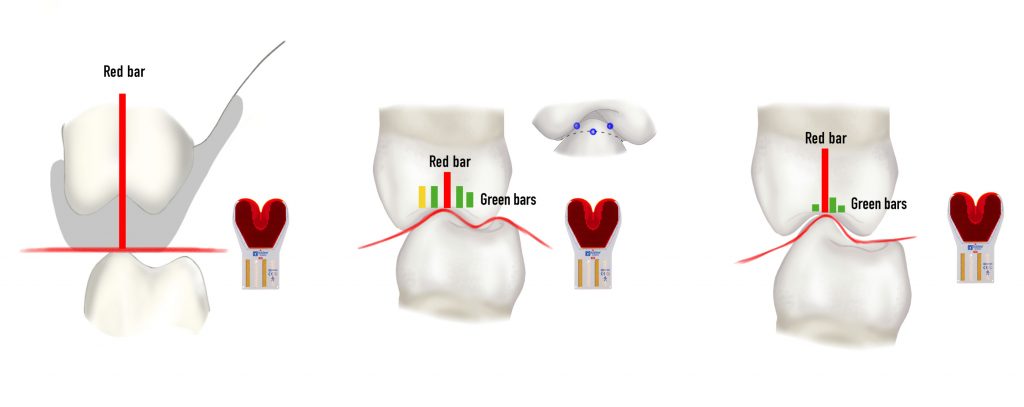
The occlusion data is evaluated simultaneously in 2D and 3D views. In 3D mode, the bar height represents the relative pressure, while the colour coding reflects the pressure distribution: green indicates flat contacts, red indicates pinpoint pressure. Red markings alone do not indicate pathology; clinical relevance depends on timing, duration, and distribution.
Frame-by-frame playback allows analysis from first contact to MI. A vertical filtering slider helps isolate clinically relevant overloads by excluding low-level noise. Contacts that persist across multiple frames and remain visible at higher filter thresholds are considered significant.
Clinical applications
In occlusal splint therapy, OccluSense is primarily used to verify adjustments made with articulating paper. Due to the flat posterior splint surface, posterior interferences are rare, and digital analysis mainly confirms balanced force distribution and immediate posterior disocclusion during excursions.
In full adhesive rehabilitations, digital analysis is particularly valuable because complex cusp-fossa relationships increase the risk of force concentration and false-positive markings. While meticulous adjustment with articulating paper remains essential, OccluSense serves as an objective quality-control tool to confirm occlusal stability.
Discussion
Clinical experience and in vitro studies demonstrate that OccluSense provides reliable and reproducible occlusal data, especially when used with the CenterFix alignment system. Although it does not replace conventional occlusal indicators, it significantly enhances diagnostic accuracy by revealing contact timing and force distribution.
Conclusion
Structured occlusal concepts and adjustment protocols enable predictable outcomes in adhesive rehabilitation of tooth wear. Digital occlusion analysis with OccluSense represents a logical extension of these principles, providing objective verification of occlusal balance at reasonable cost. Its application in occlusal splints offers an effective learning platform prior to use in complex restorative treatments.
Download the full article: www.occlusense.link/fte.
Find out more
- Dr Jean Bausch GmbH & Co. KG
Oskar-Schindler-Str. 4
50769 Cologne – Germany - Phone: +49-221-70936-0
- Fax: +49-221-70936-66
- Email: info@occlusense.com
- Web: www.occlusense.com | www.occlusense-shop.com
This article is sponsored by Dr Jean Bausch.