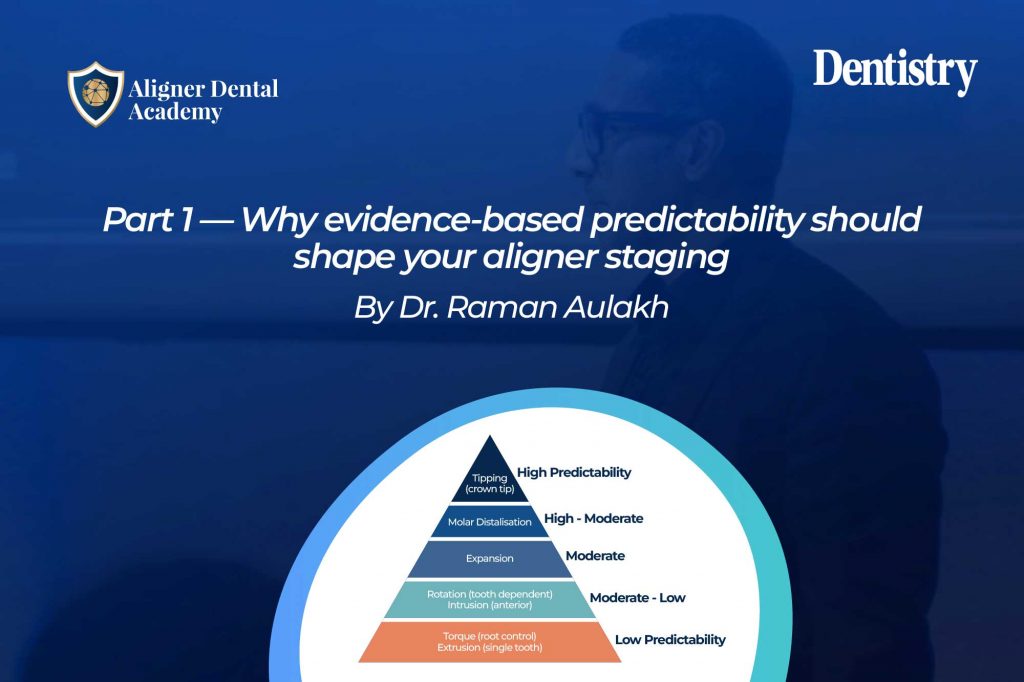
Raman Aulakh explains why evidence-based predictability should shape your aligner staging.
If you take only one message from this mini-series, let it be this: clear aligner practice is not a book of recipes. It’s a set of principles you can apply, measure and refine. Protocols have their place. Blind faith does not.
In general practice, the most common reason aligner cases drift into multiple refinements is simple: we plan as if every movement is equally predictable – that is not the case!
The direction of the evidence has been consistent for years: some movements track reliably; others are inherently higher risk. That doesn’t mean we avoid those movements. It means we plan for this: we stage more carefully, we build control earlier, we build in over-engineering to compensate and we intervene sooner.
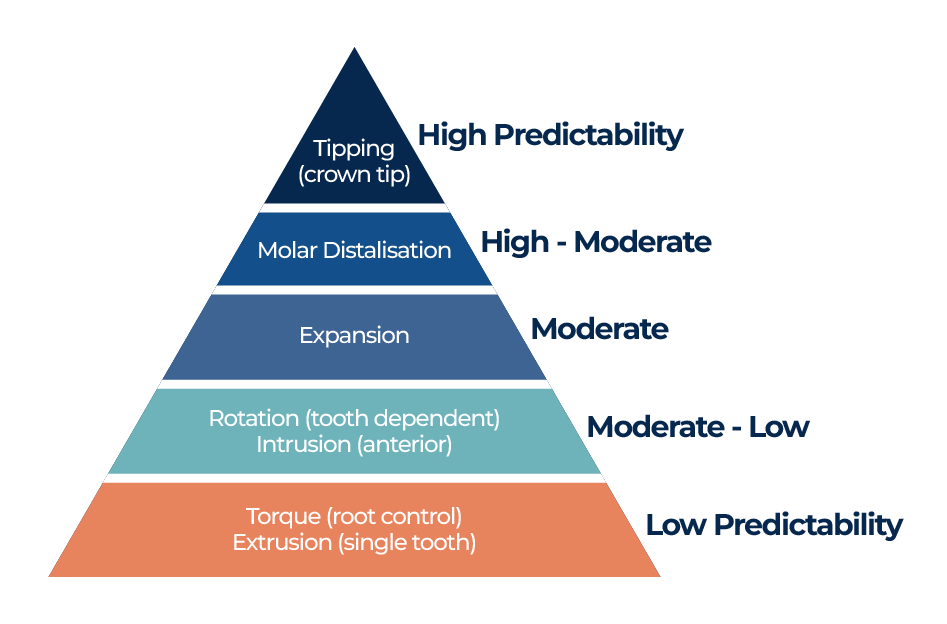
Here’s the hierarchy I use as my starting point based on experience and recent systematic reviews, meta-analyses and randomised controlled trials between 2021-2026 (references below).
The predictability hierarchy
Most predictable → least predictable (clear aligner therapy)
Why does this hierarchy exist?
Aligners work best when the plastic has full coverage of the tooth and push in a controlled way. That’s why simple movements like tipping are usually more predictable – the aligner can ‘grab’ the crown and express the necessary force required.
Where things get harder is when the movement depends on more than a push and creating a different force system at the crown level.
Some movements need one (or more) of the following:
- A stronger force and point of application such as for torque or translation
- A precise place to apply forces such as in rotations
- Resistance to plastic flexing and distortion such as in space closure cases.
So, the planning principle is straightforward: plan according to the hierarchy.
I will go into a lot more detail about this in part two.
My chairside planning guide
Turning predictability into a plan (and staying out of refinement jail)
When I open a digital setup, I try not to be seduced by the animation. I run this quick sequence instead:
1. Label the movements by hierarchy first
Before I admire the simulation, I label the main movements as high, moderate, or low predictability.
2. Over engineer
If a movement is low predictability, I don’t demand heroics per aligner but think of how I can over engineer the movement to make up for what I need.
3. Add control early
You need an anchorage strategy for every case. For every challenging movement I am thinking of where the equal and opposite effect is going to cause a side effect.
4. Slow down when it’s hard
I avoid stacking difficult movements together and some movements can be done consistently together and others not. I will discuss this in part three of the series.
5. Define tracking failure – and act fast
I decide in advance what ‘off-track’ means in my hands: persistent aligner gap, loss of seating, rotation lag, torque not expressing clinically. Then I intervene early rather than later.
The bigger point: principles beat protocols
I treat every digital setup for what it really is: a force system. The software shows what could happen if biology and mechanics behave perfectly. Real mouths and patients don’t. There is a standard deviation of predictability patient to patient!
The plan is negotiated by reality: bone biology, crown and root shape and length, periodontal support, occlusion and – most importantly – patient compliance. That’s why rigid ‘do-this-do-that’ protocols can feel comforting, but they don’t keep you in control when the case deviates.
This is exactly where principles help. The predictability hierarchy isn’t bad news for clear aligners; it is a guide on how to hack the system using principles. It tells me what to trust, what to stage more gently, and where to build control early.
What’s coming in part two?
In part two of this series, I’ll take the hierarchy and translate it into a movement-by-movement guide: the key biomechanical principle for each movement and the practical protocol thought process that follows. That’s where planning starts to become demystified for the thinking clinician.
If you want fewer refinements, stop collecting protocols – and start owning principles.
That’s exactly why I created the SAFE Clear Aligner Diploma. It’s principles-first training designed to help you:
- Translate predictability into staging choices
- Build biomechanics intentionally (attachments, anchorage, vertical control)
- Troubleshoot tracking logically instead of guessing
- Improve case selection and patient communication
- Run aligner therapy with calm consistency – not constant refinement stress.
Find out more about the diploma.
References
- Bouchant et al, 2023, International Orthodontics – Systematic review on expansion predictability
- Ma and Wang, 2023, BMC Oral Health – Systematic review of Invisalign outcomes
- Castroflorio et al, 2023, Progress in Orthodontics – Meta-analysis of tooth movement predictability
- Ghislanzoni et al, 2023, Orthod Craniofac Res – Prospective RCT-level accuracy study
- Al Baqshi et al, 2025, Cureus – Systematic review on Invisalign predictability factors.
This article is sponsored by the Aligner Dental Academy.