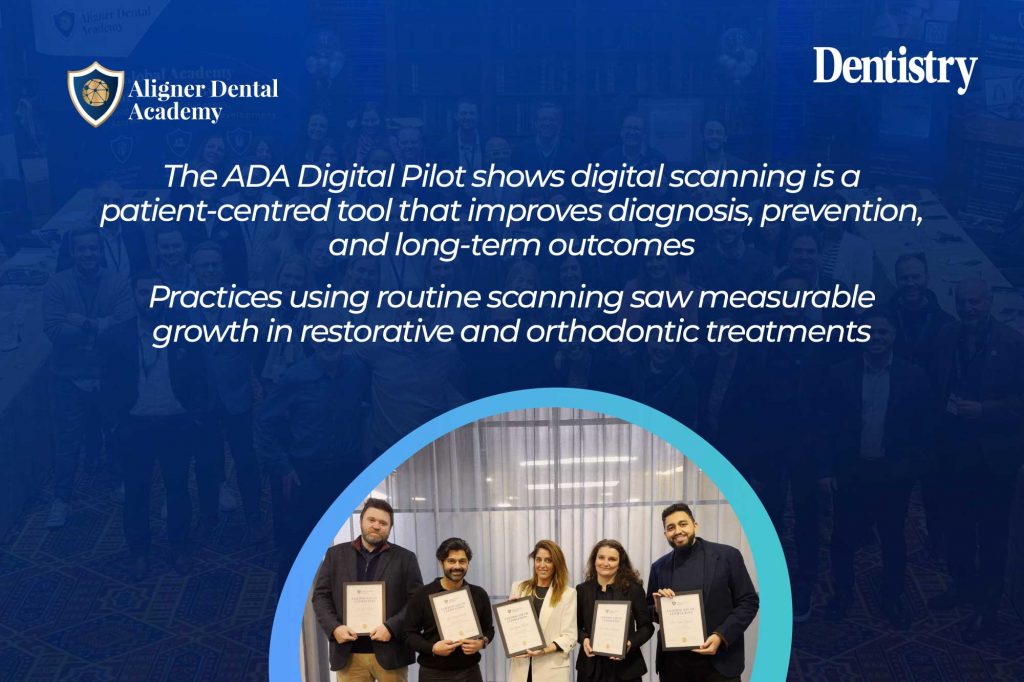
The Aligner Dental Academy shares findings from the ADA Digital Pilot Programme, highlighting the benefits of digital scanning for the patient journey.
Digital technologies are increasingly central to modern healthcare, and dentistry is no exception.
Intraoral scanning, artificial intelligence supported diagnostics and digital workflow integration are now recognised as important tools for improving clinical quality and patient outcomes.
The ADA Digital Pilot Programme provides evidence on how routine intraoral scanning is not just a digital tool, but as a clinical and patient-centred instrument which can improve diagnostic clarity, streamline workflows and support more predictable restorative and orthodontic care.
The rationale for routine digital scanning
While many practices already possess intraoral scanners, the technology is often underutilised, usually reserved for impression replacement. However, routine scanning has a broader clinical value. High-resolution imagery enables clinicians to document baseline conditions, monitor changes over time and provide patients with clear, visual explanations of oral health concerns such as attrition, crowding, gingival recession or failing restorations.
Evidence suggests that when patients are shown digital representations of their oral status, comprehension improves and they are more engaged in decision-making. This supports earlier intervention, more consistent uptake of preventive care and more predictable long-term outcomes.
The ADA pilot asked participating dentists to adopt one key behaviour: scan every patient, irrespective of treatment intention. This behavioural change served as the catalyst for improvements in both clinical care and patient communication.
Programme structure and support framework
The pilot employed a structured three-phase approach comprising scanner integration, clinician training and ongoing performance review. Support included personalised one-to-one training, consultation strategies, case discussions and weekly reviews. Importantly, each clinician’s existing workflow, time constraints and practice environment were carefully assessed to tailor solutions.
This approach reflects contemporary evidence that successful digital adoption is not merely technological, it requires workflow redesign, time-management support and confidence-building for clinicians.
Have a look below on the biggest takeaways from our doctors who were part of this pilot:
Findings across diverse clinical contexts
1. Dr Deepak Doll: Chiswick Dental Care
As an associate working across NHS and private settings, Dr Doll initially faced concerns regarding appointment duration. Over time, refining his scanning workflow enabled him to incorporate digital assessments efficiently without lengthening visits. His restorative work increased substantially, and better patient understanding of treatment needs. His conclusion that the process was ‘enlightening’ reflects how digital tools can strengthen patient-clinician communication and foster more consistent, evidence-based care.
Dr Doll described his experience noting: ‘I’m enjoying dentistry, I’m enjoying interacting with my patients a lot more, and we’re making more comprehensive treatment plans for patients. So now we’re doing Invisalign, then followed by implants, then followed by crowns, bridges, so we can now offer the complete package to a patient.’
2. Dr Joshua Davies: Hooker House Dental Practice
Despite NHS UDA pressures, Dr Davies increased his daily scanning frequency to an average of five per day. This consistency supported a notable rise in restorative care delivered, reflecting an improved approach to recognising patients’ clinical needs and having more effective discussions with patients. He saw a significant improvement in workflow efficiency without compromising patient volume.
Reflecting on his experience, Dr Davies shared: ‘If you have an Itero and you’re not using the Oral Health Suite, you’re really missing out. You’re missing out on loads of restorative cases and loads of Invisalign cases.’
3. Dr Sabina Chakalova: Bupa Portsmouth
Working within a corporate setting presented challenges in modifying established workflows. Nevertheless, Dr Chakalova achieved strong improvements in restorative care output, supported by the routine documentation provided by digital scan. She found routine scanning really helped with the quality of the diagnosis she was able to provide and in turn the patients understanding.
Dr Chakalova shared with ADA: ‘It was a bit of a learning curve in the beginning, but now it’s second nature to me. At the start of this program, it took me 20 minutes to take a scan, but at the end, I’m only down to three and a half minutes. Now, in my working day now, I try to scan as many patients as I can.’
4. Dr Usman Yaqoob: Smile Sanctuary Hornchurch
Dr Yaqoob’s practice serves an older demographic, where restorative needs often outweigh aesthetic demand. Incorporating routine digital scans improved diagnostic visualisation and supported clearer treatment planning conversations. His increase in restorative provision suggests that patients were better able to understand the functional benefits of addressing issues such as wear, failing crowns or misalignment.
Dr Yaqoob noted: ‘I’ve found since starting the program, showing people their scans, what’s going on in the mouth, it improved the Invisalign number, so it went up by two or three times.’
5. Dr Yanni Boille: Abbots Lodge Dental Practice
Infrastructure limitations initially hindered scanning consistency. However, with tailored workflow adjustments, Dr Boille integrated routine scanning effectively. Her increase in both restorative and orthodontic activity reflects enhanced diagnostic accuracy and improved patient confidence, particularly among those previously hesitant to commit to treatment.
Dr Boille explained: ‘Now it’s a lot easier for patients to see and understand what I’m talking about, because they are able to see on the scanner straight away… My Invisalign cases has doubled, and my crown and bridge work has gone up for 50 or 60% as well.’
Summary
Across all five practices, the pilot demonstrated several consistent themes:
- Improved diagnostic precision: routine scanning enabled clinicians to identify and communicate restorative needs earlier and more accurately
- Enhanced patient understanding: visual scans helped patients perceive issues that may not be easily explained verbally, supporting informed consent and shared decision making
- More efficient workflows: once embedded into routine examinations, scanning did not significantly extend appointment duration and, in some cases, improved overall time management by reducing repeat discussions or delayed diagnoses
- Stronger preventive focus: patients responded positively to longitudinal comparisons, which encourage proactive care and motivate early intervention
- Better continuity of care: documented digital records facilitated consistent monitoring and streamlined referral or interdisciplinary planning.
Conclusion
The ADA Digital Pilot Programme provides meaningful evidence that routine digital scanning serves as a valuable patient-centred tool. Its primary benefits lie not in increasing treatment volume, but in enhancing diagnostic accuracy, supporting shared decision-making, improving restorative outcomes and enabling more efficient practice workflows. As dentistry continues moving toward a more digitally integrated model, routine scanning should be considered a core component of comprehensive, patient-focused care.
This article is sponsored by the Aligner Dental Academy.