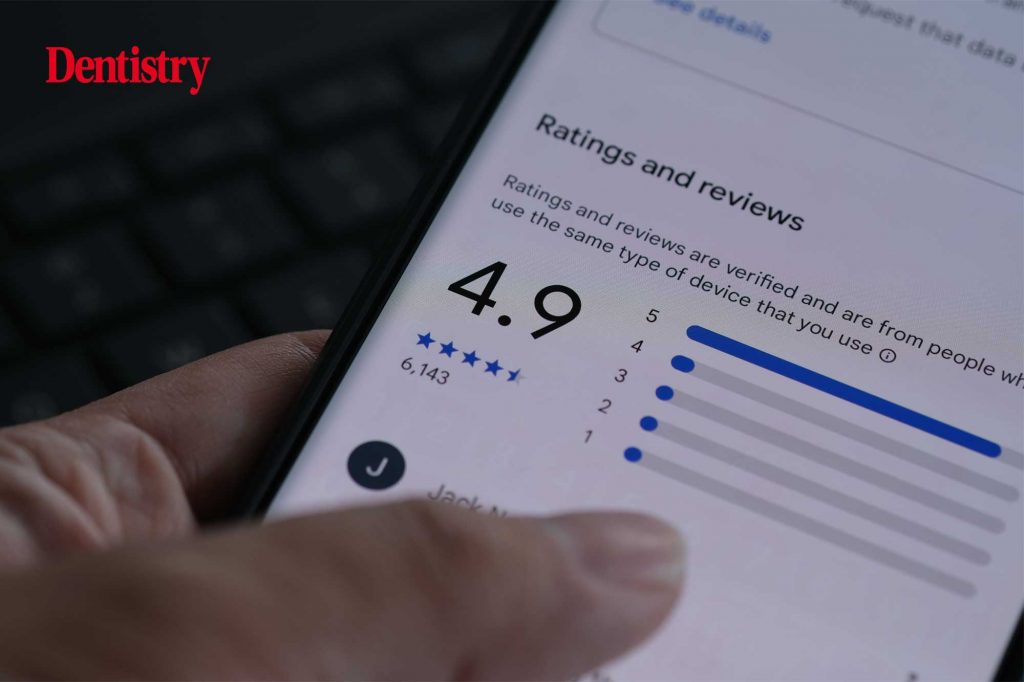
David Nelkin questions over-reliance on Google reviews in dental marketing to help practices achieve a holistic reputation strategy.
For a long time, you’ve likely heard the same simple rule when it comes to reputation, which is: get more Google reviews.
That advice wasn’t necessarily wrong; Google reviews are still hugely important. They influence local rankings, map pack visibility, and whether someone feels confident enough to pick up the phone and become a patient. However, if your review strategy still begins and ends with Google, you’re already behind and need to pivot now to stay ahead.
What’s changed is how reputation is now used to decide who gets seen, trusted and recommended. It’s no longer just about stars on a single platform but is about corroboration, consistency and credibility across multiple channels.
To stay ahead in 2026, dental practices need to have already evolved beyond a Google-only mindset. In this article, I’ll explain why that shift has happened, what it means for visibility and AI-driven discovery, and exactly how practices should be thinking about reputation going forward.
Why reputation matters more than ever
Most practices still think of reputation as something patients check after they’ve found you. A quick look at Google, a glance at the stars, job done. However, over the last few weeks we’ve seen some significant shifts that should be top of mind for every practice owner. These will be a cause of concern for those who don’t act and a great opportunity for those who want to be the frontrunners. They are:
- Google reviews going missing or being removed without clear explanations
- Reviews taking longer to publish, or not appearing at all
- People can now leave anonymous reviews
- Google reducing or softening the visibility of features practices once relied on, including Q&A and prominent routes that previously drove users through to practice websites
- Most importantly, AI increasingly deciding who gets recommended, not just who ranks.
This last point is the biggest game-changer.
Reputation is no longer being judged on a single platform; Google itself now references and surfaces reviews from other sources. Conversational AI tools aside from Google – the ones patients are starting to use to research treatments and providers like Chat GPT and Perplexity – cannot seemingly access Google reviews at all. Instead, they look for corroboration across multiple platforms.
In practical terms, this means a strong Google review profile still helps with local SEO, but it mustn’t be a standalone strategy for AI-driven visibility. If your reputation only exists in one place, it’s increasingly invisible in some key areas where people are looking for a dentist.
The uncomfortable truth about Google reviews in 2026
Google reviews absolutely still matter; they just matter differently now. One of the biggest mistakes practices make is obsessing over total review count, rather than asking a far more important question of how recent their reviews are.
Would you want 4,000 or 400 reviews? Almost every practice I’ve spoken to say 4,000. The issue here is that on its own, that’s the wrong metric to focus on. If the practice with 4,000 reviews hasn’t received a new one in three months, and the practice with 400 reviews is getting one every week, the second practice will almost always outperform the first.
Google uses review recency as a key signal to determine whether a business is active and relevant. When new reviews stop coming in, rankings don’t plateau, they actually slip. Recency tells Google that patients are still choosing you now, not that they liked you a few years ago.
How often should you be getting new reviews?
The simplest benchmark is your competitors. If the leading practices around you are averaging four reviews a month, you want to be comfortably above that, even if it’s only by one or two as what matters is momentum.
What doesn’t work as well is batching review requests, having a short spike, then going quiet for six months. Review generation needs to be an ongoing, embedded process, not a campaign you run twice a year.
Alongside recency, keywords and what patients actually say in their reviews is another key factor. Keywords in reviews are still debated within the local SEO community in terms of direct ranking impact, but focusing on that misses the bigger picture. Even if keywords weren’t a ranking factor at all, they still deliver real, measurable value. If your entire SEO strategy still revolves around rankings alone, this is where thinking needs to shift.
When reviews naturally mention treatments, services and patient concerns, several things happen:
- Google is more likely to show review justifications in search results, which increases click-through rates
- Google creates clickable topics from commonly mentioned terms, highlighting your specialties
- Frequently mentioned phrases are bolded in review snippets, drawing attention to your profile
- Google’s AI-generated business and review summaries pull concepts directly from review language
- The new AI-powered ‘Ask maps about this place’ feature increasingly relies on review content, as the old Q&A is phased out.
How reputation now influences visibility, not just trust
Reviews have traditionally been treated as something nice to have once the marketing was done, but it’s key that you shift away from this mindset. Reputation now directly influences visibility in terms of not just whether a patient trusts you, but whether platforms and AI systems decide to surface you at all.
The key question has shifted from ‘how many reviews do you have?’ to ‘how consistent, diverse, and believable does your reputation look?’.
Modern systems look at far more than star ratings. They assess review language and sentiment, how regularly feedback appears, whether multiple platforms tell the same story, and whether your wider digital presence supports what those reviews are saying.
AI-powered discovery tools, in particular, need multiple sources to trust you. One strong signal isn’t enough anymore.
The rise of cross-channel reputation
A modern reputation footprint now goes far beyond Google and, for dental practices, should include a mix of:
- Google reviews
- Facebook reviews
- Trustpilot, Doctify, Whatclinic or other healthcare-specific platforms
- Testimonials on your website – especially treatment-specific reviews placed on relevant treatment pages
- Video reviews
- Engagement signals – think replies to reviews.
This isn’t about being everywhere for the sake of it but is about resilience. When one platform changes the rules, a diversified reputation protects you and, more importantly, it builds a level of credibility that single-platform strategies simply can’t.
Why ‘asking for a Google review’ is the wrong approach
One of the most common mistakes I see is practices leading with the platform – for instance: ‘Would you mind leaving us a Google review?’.
This limits outcomes, and the psychology here really matters. Phone calls and asking in-person outperforms automated emails, and crucially, asking patients to share their experience, rather than directing them to a specific platform, naturally diversifies where reviews appear.
Reputation shouldn’t be a campaign, but a system
Practices that want to be leaders shouldn’t ‘do reviews’ once or twice a year, but treat reputation as an ongoing system – no different to other daily tasks in the practice.
That means logging feedback, tracking platforms and sentiment, and looking at reputation health rather than obsessing over star ratings alone. It also means reviewing negative feedback properly. The most successful practices don’t see criticism as a marketing problem and go to automatically defend themselves, but as an operational insight.
A framework for 2026
Here’s a simple framework to help you think about this properly:
- Protect – don’t rely on one platform. Assume any platform can change overnight
- Diversify – build credible proof across multiple channels that matter to both patients and AI-driven discovery
- Activate – use reviews everywhere – on your website, on treatment pages, in paid media, in nurturing sequences, and in consultations.
Reputation feeds SEO, conversion rates, paid media performance, and AI recommendations. Treat it as key to all your marketing and growth efforts, not separate from these.
Outstanding experiences
Outstanding reviews only come from outstanding experiences. If your patient journey is genuinely exceptional, reviews will follow naturally. Systems can and will never replace that as they are there to help capture what already exists.
We know that the overwhelming reason people choose one practice over another is down to the patient experience journey. This is really just an extension of that with some structure around it.
For now, the key message is simple: Google reviews still matter but they just don’t work in isolation anymore and the practices that understand that now will be the ones leading, not scrambling, as we move into 2026.
Growing the practice with the right model
I’m David Nelkin, founder and CEO of Xcelerator Dental (XD). For 14 years, I’ve worked exclusively with dental practices to help them grow in a way that’s sustainable, measurable, and aligned with how patients actually make decisions.
Our model is simple: promote, convert, grow. We help practices attract the right patients through a cross-channel approach to dental marketing, convert interest into enquiries and bookings, and then build systems and provide training that turn those enquiries into long-term patients.
Reputation sits right at the centre of that model and everything I’ve covered in this article is a core part of how we work with our clients. We don’t treat online reviews as a side project or a box-ticking exercise but help build them into a wider growth system.
As part of this, we provide practices with an online review management system that helps them generate, track and manage reviews across multiple platforms, monitor sentiment over time, and use feedback to genuinely improve the patient experience.
If you’d like to understand how this fits into your practice, you can find out more via our website, or Whatsapp me on 07834 978074.
Follow Dentistry.co.uk on Instagram to keep up with all the latest dental news and trends.