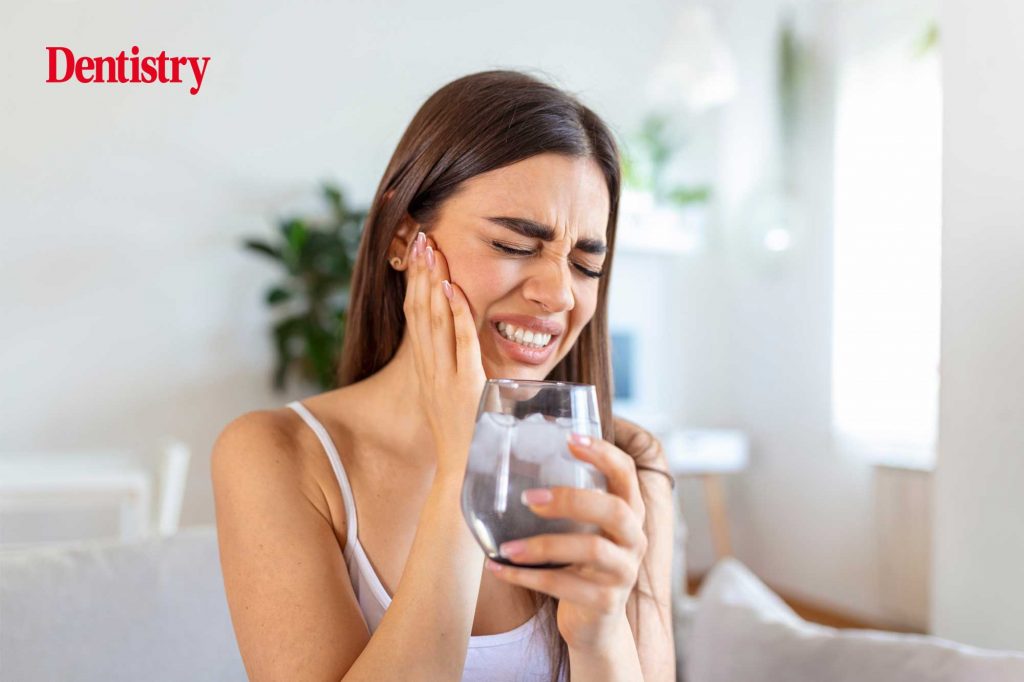
Niall Kent explains how an unexpected discovery inspired him to develop a novel tooth sensitivity gel which provides relief on the go.
Niall Kent, an oral and maxillofacial surgeon, stumbled on the extraordinary solution for tooth sensitivity when he was asked by his brother, who worked at the Royal Academy of Art, to create sculptures using aerogels.

Aerogels are a type of ultra-light synthetic material first developed by chance in 1931 as part of a bet between chemists. They have since been used in aerospace, building and architecture, and environmental clean-up. However, Niall saw the potential of aerogels for use in dentistry due to their vast surface area.
He said: ‘To put the surface area in perspective, one gram of this kind of material can have a surface area of 600-700 metres squared. So if you were to unravel just one gram of material, it would have the same surface area as two tennis courts.’
In 2016, Niall created a material called aerograft based on aerogels, originally as a bone graft. He then realised that it was highly effective against tooth sensitivity.
He explained: ‘Aerograft incorporates calcium and phosphate into an aerogel, precipitating a mineral called hydroxyapatite. These particles mix with the water in saliva and fill the dentinal tubules. Sensitivity is fundamentally caused by open tubules allowing access to the nerves inside the tooth.’
How is the sensitivity gel better than existing products?
Ozen’s on-the-go gel uses this technology to provide relief from sensitivity in less than 30 minutes. This is considerably faster than the previous gold-standard in sensitivity treatment, which would generally take around 22 hours to take effect.
The innovation was partly inspired by Niall’s observation that colleagues were recommending patients apply normal anti-sensitivity toothpaste to affected areas and leave it there. He pointed out that toothpaste contains abrasive ingredients and has a very strong taste in high concentration – making it less than ideal for prolonged contact with the mouth.
The new sensitivity gel eliminates the unnecessary ingredients found in toothpaste and has twice the concentration of actives. Niall considers it a completely new solution with no previous equivalent.
Dental therapist Benjamin Tighe said: ‘I can really see a place for Ozen alongside tooth whitening treatments. Its fast-acting formula is particularly appealing, especially when compared with conventional desensitising toothpastes, making it a valuable option for patients seeking rapid relief from sensitivity.’
The impact of tooth sensitivity on patients and dental professionals
Niall feels that the impact of dental sensitivity is often overlooked. While one third of the population reports issues with sensitivity, it is estimated that 50% of sufferers do not recognise their symptoms.
Commenting on the impact that tooth sensitivity can have on patients’ lives, Niall said: ‘Severe sensitivity affects what people eat, so they might avoid cold, hot or sugary food and drinks because they cause pain. It has quite a big impact on their life and what they can enjoy, and it also affects their behaviour when seeking dental care. Often, patients won’t go to hygiene visits because it causes them pain.’
Addressing sensitivity can therefore benefit dental professionals as they are less likely to lose patients and experience failures to attend.
Niall continued: ‘As it stands, there isn’t really a good solution that dental professionals can utilise before treatments such as tooth whitening that might cause sensitivity.’
He advises first identifying potential triggers for a patient’s sensitivity, then recommending Ozen’s sensitive formula toothpaste, following up with the topical gel if needed.
This advice can be incorporated into protocols surrounding sensitivity-inducing treatments such as whitening and hygiene visits.
Sweta Surana Bhandari, a dental therapist, agreed that the gel could be useful in practice. She said: ‘I think we definitely need a gel which could help with sensitivity during scaling and help to ease discomfort for both clinician and the patient. I don’t know if this specific gel will be effective but we need a better solution than extended application of sensitivity toothpaste.’
Positive early feedback for the sensitivity gel
Niall has already received positive feedback from clinicians using the gel in practice, for example before scaling.
He said: ‘A number of dental hygienists and therapists have found that patients are much more comfortable during the procedures when using the gel.’
It has also seen great success in a 1,200-person user trial. More than 89% of users saw a reduction in sensitivity after just one use, while 100% saw improvement within a month. A further 77% said they were more able to enjoy hot and cold foods and drinks.
The next step for Niall and the Ozen team will be developing more products that address patients’ pain and discomfort, whether in practice or in their daily lives. In general, Niall is interested in ‘other problems in dentistry where current solutions aren’t good enough’.
Follow Dentistry.co.uk on Instagram to keep up with all the latest dental news and trends.