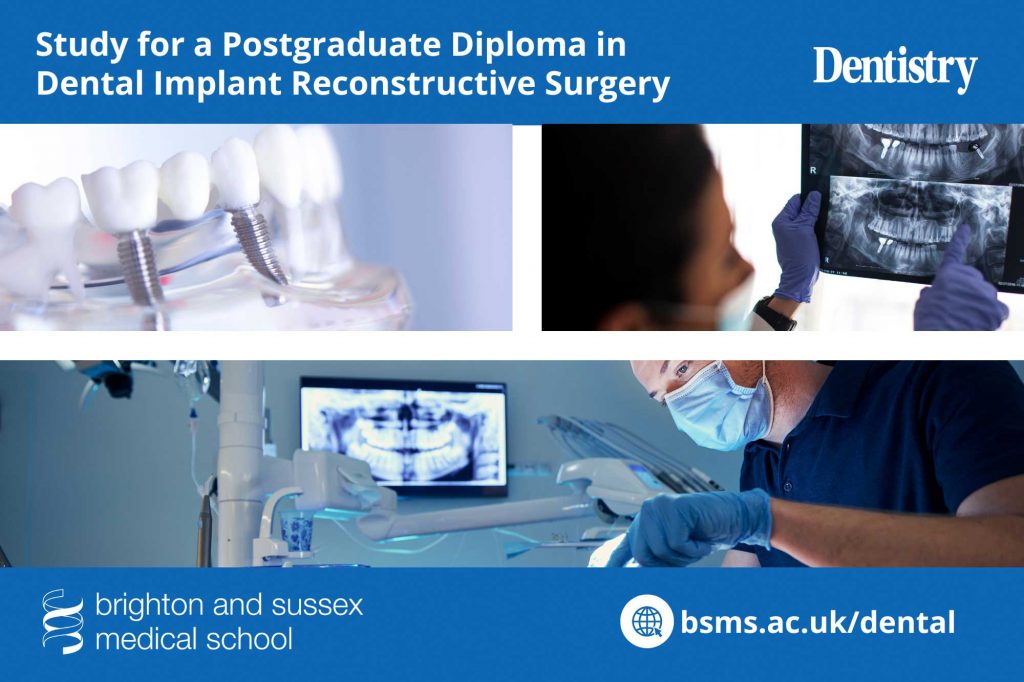
Brighton and Sussex Medical School (BSMS) introduces Modules 3 and 4 of its Postgraduate Diploma in Dental Implant Reconstructive Surgery.
Following the strong diagnostic, planning and restorative foundations established in Modules 1 and 2, clinicians on the Postgraduate Diploma in Dental Implant Reconstructive Surgery at BSMS progress into the core surgical and reconstructive elements of implant dentistry.
Modules 3 and 4 represent a pivotal transition point in the programme. At this stage, delegates move beyond straightforward implant concepts in the first year and begin developing the biological, regenerative and digital understanding required to manage more complex cases predictably. Importantly, introducing digital workflows earlier in training was intentional so they underpin, rather than follow, more advanced surgical concepts.
Module 3: bone preservation, grafting and soft tissue techniques
Developing biological and surgical predictability
Module 3 focuses on the biological principles and surgical techniques that underpin successful implant outcomes. Delegates build on earlier surgical fundamentals to learn how to preserve, augment and manipulate both hard and soft tissues.
- Ridge preservation and socket management
- Bone graft biology and biomaterials
- Guided bone regeneration (GBR) principles
- Defect assessment and graft selection
- Flap design, vascularity and wound closure
- Soft tissue handling and augmentation techniques.
Training is delivered through a combination of lectures, simulation, model-based exercises, cadaveric dissection and supervised clinical exposure. The emphasis is on predictability rather than complexity – understanding when, why and how to intervene biologically to support long-term implant success.
Module 4: emerging techniques
Introducing digital thinking earlier – by design
To better reflect modern implant practice, BSMS has intentionally included the digital workflow module, allowing delegates to integrate digital planning and other principles earlier in their clinical development.
- Digital implant planning and prosthetically driven workflows
- CBCT-based planning and data interpretation
- Surgical guides: indications, limitations and risk management
- Digital restorative planning and communication with laboratories
- Understanding how digital workflows support accuracy and safety
- Integrating analogue and digital techniques in real-world practice.
By introducing digital concepts at this stage, clinicians can immediately apply them to their grafting, surgical and restorative cases – reinforcing good habits before more advanced surgical exposure.
This sequencing ensures digital workflows are seen not as an add-on, but as a core planning and risk-reduction tool embedded within everyday implant practice.
Clinical mentoring: applying new skills to real patients
Throughout Modules 3 and 4, delegates continue to be supported in treating patients under supervision as part of their clinical logbook development. At this stage, clinicians are supported in:
- Managing ridge preservation and augmentation cases
- Applying digital planning to surgical decision-making
- Integrating guided and freehand surgical approaches
- Refining soft tissue handling and closure techniques.
Structured mentoring, work-based assessments and directly observed procedural skills (DOPS) ensure that clinical progression remains safe, supported and competency-driven.
- These modules begin to see digital workflows rooted earlier in training with learning better reflecting contemporary implant practice. Embedding surgical planning and skills that are more accurate and prosthetically driven, crucially reinforce confidence in practical skillsets through logical and cohesive progression
- Modules 3 and 4 mark a turning point – where clinicians move from foundational skills into confident, digitally informed implant surgery.
Find out more about the course.
This article is sponsored by Brighton and Sussex Medical School.