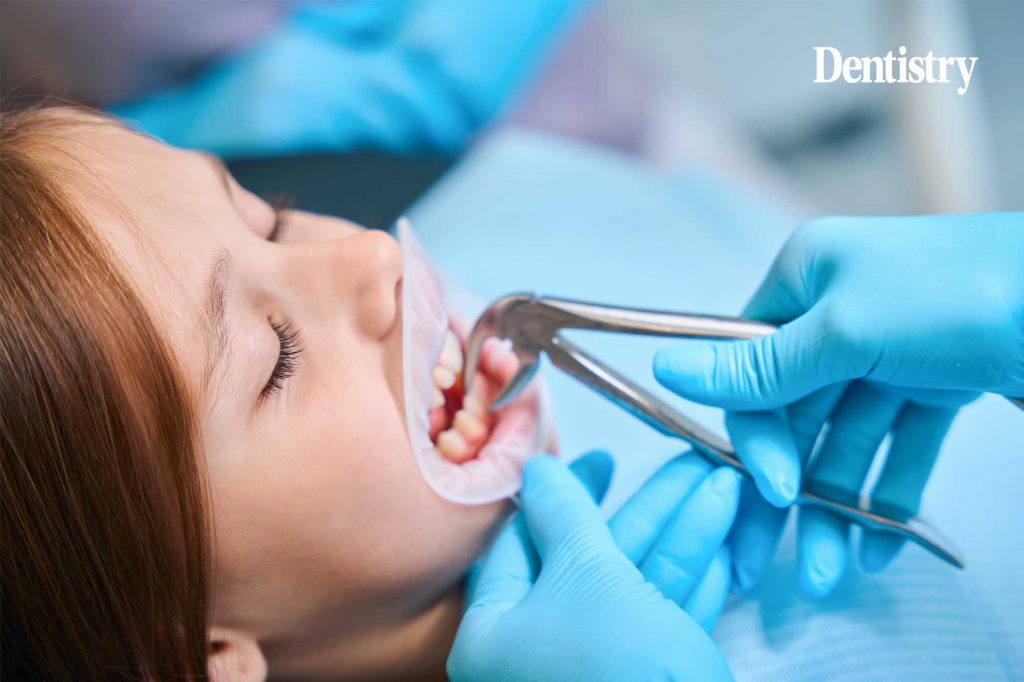
Decay-related tooth extractions cost the NHS £51.2 million in the 2024/5 financial year, up from £45.8 million the previous year, according to newly-released statistics.
The Office for Health Improvement and Disparities (OHID) has released statistics surrounding childhood hospital tooth extractions for the past financial year. These suggest that NHS spending on tooth extractions in this period reached £87.7 million, with decay-related extractions accounting for almost 60% of the total.
The data shows the number of young people aged zero to 19 undergoing decay-related extractions had risen by 11% to almost 34,000. The total number of extractions in this age group had also risen by 14% to more than 56,000, with non-decay-related extractions due to factors such as positional anomalies up by 20%.
Tooth decay accounted for six in 10 of the childhood extractions – the highest proportion of these cases were in the five to nine age bracket.
The number of tooth extractions has been rising steadily since 2022, following a sharp drop off due to the COVID-19 pandemic.
Are childhood tooth extraction rates the same across the UK?
Rates of childhood extractions varied dramatically across different regions of the UK. While the UK average stood at 251 extractions per 100,000 children, Yorkshire and the Humber had more than twice this frequency at 504 per 100,000. The east Midlands saw the lowest rates, with 73 childhood extractions per 100,000.
Children in more deprived areas had more than three times higher rates of tooth extractions compared to those in the least deprived regions.
Tooth decay remains the leading reason for childhood hospitalisation.
British Dental Association (BDA) chair Eddie Crouch said: ‘These horrific statistics are a badge of dishonour for governments past and present. Tooth decay can’t go unchallenged as the number one reason for child hospital admissions.
‘Targeted preventive programmes are now in place, but there’s still little sign government is willing to rebuild access to care. Dentists can’t nip these problems in the bud if we don’t get to see them.’
‘A postcode must never dictate a child’s health’
Jo Cooper, general manager for the UK and Ireland at Haleon, said the figures represented ‘a worrying reminder that too many are still experiencing preventable oral health problems’. She said: ‘Prevention must be prioritised, with stronger action to help families build good oral health habits from an early age.’
Charlotte Eckhardt, dean of the Faculty of Dental Surgery at the Royal College of Surgeons of England, expressed concern at the scale of the geographic disparities.
She said: ‘No child should be hospitalised for a disease that is almost entirely preventable. Tooth decay is causing unnecessary pain, missed school days and avoidable hospital admissions at a higher rate in 2025 than the year before. This direction of travel must be reversed.
‘Evaluation of the supervised toothbrushing scheme is a welcome step. It will give us a clearer picture of what works and where further improvements are needed.
‘If the government is to meet its goal of transforming the NHS dental system by 2035, it must ensure every child can see a dentist when they need to. A postcode must never dictate a child’s health.’
‘This information is not a complete data set’
However, the British Society of Paediatric Dentistry (BSPD) said the statistics were an ‘incomplete data set’.
BSPD president Oosh Devalia said: ‘Care must be taken not to read too much into variations in the hospital episode statistics just released, since this information is not a complete data set. For example, activity within community-based services is significant and often not included.
‘BSPD urges policymakers to keep a steady focus on the priorities that we know will help turn around children’s oral health – such as supervised toothbrushing, community water fluoridation and early access to dental teams.
‘We also need to cut under 16s’ sugar consumption – and, importantly, push for every child to have a “dental home”, with access to a dental check by their first birthday. Together these interventions will get to work on bringing the hospital episode numbers down for children.’
Follow Dentistry.co.uk on Instagram to keep up with all the latest dental news and trends.