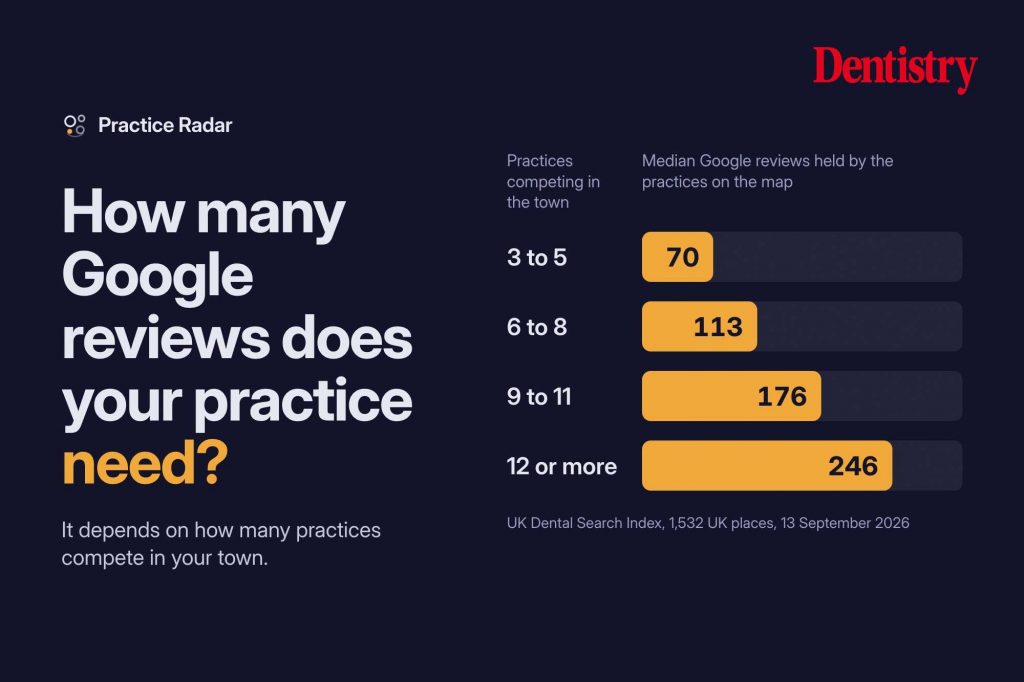
Practice Radar searched 1,532 UK towns, cities and suburbs for a dentist and recorded every practice Google put on the map. The median review count held there runs from 70 to 246 – what sets it is how many practices compete in your town.
Search ‘dentist’ and your town on a phone. Before any website, Google shows a map and three practices. For most patients, that is the decision.
Why reviews decide who gets on the map
Google says its local results are mainly based on three things: relevance, distance and prominence, which it describes as how well known a business is. Distance you cannot change. Relevance comes from your Google listing and website saying clearly what you do and where. Prominence is where reviews come in. Google’s guidance is plain: more reviews and positive ratings can help a business’s local ranking.
Reviews keep working after the ranking. The map puts your stars and review count next to every rival’s, so they help decide who gets the tap. When patients mention a treatment in a review, Google can show those words under your name to someone searching for it. Google also advises replying, and the next patient reads your replies too.
Almost nobody is told how many reviews that takes. So we measured it.
What we measured
On 13 September 2026, we searched ‘dentist’ plus the place name on a phone for all 1,532 UK cities, towns and suburbs, and recorded the rating and review count of the three practices on each map: 2,537 practices, each counted once.
Your star rating will not separate you
The median rating is 4.8, and 72% sit at 4.6 or better. Ratings separate almost nobody.
Review counts do the opposite. The practice a tenth of the way up the list has 12. The one nine tenths of the way up has 557.
The number depends on your town
The national median is 113 reviews, but no practice competes in a national average. Split them by how many practices appear on page one for their town’s name, and the bar moves a long way.
| Practices competing in the town | Median reviews held by the practices on the map |
| Three to five | 70 |
| Six to eight | 113 |
| Nine to 11 | 176 |
| 12 or more | 246 |
The median UK place has five practices ranking for its own name.
How to find your own number
Count who you are up against
Search ‘dentist’ and your town and count the dental practices on page one, once each. Leave out directories, the NHS website, the CQC and social media. That gives you your row.
Find your real target
Note the review counts of the three practices on the map. That is the number that matters.
Look at the gap, not the total
If the map holds 240 and you have 190, you are a steady year of asking away. If it holds 900, reviews are not your fastest lever.
Check who is above you
If a practice rated below you sits above you, reviews are not what separates you. Distance is, or how clearly your listing and website say what you do and where, and that wording you can fix this month.
Ask steadily, and ask fairly
A few reviews every week look better than 40 in a fortnight. Ask every patient, not just the happy ones, and never offer anything in return. Google’s rules forbid both, and fake or undisclosed incentivised reviews have been banned under UK consumer law since April 2025.
See it for your own town
Practice Radar does this for your town. It maps every competing practice, shows who holds the map for each search that matters and how many reviews each has, re-checks the rankings every week, and drafts a reply to every new review in your practice’s voice.
It was built by a practice owner. My fiancée and I own a practice in Bollington, where page-one keywords went from 6 in May to 194 by 14 September. On a paid growth plan it posts the replies you approve and makes the changes you approve to your website, Google listing and ads.
References
- Google’s local ranking factors and the review guidance: Google Business Profile Help, ‘Tips to improve your local ranking on Google’, https://support.google.com/business/answer/7091
- 1,532 places, 2,537 practices, 4.8, 72%, 12, 557, 113, 70, 176, 246 and five practices per place: https://practiceradar.co.uk/blog/uk-dental-search-market-2026
- Six to 194 page-one keywords: https://practiceradar.co.uk/
This article is sponsored by Practice Radar.