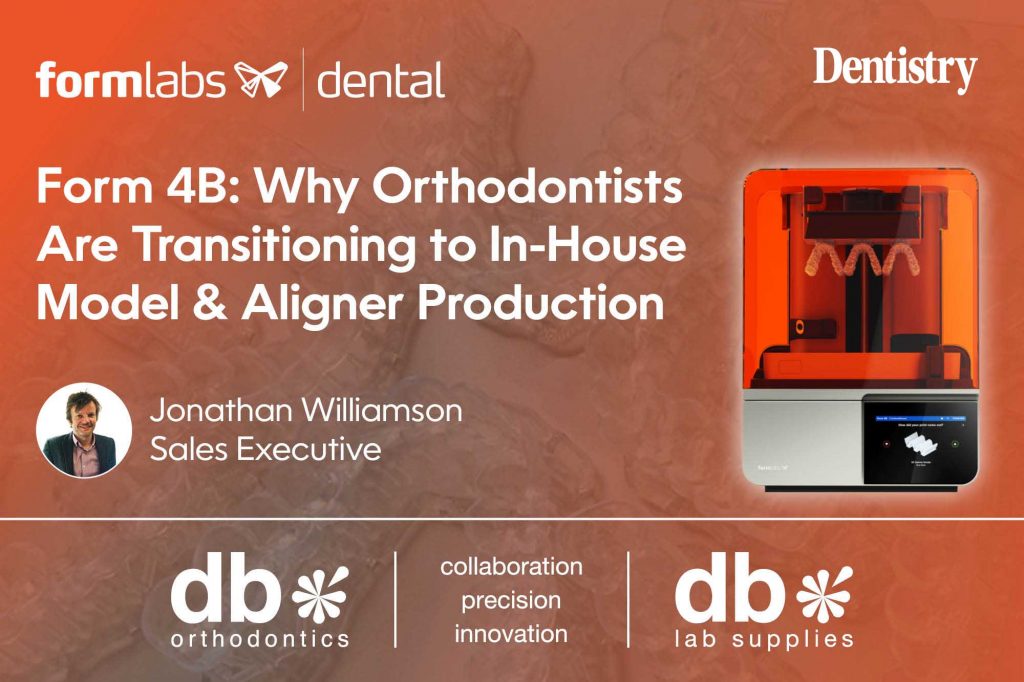
A conversation with Jonathan Williamson, digital workflow specialist, on the advantages of in-house model and aligner production.
As orthodontic practices and laboratories continue to embrace digital workflows, one question keeps coming up: how can we produce more in-house without adding complexity, staffing pressures, or longer working hours?
Jonathan Williamson, one of the digital workflow specialists at DB Orthodontics and DB Lab Supplies, explains why the Formlabs Form 4B is generating so much interest among orthodontists and dental technicians. Having worked closely with practices, laboratories, and our own in-house production team, Jonathan has seen first-hand how the latest generation of dental 3D printing is changing what is possible.
Jonathan, what makes the Form 4B different from other dental 3D printers?
‘The first thing people are impressed with is the speed,’ says Jonathan. ‘Printing up to 11 orthodontic models in just nine minutes is a genuine game-changer. That’s not just a nice specification for a brochure – it completely changes how practices and laboratories can work.’
Traditionally, many orthodontic teams have relied on overnight printing. Models are queued up at the end of the day and staff return the next morning hoping everything has printed successfully.
‘The Form 4B removes that mindset,’ Jonathan explains. ‘You can print during normal working hours. If you need aligner models, retainer models, or diagnostic models, you can produce them throughout the day rather than waiting until tomorrow. That has a huge impact on workflow efficiency.’
Is speed the main reason people are investing?
‘Speed gets people’s attention, but accuracy and reliability are what convince them,’ says Jonathan.
Orthodontic appliances depend on accurate models. Any variation can affect appliance fit, create additional adjustments, and ultimately impact treatment efficiency.
The Form 4B delivers exceptional precision, with 95% of surfaces within 50 microns of the CAD model and 99% within 100 microns. That’s the level of consistency orthodontic professionals need when they’re producing aligner models, retainers, indirect bonding trays, and other appliances.
Just as importantly, that accuracy is maintained across the entire build platform, allowing multiple models to be printed simultaneously without compromising quality.
What about reliability?
‘Ask anyone who has experienced failed prints. Reliability suddenly becomes your number one priority.’
The Form 4B has been designed to minimise production interruptions through intelligent monitoring systems that track resin levels, temperature, print forces, and overall build conditions throughout the printing process.
‘The reported print success rate is over 98%, which is incredibly important for busy practices and laboratories. Failed prints don’t just waste resin. They waste time, delay cases, and create frustration. Reliability is often where the real return on investment comes from.’
Is the Form 4B suitable for practices that are new to digital manufacturing?
‘Absolutely,’ says Jonathan. ‘One of the biggest misconceptions about digital workflows is that they’re difficult to learn. Formlabs has done a fantastic job of making the process incredibly intuitive.’
Most users can learn the workflow in around 15 minutes. From importing scans and preparing models through to washing, curing, and finishing, the process has been designed to be simple and repeatable.
‘You don’t need a dedicated 3D printing expert in your practice to make this work. That’s one of the reasons adoption has accelerated so quickly.’
What types of orthodontic applications are customers using it for?
According to Jonathan, the majority of interest currently centres around clear aligner production and retainer workflows, but the possibilities extend much further.
‘We regularly see customers producing clear aligner models, retainer models, indirect bonding trays, occlusal splints, diagnostic models, and surgical guides. The open material capability also gives laboratories and advanced users additional flexibility when choosing materials.’
With Open Material Mode, users can work with validated Formlabs materials as well as selected third-party options, helping future-proof their investment as workflows evolve.
DB Orthodontics uses the Form 4B internally in its on-site lab. How important is that?
‘For me, it’s probably one of the biggest advantages we offer,’ says Jonathan. ‘At DB Orthodontics and DB Lab Supplies, we don’t just sell the equipment. Our own laboratory team uses the Form 4B every day. We’re producing models, testing workflows, solving challenges, and continually learning how to get the very best from the technology.’
That practical experience means conversations go beyond specifications and sales literature.
‘When customers ask questions, we’re answering from experience. We understand how the printer fits into an orthodontic workflow because we’re doing it ourselves.’
What would you say to someone considering a move to in-house production?
Jonathan’s answer is straightforward. ‘Come and see it. We actively encourage orthodontists, dental technicians, and laboratory teams to visit us and see the Form 4B running in a real orthodontic environment. You can speak to our laboratory team, ask questions, look at printed models, and understand exactly how the workflow operates from start to finish.’
He adds: ‘The technology is impressive, but what really helps people make decisions is seeing it working in practice and discussing their specific challenges with people who genuinely understand orthodontics.’
Final thoughts
The Form 4B is more than just another dental 3D printer. With the ability to print up to 11 models in nine minutes, accuracy of 95% of surfaces within 50 microns, and a reported print success rate of over 98%, it represents a significant step forward for orthodontic manufacturing.
Perhaps most importantly, it allows practices and laboratories to bring more production in-house without increasing complexity. Faster turnaround times, reduced outsourcing, predictable results, and a workflow that fits comfortably within the working day are compelling benefits for any modern orthodontic business.
And if you’re wondering whether it could work for your practice, Jonathan’s advice is simple: visit our DB headquarters, see it in action, and talk to the people using it every day.
Ready to see the Form 4B in action?
This article is sponsored by DB Orthodontics.