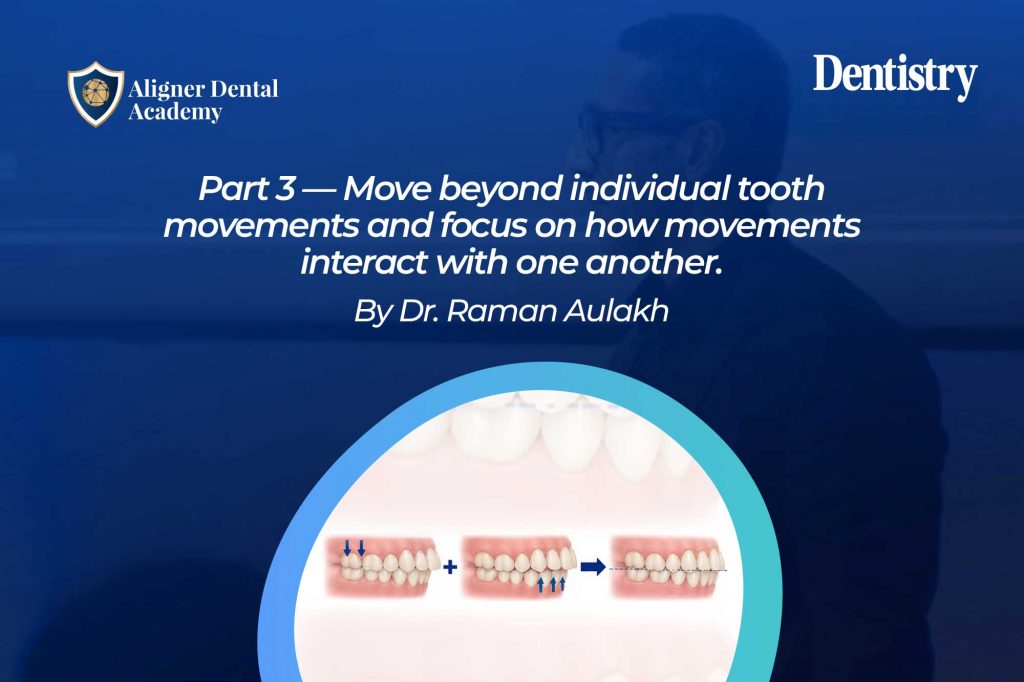
Raman Aulakh explores how synergistic and antagonistic tooth movements influence clear aligner predictability, offering GDPs practical staging principles to improve tracking, reduce refinements and plan more efficient treatment.
This is the third and final article in our series exploring the principles of clear aligner biomechanics.
In Part 1, we discussed why evidence-based predictability should guide aligner staging rather than relying solely on protocols, while Part 2 translated the predictability hierarchy into practical chairside biomechanics.
In this article, we move beyond individual tooth movements and focus on how movements interact with one another. Some movements work together to improve aligner efficiency and predictability, while others compete against each other and can increase the risk of poor tracking, anchorage loss and refinements. By understanding which movements are synergistic and which are antagonistic, clinicians can make better staging decisions and create more predictable treatment plans for their patients.
A recent review by Martínez-Lozano and colleagues explored this concept in detail through the idea of staging and biomechanics in clear aligner therapy. While the original paper provides a comprehensive and highly technical discussion, there are several practical lessons that every GDP providing aligner treatment can apply immediately in practice.
It’s not just where teeth end up – it’s how they get there
When reviewing a digital setup, many clinicians focus on the final result.
Will the teeth end up in the right place?
A more important question is: How will they get there?
Aligners work by delivering a series of small, controlled movements. If those movements support each other, treatment tends to be efficient and predictable. If they oppose each other, the aligners can struggle to express the programmed movement, leading to poor tracking and additional refinement stages.
Simply put, some movements create favourable conditions for other movements. Others create resistance.
What are synergistic movements?
Synergistic movements are movements that assist each other biomechanically.
When planned together, they tend to improve aligner efficiency and increase the likelihood that the planned movement will be expressed clinically.
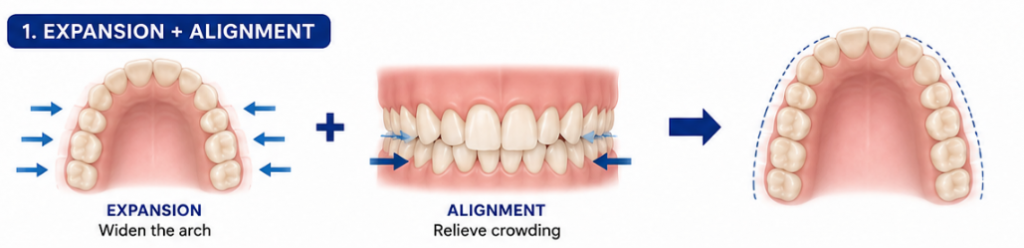
Example one: expansion and anterior retraction
A common clinical scenario is a patient with mild crowding and proclined upper incisors.
When posterior expansion is combined with anterior retraction, space is being created posteriorly while being utilised anteriorly. These movements complement one another and often produce more predictable outcomes.
Rather than fighting for space, the aligner is working with the available arch form.
Example two: distalisation and incisor proclination
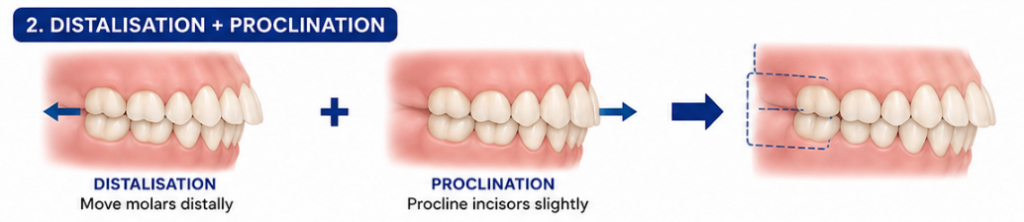
Another example is molar distalisation combined with mild incisor proclination.
As posterior teeth move distally, space becomes available within the arch. At the same time, slight proclination of the incisors can assist alignment and crowding relief.
These movements work in harmony and frequently demonstrate better predictability than attempting more complex combinations of movement.
Example three: posterior intrusion and anterior extrusion
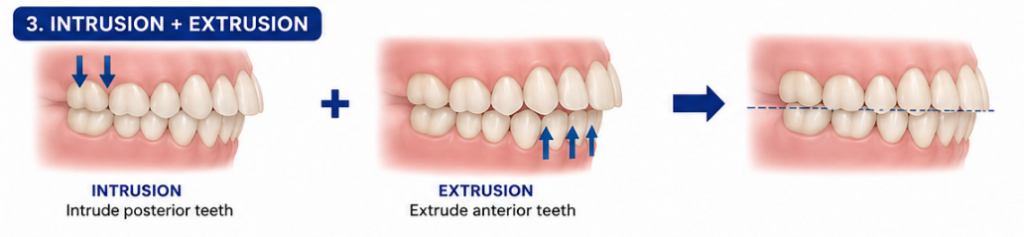
In selected deep bite cases, posterior intrusion combined with anterior extrusion can help improve vertical relationships.
Because these movements contribute towards the same occlusal objective, they tend to be more efficient than attempting contradictory vertical movements elsewhere in the arch.
A practical rule for GDPs
When reviewing a ClinCheck or digital setup, ask yourself three simple questions:
1. Does this movement create space or consume space?
Movements that create space, such as expansion or proclination, are often best completed first.
Movements that consume space, such as compression, retraction or certain vertical movements, are often easier once adequate space already exists.
2. Am I trying to achieve too many difficult movements at once?
Aligners are highly effective, but they still have biomechanical limitations.
If a tooth requires rotation, extrusion and root torque simultaneously, consider whether these movements would be better staged.
3. Could I simplify the plan?
One of the biggest mistakes made by newer aligner providers is trying to achieve every correction at the same time.
Often the most predictable treatment plans are the simplest.
Create space first.
Align teeth second.
The value of staging
As clinicians become more experienced with aligners, they begin to think less about individual aligners and more about the sequence of treatment.
Successful aligner therapy is not simply about knowing what movements are required.
It is about understanding when those movements should occur.
By recognising which movements are synergistic and which are antagonistic, clinicians can improve predictability, reduce refinements and deliver more efficient treatment for their patients.
Complete difficult finishing movements last.
By creating space first, aligning teeth second and reserving finishing movements for the final stages of treatment, clinicians can improve aligner tracking, anchorage control and overall predictability.
Further reading
The concepts discussed in this article are based on the review by Martínez-Lozano D, Castellanos-Andrés D and López-Jiménez AJ, Staging of Orthodontic Tooth Movement in Clear Aligner Treatment: Macro-Staging and Micro-Staging – A Narrative Review (Applied Sciences, 2024). Readers with a particular interest in aligner biomechanics are encouraged to review the original publication for a more detailed discussion of staging strategies and clear aligner biomechanics.
To learn more or arrange a no-obligation call with course director Dr Raman Aulakh, visit alignerdentalacademy.com/clear-aligner-therapy-diploma or reach out to diploma@alignerdentalacademy.com and discover how the SAFE Clear Aligner Diploma can take your career to the next level.
This article is sponsored by Aligner Dental Academy.