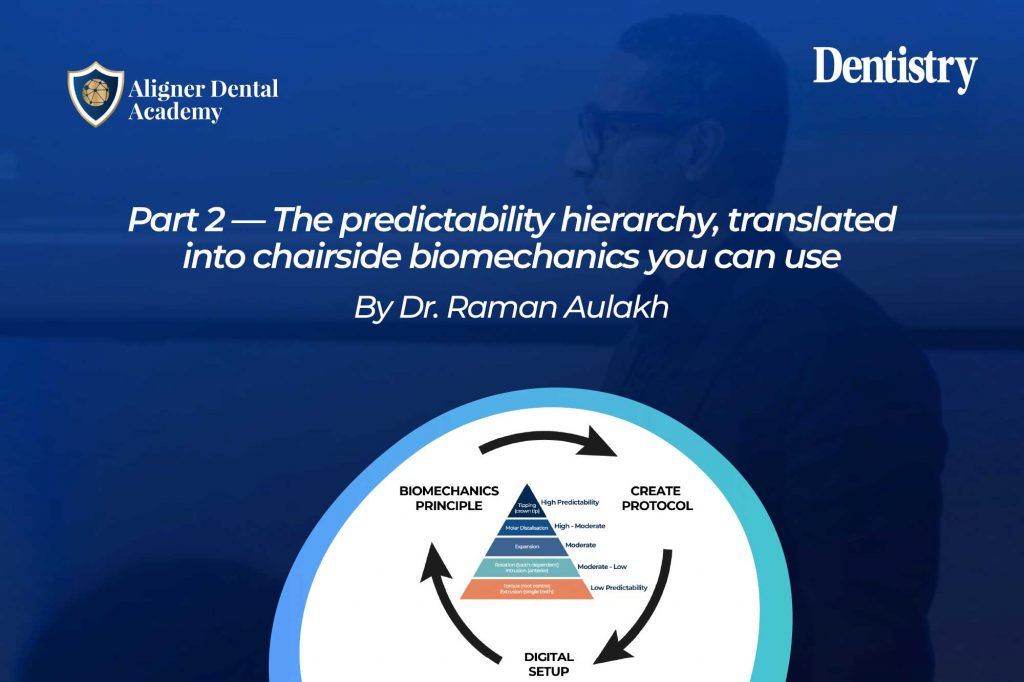
In part two of a series on protocols versus principles in clear aligner biomechanics, Raman Aulakh considers the predictability hierarchy as translated into chairside biomechanics you can use.
In part one, we established a simple truth: protocols only work when they sit on top of sound biomechanical principles. Principles explain why a movement behaves the way it does; protocols tell you how to stage it safely. Without the former, the latter becomes guesswork.
Now it’s time to translate that hierarchy into something practical – a movement-by-movement guide that gives you the single most important principle behind each movement, and the protocol logic that naturally follows from it.
This is where aligner planning stops feeling like a mysterious art form and starts behaving like a predictable system: you are no longer just ordering aligners, you are building force systems.
Below are the seven key movements, each reduced to two questions:
- Biomechanical principle – what is really going on?
- Protocol logic – how should I stage it?
Tipping (crown tip)
- Principle: tipping is one of the most predictable aligner movements because the tray can reliably grip the crown and deliver simple forces effectively
- Protocol logic: use tipping early to align teeth, gain space, and improve arch form, while protecting anchorage and ensuring full tray seating
- Chairside take-home: tipping is often the safest early ‘win’ in an aligner plan, as long as the aligner is fully seated.
Molar distalisation
- Principle: distalisation is predictable only when anchorage is controlled, otherwise the system leaks forward through tipping, proclination, and bite instability
- Protocol logic: stage distalisation sequentially with anchorage planned from the outset, using elastics when the anchorage budget is limited
- Chairside take-home: distalisation is never free space; every millimetre must be paid for with anchorage control.
Expansion (transverse)
- Principle: aligner expansion is usually crown tipping unless root control is built in, which risks buccal flaring, poor seating, and posterior open bite
- Protocol logic: expand early and gently when needed, and avoid combining transverse change with other difficult movements unless root control is planned from the start
- Chairside take-home: expansion is easy to prescribe digitally but much harder to control biologically if the roots are ignored.
Rotation
- Principle: rotation becomes unpredictable when the aligner loses grip, especially on rounded teeth such as canines and premolars
- Protocol logic: build engagement early with deliberate space and attachment design, and avoid combining major derotation with other fit-dependent movements
- Chairside take-home: rotation problems are usually grip-and-space problems, not simply a matter of adding more trays.
Anterior intrusion
- Principle: intrusion is difficult because it depends on stable vertical control of both the active teeth and the anchorage unit
- Protocol logic: slow staging, simplify and differentiate between relative and absolute intrusion, and ensure full posterior seating before expecting reliable anterior intrusion
- Chairside take-home: intrusion is not just pushing teeth up; it is controlling the reaction forces everywhere else.
Torque (root control)
- Principle: torque is one of the least predictable aligner movements because flexible plastic often deforms before delivering effective root control
- Protocol logic: start torque early, stage it slowly, and over-engineer with attachments and precise fit to improve expression
- Chairside take-home: torque is where digital planning and clinical reality diverge most unless the plan is deliberately over-engineered.
Check out my previous article on how to handle torque control.
Single-tooth extrusion
- Principle: extrusion is highly unpredictable because it depends on exceptional retention and full seating, both of which are easily lost
- Protocol logic: prioritise retention, isolate extrusion in a simple phase of procline then retract and extrude. Correct any early lag quickly before the force system breaks down
- Chairside take-home: extrusion is difficult not because it is hard to design, but because the aligner must stay engaged while pulling.
Check out another one of my articles on how to handle single tooth extrusion.
The bigger lesson
The hierarchy only becomes useful when it changes how you stage treatment.
High-predictability movements can often be used early to improve alignment and arch form. Lower-predictability movements need more than optimism: they need anchorage planning, attachment strategy, cleaner sequencing and fewer competing demands. That is the real protocol logic that flows from principles.
Cases become unstable when clinicians stack expansion, rotations, AP correction and vertical changes at the same time without hierarchy, anchorage planning or sequencing logic. I will be discussing this further in part three and diving into synergistic and non-synergistic movements.
So the clinical translation is simple:
- Use easy movements to improve engagement and create momentum
- Protect anchorage before attempting expensive movements
- Avoid stacking difficult vectors together
- Slow down when the movement depends on root control or vertical precision
- Intervene early when tracking starts to drift.
And that is why principles still matter more than protocols. Develop a thorough grounding in clear aligner principles and build real clinical confidence by enrolling in the SAFE Clear Aligner Diploma. Designed specifically for general dentists, this Diploma equips you with the skills to integrate clear aligner therapy into every area of your practice – from aesthetic and restorative treatments to periodontal care.
To learn more, arrange a no-obligation call with course director Dr Raman Aulakh or reach out to diploma@alignerdentalacademy.com to discover how the SAFE Clear Aligner Diploma can take your career to the next level.
This article is sponsored by the Aligner Dental Academy.