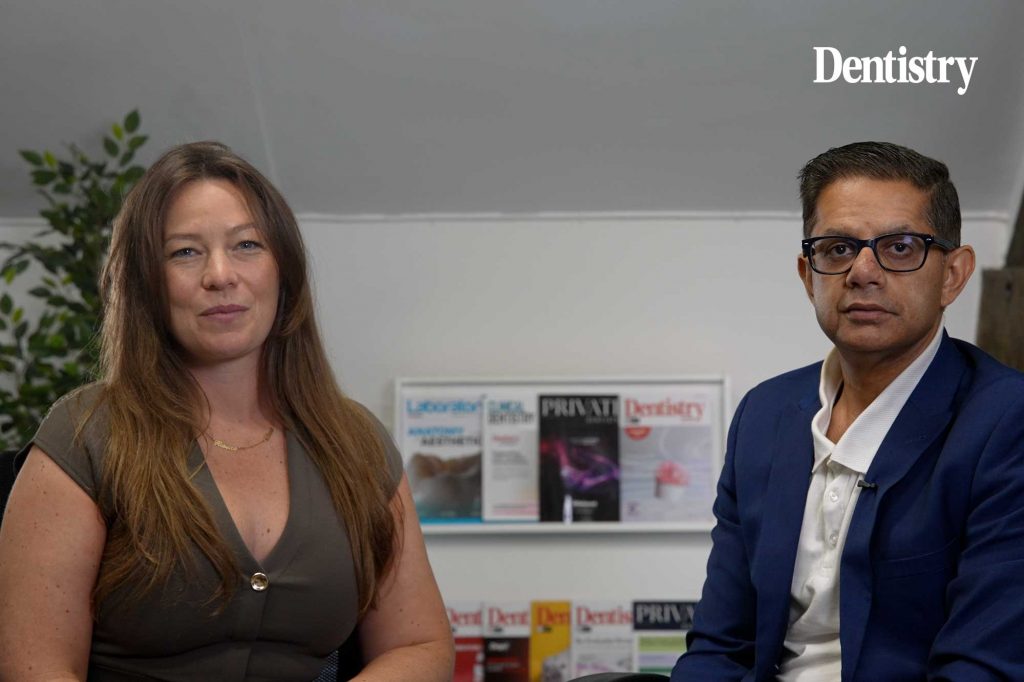
Mastering prevention is dentistry’s next great challenge – but meeting it needs unity and inspiration, Cat Edney and Avi Banerjee tell Guy Hiscott.
Antiquated remuneration systems have created a ‘watch and wait’ culture that makes no sense clinically. You wouldn’t tell a patient with high blood pressure to watch and wait.
For all the talk of innovation, the most critical transformation facing dentistry might not be a new material, a shiny digital workflow or even the latest AI diagnostic.
Instead, it’s a mindset shift. One that reframes oral healthcare as a long-term investment in wellbeing, instead of a reaction to disease.
A profession on the brink of dramatic change
Few people explain that better than dental therapist Cat Edney and Professor Avijit Banerjee, who paint a picture of a profession on the brink of dramatic change – if it can only seize the opportunity.
‘In the last five to 10 years we’ve seen huge innovations in oral care,’ Cat begins. ‘My hope is that the next decade brings that impact to the grassroots: fewer children in hospital for extractions, earlier intervention, and an entire dental team taking an active role in prevention.’
Avi agrees, and stresses that the shift is already underway. ‘The way we deliver oral healthcare needs to adapt,’ he says.
‘We have a framework for this: minimum intervention oral care. It’s being taught to new graduates and increasingly embedded in primary care. But it needs to permeate the whole profession so teams are empowered to help patients change behaviour.’
For this to happen, prevention must move beyond technique and into culture. As Avi puts it, the goal is to go from asking‘what is the matter with you?’ to ‘what matters to you?’
It’s a model endorsed by the World Health Organization and widely adopted in general healthcare. But dentistry is behind the curve.
Avi continues: ‘What happens in your mouth affects your body – your general health, your mental health, your wellbeing. The evidence is there. The challenge is making the system catch up.’
Help shape the next frontier in oral health
Explore the solutions shaping prevention’s future at the North of England Dentistry Show on 13 February at AO Arena, Manchester. Join Cat, Avi and a panel of leading clinicians, policymakers, researchers and industry innovators as they unpack practical solutions, from minimum intervention care and skill mix to system reform and the technologies reshaping prevention. Sign up for free to join the conversation – and help shape the next frontier in oral health.
Understanding the barriers
If prevention is the frontier, then education – for both patients and professionals – is the foundation.
Cat is unequivocal about this: ‘There’s a huge number of people in the UK who have very limited understanding of oral health. We need to start education early, from primary-age families to older patients who still see tooth loss as inevitable. It’s a wider societal issue, not just a dental workforce issue. Policy has to address it too.’
And Avi believes the gap is structural as much as cultural. ‘We have a brilliant NHS at its core,’ he says. ‘But dentistry often sits at the periphery of its mechanisms.
‘Policy makers talk about change, but delivering it requires appetite and alignment. The barriers aren’t clinical – they’re systemic.’
And one of the largest of those barriers is financial. Cat points out: ‘In dentistry, we’ve historically rewarded treatment rather than prevention. If you’ve not done something physical, you’re not paid for it. So why would practices invest time, money and training in prevention?’
It’s a sentiment Avi echoes: ‘Antiquated remuneration systems have created a “watch and wait” culture that makes no sense clinically. You wouldn’t tell a patient with high blood pressure to watch and wait. You wouldn’t tell a pre-diabetic to come back in six months. Yet that’s what we’ve done for decades.’
Both Avi and Cat believe that change is coming – the problem is that it’s happening very slowly.
‘There is movement,’ Avi says, ‘but it’s incremental. The key is updating our messaging to the public. People don’t go to the doctor only when something hurts; they go to stay healthy. Dentistry needs the same shift.’
Skill mix, industry and the power of working together
But that shift is bigger than any one person. Indeed, it’s bigger than any one clinical role working on its own, argues Cat.
‘Dental nurses who are oral health educators, dental hygienists, dental therapists – they all have enormous potential in minimally invasive care,’ she says. ‘But that’s only possible if the system values what they do.’
Industry, too, must have a seat at this table. ‘The innovations we’ve seen over the last 20 years have been incredible,’ Cat continues. ‘But we need industry partners working together to show how these technologies integrate to deliver personalised care.’
For Avi, this alignment is long overdue. ‘If all stakeholders used the same language and pushed towards the same outcomes, policy makers would have no choice but to respond,’ he says.
‘Medicine has achieved this unity; dentistry is catching up. The stars are aligning, but we must accelerate.’
This unity is not just philosophical. It has practical benefits: clearer patient communication, stronger delegation, better adherence to evidence-based care and more consistent outcomes. Above all, it creates the conditions for system reform – and without this, prevention cannot scale.
The technology horizon
There’s one further silver lining, agree the pair. Despite all the structural issues dentistry needs to address, technology is already reshaping prevention.
‘AI is helping us educate patients about their radiographs in ways we couldn’t before,’ Cat explains.
‘With that knowledge, patients are much more open to treating early carious lesions. They’re not asking us to watch and wait any more: they’re asking what they can do.’
This is part of a bigger shift in patient expectations. ‘Future generations value their health and expect personalised, transactional care,’ Avi adds.
‘Shared decision-making, environmental sustainability, the phasing out of mercury – all of this fits into minimum intervention care. It’s not about overtreatment; it’s about wellbeing.’
And we’re not done yet, he adds. ‘The tech will only get more exciting,’ Avi says. ‘The way dental teams learn and deliver care will change dramatically. And that’s positive – as long as we temper innovation with common sense.’
A profession ready for new conversations
Both Cat and Avi believe the next step is to bring these discussions into the open with energy, unity and honesty.
‘Dentistry needs a new conversation,’ Avi says. ‘Not scripted, not filtered. Raw conversations that reflect the reality of practice, the evidence, and the passion people feel for making things better.’
Cat agrees: ‘It’s all about innovation, but also action. Prevention is the direction of travel – now we need the system to support it.’
Follow Dentistry.co.uk on Instagram to keep up with all the latest dental news and trends.