Integrating Invisalign clear aligners with exocad is redefining ortho-restorative dentistry, enabling clinicians to deliver more predictable, minimally invasive treatment.
The convergence of clear aligner therapy and digital restorative dentistry is transforming the way clinicians approach complex cases. Rather than viewing orthodontics and restorative dentistry as separate disciplines, modern digital workflows now allow practitioners to integrate both from the very beginning of treatment planning.
At the heart of this evolution is the concept of ortho-restorative dentistry, a treatment philosophy in which tooth movement is planned to facilitate minimally invasive restorative outcomes. Combined with Invisalign clear aligners, exocad has emerged as one of the most powerful tools for achieving this goal.
The shift from tooth alignment to outcome-driven treatment
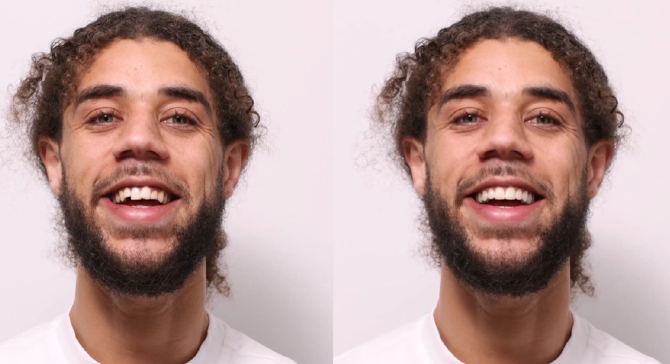
Modern dentistry increasingly embraces a ‘begin with the end in mind’ philosophy, shifting treatment planning from tooth alignment alone to a restoratively driven approach. Rather than asking, ‘How do I straighten these teeth?’, clinicians first define the ideal restorative outcome and then determine the optimal tooth positions required to achieve it. This paradigm, enabled by digital workflows and technologies such as Invisalign and exocad, enhances treatment predictability, interdisciplinary collaboration, and long-term clinical outcomes.
This approach is particularly valuable for patients presenting with:
- Worn dentition
- Peg laterals
- Missing teeth
- Implant cases
- Black triangles
- Uneven gingival architecture
- Crowding requiring restorative rehabilitation
- Patients seeking veneers or composite bonding.
In these situations, orthodontics becomes a tool to create ideal spacing, tooth proportions, and restorative conditions before any definitive treatment begins.
Why exocad matters
The challenge with ortho-restorative cases is visualising the final outcome before treatment starts.
This is where exocad provides a significant advantage.
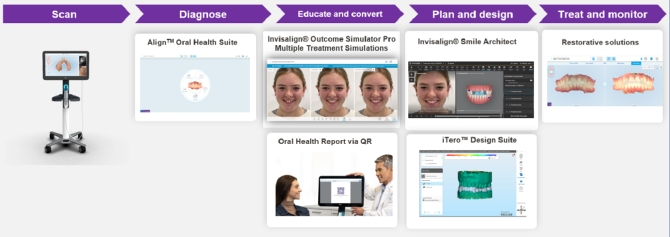
Using intraoral scans, photographs, CBCT data, and digital models, clinicians can create a virtual wax-up of the desired final restoration. Whether planning composite bonding, veneers, crowns, implant restorations, or full-mouth rehabilitation, exocad enables the restorative endpoint to be designed digitally.
Rather than moving teeth first and restoring later, clinicians can reverse engineer the entire process.
The restorative design becomes the blueprint that guides orthodontic treatment.
Designing the end before the beginning
A common workflow involves:
Step one: digital assessment
The patient is scanned using an intraoral scanner, creating an accurate digital model.
Step two: restorative design in exocad
Using exocad, the clinician or laboratory designs the ideal final smile. Tooth proportions, emergence profiles, incisal edge position, and restorative contours can all be visualised digitally.
This digital mock-up represents the desired endpoint.
Step three: space analysis
The restorative design immediately reveals whether sufficient space exists for veneers, composites, crowns, or implant restorations.
Frequently, it becomes apparent that orthodontic movement is required before restorative treatment can proceed predictably.
Step four: orthodontic planning
The restorative design can then be used as a reference when planning Invisalign treatment.
Instead of aligning teeth to textbook positions, the teeth are moved into positions that support the final restorative plan.
This approach minimises over-preparation of healthy tooth structure and improves aesthetic outcomes.
The benefits of an ortho-restorative workflow
1. More conservative dentistry
One of the greatest advantages of combining Invisalign with exocad is the preservation of natural tooth structure.
Rather than aggressively preparing teeth to compensate for crowding, rotations, or spacing discrepancies, orthodontic treatment can create the required space naturally.
This often allows clinicians to perform:
- Additive composite bonding
- Minimal-prep veneers
- Conservative ceramic restorations.
The result is more biologically respectful dentistry.
2. Improved communication
Digital planning allows clinicians, laboratories, and patients to visualise the same treatment objectives.
The ability to demonstrate the proposed final restoration before treatment begins significantly improves patient understanding and case acceptance.
Patients can see not only how their teeth will move, but also how the final smile is expected to look.
3. Greater predictability
Complex restorative cases often fail when insufficient space is available for ideal restorative contours.
By designing restorations first in exocad, clinicians can identify these issues early and use orthodontics to solve them before restorative treatment begins.
This reduces compromises and increases long-term predictability.
Exocad as a communication tool
Beyond design capabilities, exocad serves as a powerful communication platform.
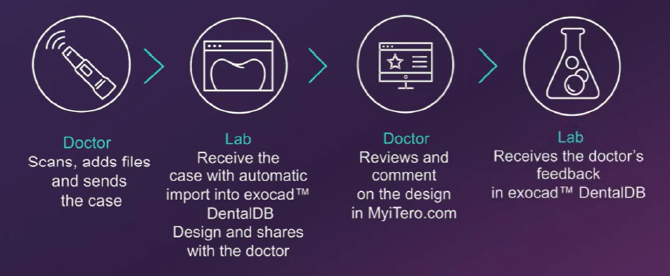
The software enables seamless collaboration between general dentists, orthodontists, prosthodontists, implant surgeons and dental laboratories.
Each member of the team can review the digital plan and understand how orthodontic movement contributes to the final restorative outcome.
For multidisciplinary cases, this level of communication is invaluable.
Clinical applications
Some of the most successful applications of Invisalign and exocad integration include veneer cases, where minor tooth movements create ideal tooth proportions and reduce the need for extensive tooth preparation. Orthodontic alignment also supports minimally invasive composite bonding and helps develop optimal spacing and emergence profiles for implant placement. In full-mouth rehabilitation cases, exocad digital wax-ups allow clinicians to coordinate orthodontic tooth movement with restorative and occlusal objectives for more predictable outcomes.
The future of digital dentistry
The future of dentistry is increasingly defined by digital integration, interdisciplinary collaboration, and outcome-driven treatment planning. The combination of Invisalign and exocad enables a restoratively driven approach by allowing clinicians to visualise the desired end result, optimize tooth positioning, and facilitate minimally invasive treatment. Together, these technologies represent a powerful digital workflow that enhances predictability, communication, and clinical outcomes in contemporary ortho-restorative dentistry.
To explore the orthodontic-restorative workflow and exocad integration in greater detail, the Aligner Dental Academy invites you to join its professional certificate course. This comprehensive program is designed to help you master Invisalign treatment planning and execution, increase your clinical confidence, and deliver outstanding patient outcomes.
Find out more and register here.
This article is sponsored by Aligner Dental Academy.