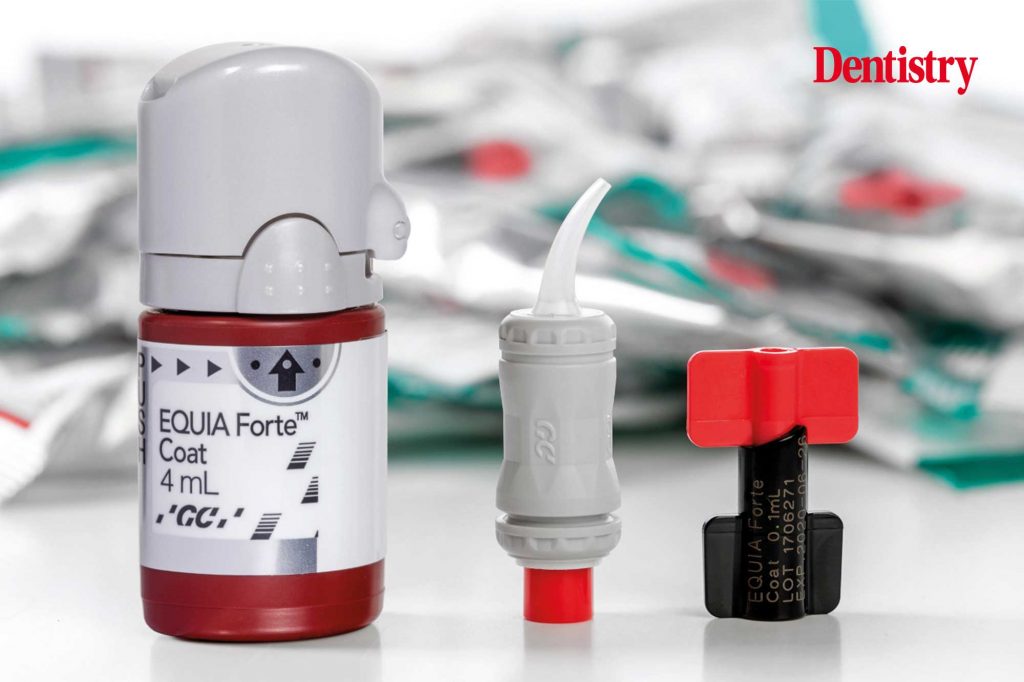
Glass hybrids are the hassle-free restorative alternative when composites are not an option – find out more now.
You may have seen glass hybrids mentioned over the last few years and wondered how they can fit into your clinical practice.
This blog answers all the questions you might have about this cost-effective, long-term restorative alternative, and you’ll find out why so many clinicians turn to it for a variety of reasons.
Plus find out below how to get your hands on an EQUIA Forte HT Intro Pack from GC, as well as a ticket to a GC Lecture Evening with restorative clinician and educator, Professor Falk Schwendicke in Birmingham on 22 April.
What are glass hybrids?
Glass hybrids are moisture-tolerant, fast-to-place restoratives built on glass ionomer technology and modified with resin for greater wear resistance.
Glass hybrid systems offer the strength of the latest innovative glasses combined with the wear resistance of a nano-filled coating. The reaction between the coating and the self-cure bulk-fill material improves the durability and wear resistance of the restoration.
Why do I need a glass hybrid?
When conditions for composite restorations are not met, glass hybrids are the ideal alternative as they are strong, moisture-tolerant and easy to place.
Glass hybrids are therefore ideal in the following situations:
- As an amalgam alternative
- For restoring teeth affected by MIH (molar incisor hypomineralisation)
- For restoring complex cases like geriatric and paediatric patients
- For restoring posterior teeth in high-risk patients.
What is EQUIA Forte HT?
EQUIA Forte HT is the latest iteration of the glass hybrid technology developed by GC. It combines a self-cure bulk-fill restorative with a resin coating and is indicated for:
- Class I restorations
- Stress-bearing Class II restorations
- Non-stress bearing Class II restorations
- As an intermediate restorative
- Class V and root surface restorations
- Core build-up.
What are the advantages of EQUIA Forte HT?
- Unlike composite, glass hybrids are hydrophilic and can therefore withstand the humidity of the oral environment. This makes them ideal to use when isolation is difficult to achieve
- No bonding is required as they chemically bond directly to dentine, enamel and cementum to create a strong, stable and chemically fused seal for long-term resistance to micro-leakage
- EQUIA Forte HT is packable, non-sticky, with a prolonged working time and short setting time, making the total procedure from application to coating only three minutes and 25 seconds
- The protective resin coating, EQUIA Forte Coat, that is applied as part of the procedure, protects the glass ionomer cement during the initial setting phase and makes a smooth surface, allowing patients to bite and chew immediately after placement
- With its ion exchange capacity, EQUIA Forte HT helps prevent demineralisation and promotes remineralisation of tooth structure
- Fluoride release helps prevent decay in high-risk patients.
Reviews of EQUIA Forte HT
EQUIA Forte HT as a bulk-fill
In a recent review of bulk-fill hybrids by Professor Trevor Burke and Dr Peter Sands in Dental Update (January 2026), the report stated that based on clinical studies cited, EQUIA Forte HT showed promising results in Class I restorations and in small/medium Class II restorations, with better cost-effectiveness than equivalent resin composite restorations because it is quick and easy to use.
EQUIA Forte HT to restore MIH
Dr Greig Taylor, NIHR clinical lecturer in paediatric dentistry at Newcastle University, uses EQUIA Forte HT to restore teeth affected by MIH: ‘With EQUIA Forte HT, rubber dam is not routinely needed. Even in particularly difficult areas where the hypomineralisation defect goes to the gingival margin or goes sub-crestal, there is no need for conditioning or bonding due to its inherent chemical adhesion properties.’
EQUIA Forte HT for complex cases
Specialist Prosthodontist, Dr Akit Patel at Perlan Specialist Dental Centre, Eastbourne commented: ‘In challenging moisture-control conditions, EQUIA Forte HT excels with its hydrophilic properties, chemically fused seal, and enhanced strength – courtesy of GC’s advanced glass hybrid technology. This unique combination ensures ease of use, excellent sculptability, and superior marginal adaptation for a reliable seal. A standout solution in restorative dentistry!’
EQUIA Forte HT as an amalgam alternative
Professor Falk Schwendicke, head of department for conservative dentistry and periodontology, LMU Klinikum Munich believes that glass hybrids like EQUIA Forte HT will play an important role in the search for amalgam alternatives.
‘As part of my work with the FDI World Dental Federation and WHO on the amalgam phase down, we are seeking alternatives to dental amalgam. Particularly for more technically demanding cases and high-risk patients, glass hybrids like EQUIA Forte HT will play an important role, with their increased wear resistance and flexural strength over glass ionomers.’
Try EQUIA Forte HT for yourself
Join Professor Falk Schwendicke on Wednesday 22 April at Edgbaston Park Hotel and Conference Centre, Birmingham in an engaging evening lecture, in which he will compare glass hybrids with traditional restorative materials and discuss how to integrate new material options into everyday practice – while considering cost effectiveness, patient-specific needs and sustainability.
The evening includes a free EQUIA Forte HT intro pack to take away, plus drinks, buffet and a chance to connect with Professor Schwendicke and fellow clinicians.
This article is sponsored by GC.