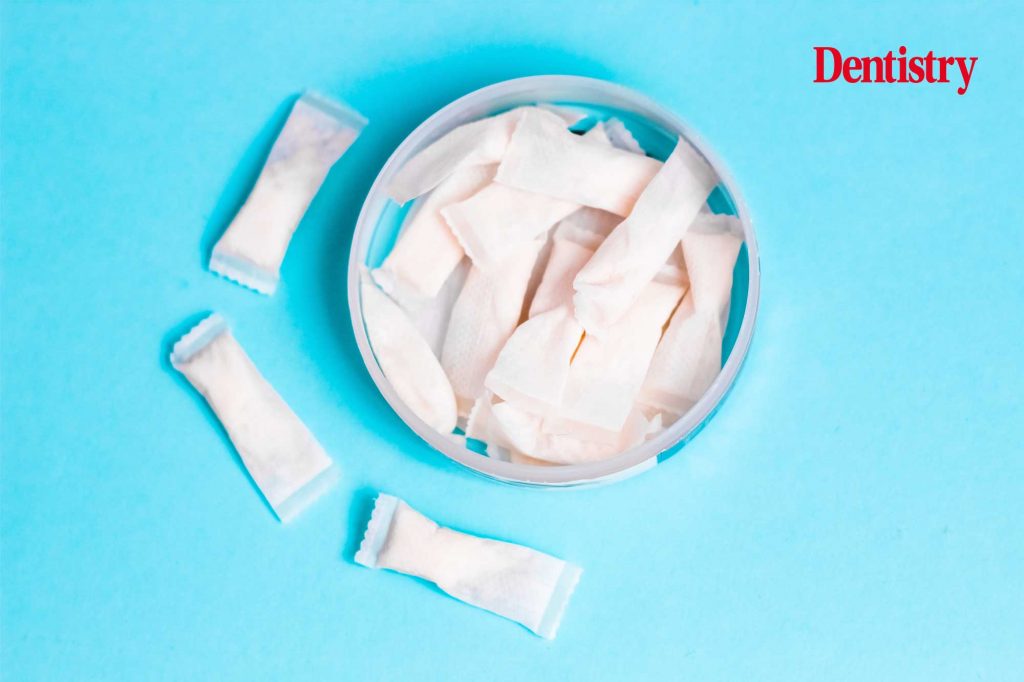
Snus, the Swedish smokeless tobacco that has seen a sharp rise in usage among UK adolescents and young adults, has been found to ‘clearly’ damage the gums.
Although illegal to sell in the UK, snus, a form of nicotine usually delivered in a small pouch placed under the top lip, has grown in popularity as it is cheaper and more discreet than vaping or smoking. But a systematic review found ‘consistent evidence’ that snus and similar can cause gum recession, particularly where the pouch is placed.
Several of the studies in the review also noted higher levels of gum inflammation in snus users, even after controlling for plaque levels.
The risk of gum recession is thought to be lower after using portioned snus pouches than loose powder. Newer sachet formats might therefore be safer than previous delivery methods.
How does snus damage the gums?
Mats Jontell is professor emeritus of oral medicine and pathology at Sahlgrenska Academy, University of Gothenburg and a researcher on the paper. He suggested that the impact of snus on the gums could be a result of inflammatory bone resorption.
He said: ‘When we weigh the evidence together, we see that snus affects the gums locally. It is not only a matter of the portion pressing against the tissue; there also appears to be an inflammatory reaction that leads to bone resorption, which over time causes the gums to recede.
‘However, we see no clear evidence that it leads to destructive periodontal disease – the type of condition in which teeth gradually lose their attachment to the jawbone.’
The review also did not find a strong link with tooth decay. Some studies reported a higher incidence of filled or decayed teeth in snus users, while others found no difference.
The researchers concluded that it was ‘not possible to conclude that traditional snus itself increases the risk of tooth decay’.
Does snus contribute to any other oral health concerns?
A larger study included in the review considered the impact of snus consumption during pregnancy. Children born to those who used traditional snus during pregnancy had a higher risk of being born with a cleft palate than children of non-users.
Maria Bankvall, senior lecturer in dentistry at the School of Health and Welfare, Jönköping University, and co-author said: ‘Although this represents an increased risk rather than proof of causation, it is an important signal from a public health perspective. The use of nicotine products during pregnancy cannot be considered risk-free, especially as snus use is increasing among young women.’
In December 2025, a University College London (UCL) investigation found that around 7.5% of 16 to 24-year-old-men were using snus pouches. This is compared to 1.9% of women in the same age group and 1% of adults overall.
Most snus users (69%) also used other nicotine products such as cigarettes or vapes, but 16% had never regularly smoked.
Lead author Dr Harry Tattan-Birch, from UCL’s Institute of Epidemiology and Health Care, said: ‘The rise in nicotine pouch use has been driven almost exclusively by young people, especially young men, while use among adults over 35 remained stable and low.
‘This may be due in part to aggressive advertising targeting this group on social media, billboards, in bars and train stations, and through sponsorships of motorsports and music festivals.’
The researchers called for age-of-sale laws, marketing restrictions and a cap on nicotine strength to limit youth uptake.
Follow Dentistry.co.uk on Instagram to keep up with all the latest dental news and trends.