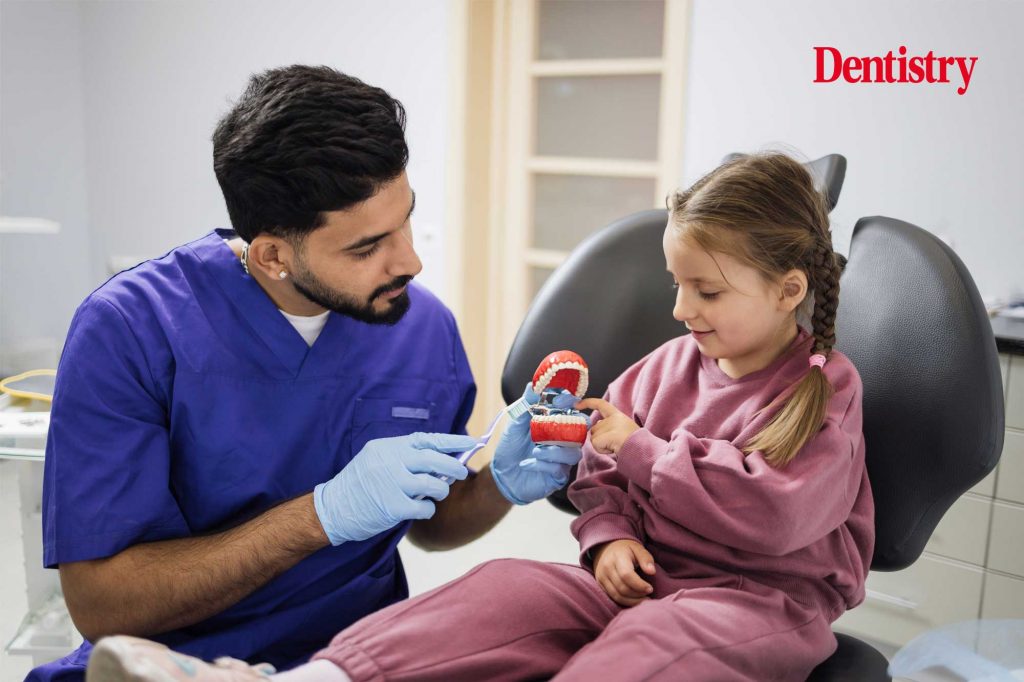
Practice Plan regional support manager Josie Hutchings spoke to Amit Jilka, a dentist and owner of five sites across Staffordshire, to garner his views on how contract changes might affect his business.
As the dental sector in England anticipates changes to the NHS dental contract, many practice owners are weighing what the changes will mean for their business, their teams and their patients.
Amit’s business Abbey House Dental offers both NHS and private dentistry. Although 40%-50% of his patients receive NHS treatment this represents only 20%-30% of the total revenue generated. As he explains: ‘We probably see a lot of NHS patients, but obviously they don’t contribute to the turnover as much as the private side does.’
Because of that mix, his NHS patients benefit from the cross‑subsidy effect as private investment in digital equipment and technology ultimately benefits all patients. ‘The fact that we’ve got all of the private equipment within the NHS practices means that you do utilise those things on the NHS to some extent,’ he notes. ‘There’s cross‑benefit in being a mixed practice.’
Recall intervals: a necessary shift or a risk to prevention?
One of the proposed reforms is to extend NHS recall intervals, potentially up to two years. This has received mixed responses from the profession. Although it aligns with NICE guidelines, Amit recognises that longer recall periods would release more appointments for new NHS patients but would leave regular attenders unseen for longer periods.
‘As dentists, we do like to see our patients more regularly,’ he says, and he cites the preventive value of six‑monthly hygiene appointments for most patients. Although extended recalls may help practices make the most of limited NHS resources, Amit still believes that, for many, ‘three‑monthly or six‑monthly recalls are super powerful’ for maintaining oral health and aesthetics. Ultimately, he sees recall frequency as patient‑dependent but acknowledges the NHS’s financial realities.
The increasing priority on emergency care
A more contentious proposal is the requirement for practices to ring‑fence a specific part of their appointment book for emergency care. Amit recognises this could be both a benefit and a burden: ‘As an NHS practice you do see a lot of emergencies, so at least you’re being funded for seeing more. But allocating more time towards emergencies can become difficult because NHS clinics are already very busy.’
He worries about the impact on continuity for regular patients, warning that ‘your routine NHS patients will be delayed in certain treatments’. Yet he also sees potential system‑wide advantages, particularly if greater NHS emergency capacity eases pressure on private practices.
The recruitment challenge and a possible solution
One area where Amit’s attitude is unequivocally positive is the proposal to tie newly graduated dentists into three years of NHS work. Recruitment has been, and remains, one of NHS dentistry’s, and that of the industry as a whole, most persistent problems in recent years. This situation Amit believes has been exacerbated by many young clinicians choosing to enter private dentistry immediately after graduation.
‘There’s been a trend of graduates wanting to go straight into private dentistry without the skill, and without the training,’ Amit says. ‘That’s always concerned me.’
He believes the proposed change could restore a more appropriate training pipeline: ‘Your junior dentists doing treatments appropriate to their skill set, and your private dentists offering advanced treatment; that’s how the system should have been set up from day one.’
The reality behind the reforms: no extra funding
Though Amit welcomes many elements of the reforms, he stresses they have one core limitation: none of the changes come with additional funding.
‘If it was, “we’re going to bring all these changes in and give you an extra 10–15% on top of your contract”, then yes, dentists would be happy, patients would be happy,’ he asserts. ‘But to do all of this without any extra money… it doesn’t make sense to me.’
The reforms and the lack of additional funding may even accelerate the rate at which practices use up their UDAs leaving them with limited (or no) NHS capacity for the remainder of the year. For practices that already hit or exceed target early, like Amit’s site in Stone, this could become a major operational challenge without the option to offer treatment privately.
A growing role for membership plans
Given this possibility, Amit foresees a rising importance for dental membership plans.
‘Right now, they’re probably the most powerful thing that a normal NHS practice can offer,’ he says. With UDAs likely to be completed earlier in the year, membership plans provide continuity of care for patients and financial resilience for practices.
A mixed practice future
Overall, Amit remains confident in the mixed practice model: ‘I truly believe in the hybrid model of NHS and private. It’s very important that you offer both services because the NHS is capped and will always be capped.’ As UDA targets are likely to be achieved earlier in the contract year, he also sees plans as the only way to plug the gap when they have run out. ‘Otherwise, you’re static,’ he says. ‘Everybody wants to grow to a point, but also you want to be able to service your own patients. So, if suddenly you can’t service as many patients because you’ve used up your funding, that’s an issue.’
While he still sees challenges ahead, especially for fully NHS practices, he views the reforms as broadly positive for those positioned to adapt. Which, as a mixed practice, he’s in an excellent position to do.
Practice Plan has been welcoming practices into the family since 1995, helping them to grow profitable businesses through the introduction of practice-branded membership plans.
We have over 300 years’ dental experience in our field team. So, if you’re looking for a provider to help you through a full or partial conversion to private dentistry that has that family feel but knows a thing or two about dentistry, then you’re in safe hands. Be Practice Plan and get in touch. Call 01691 684165 or visit www.practiceplan.co.uk/be-practice-plan.
This article is sponsored by Practice Plan.
If you’re ready for a confidential discussion with Practice Plan about the next steps in converting to private dentistry, leave your details below.