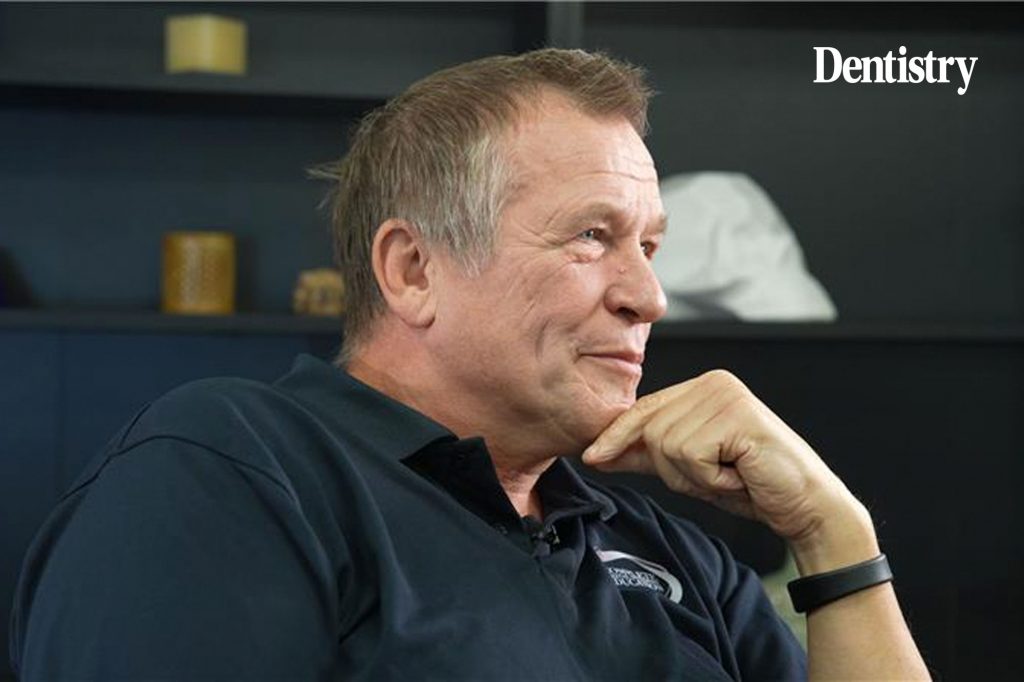
Ian Buckle tells Guy Hiscott why digital dentistry needs a new mindset to realise its full potential and avoid making the same old mistakes but faster.
Digital dentistry is unlocking possibilities that were unthinkable even a decade ago – faster workflows, richer diagnostics, more predictable outcomes. But if you believe Ian Buckle, we’re still a long way from realising the true potential of digital dental workflows. Not because the tools aren’t good enough, but because the dental profession is coming at them from the wrong angle.
‘We’re still seeing digital in a very procedural way,’ Ian explains. ‘We look at how to mill a crown or print a veneer – the single-tooth jobs – instead of asking: how does this help us look after the whole patient?’
It’s a point grounded in decades of experience. Ian has worked across cosmetic, restorative, functional and now airway-aware dentistry long enough to see techniques rise, fall and mature. And his message is not nostalgic; it is simply that every technological leap only becomes valuable when paired with sound principles.
‘There’s really no obstruction today to being a good dentist,’ he says. ‘Digital takes the strain out of so many difficult parts of diagnosis and planning. But if we use it with the wrong mindset, we’ll just make the same old mistakes – only faster.’
Ian will be exploring how diagnostics, digital workflows and complete dentistry can work together to deliver long-lasting results at the North of England Dentistry Show on 13 February at AO Arena, Manchester.
Stop thinking procedure-first
Ian’s central concern is that dentistry risks being seduced by convenience. Digital tools are astonishingly capable, but the profession’s default approach has been to use them as direct replacements for analogue steps – rather than as catalysts for rethinking workflows entirely.
‘It’s like when electricity replaced steam,’ he says. ‘At first, everyone tried to get electricity to do what steam used to do. But its real power was that it could be used differently – distributed, flexible, efficient. Digital dentistry is the same.’
He offers the example of the facebow – a familiar analogue tool that many clinicians initially tried to recreate digitally.
‘I spent five years trying to make a digital facebow,’ he admits. ‘Then one day you realise: what is the facebow actually doing? And how do our digital tools achieve that better, faster, more precisely? That’s the shift we need.’
The problem, he believes, is that dentistry has become trapped in a single-tooth mindset. Procedures are refined; workflows are tightened. However, there is a fundamental question not being asked often enough, which is: what does this patient truly need and how does digital help me deliver that?
Complete dentistry
Digital dentistry’s real promise, Ian argues, is not efficiency but completeness.
‘Instead of looking at one tooth and thinking “how do I fix it?”, we need to look at the whole human being,’ he says. ‘Digital makes it incredibly easy to assess, diagnose and treatment plan at a much higher level than most of us could manage with analogue tools.’
For Ian, that higher level is what he calls complete dentistry – an integrated approach that considers: teeth and restoration requirements; periodontal health; soft tissues; the masticatory system (muscles, joints and functional patterns); airway and breathing; posture – and only then the smile.
‘The smile is the decorating,’ he says. ‘It’s the bit everyone sees. But it only lasts if the foundations underneath are sound.’
Where analogue complete dentistry could be slow, technique-sensitive and riddled with inaccuracy, digital dentistry has removed those barriers entirely.
‘Mounting models used to take me half a day,’ Ian says. ‘Now it takes two minutes. You can create a diagnostic digital model, design a trial, and plan a whole case with extraordinary precision. There really is no excuse now not to practise good dentistry.’
The shift, then, is not technological – it’s philosophical. Digital makes complete dentistry easier, but only if clinicians choose to use it for that purpose.
Speed is not synonymous with progress
Digital workflows are often marketed on speed: instant scans, same-day crowns, rapid trial smiles. But Ian cautions that speed can be both seductive and dangerous.
‘Pete Dawson once said digital could just get you into trouble quicker,’ he recalls. ‘And he wasn’t wrong. If you use it with the wrong mindset, you can do the wrong thing faster – and more convincingly – than ever.’
He has seen it first-hand. A beautifully designed same-day smile trial that collapses under scrutiny the moment the patient goes home. A case rushed from scan to cementation with no opportunity for patient feedback. Materials selected for convenience rather than longevity.
For Ian, the provisional phase remains the dividing line between success and failure.
‘You design something, the patient takes it home, they try it out, their family sees it. You tweak the bite, tweak the aesthetics. And now digital means you can scan that provisional and reproduce it exactly. That’s where digital is transformative. But it doesn’t mean you skip the process.’
Similarly, printed materials – while increasingly impressive – demand discernment.
‘I love printing,’ he says. ‘But if my pal walks in and needs a simple onlay, I’m probably milling lithium disilicate because I know its long-term strength. Convenience isn’t a substitute for evidence.’
Do the right thing
Ian is clear-eyed about what digital should and shouldn’t be used for. Its value, he argues, is in enabling ethical, thoughtful dentistry that endures.
‘Most of my patients aren’t looking for quick fixes,’ he says. ‘They want to stay well, look good and keep their teeth working for the rest of their lives. Digital makes it so much easier to diagnose properly, plan properly and deliver something that lasts.’
Longevity, trust and fulfilment matter to him. He has treated some patients for more than 25 years – and he wants to be proud of the work that sits in their mouths.
‘Economical solutions still need to last,’ he says. ‘I’m from the back end of Liverpool – I know what “buy cheap, buy twice” means. Digital helps us give more people good, durable dentistry. But you’ve got to understand the foundations, not just the tools.’
It is this, he says, that keeps his own career exciting: the ability to do meaningful work at a higher level, with greater predictability, than ever before.
‘The biggest thing about digital dentistry today is that it really makes it so much easier to be a good dentist,’ he says. ‘But only if we use it to look after people properly – not just to do the same old jobs a bit faster.’
Offering a hand up
Ian’s philosophy is deeply informed by mentors across cosmetic, functional, restorative and occlusal disciplines – from Larry Rosenthal and Galip Gürel to Pascal Magne, Henry Gremion and the FACE group.
What they all had in common, he says, is an insistence on principles. On looking beyond the procedure. On understanding systems, not just steps.
‘Sometimes it takes 10 or 20 years before you go “now I get it”,’ he says. ‘If I can help someone learn that in a year or two, it eases my pain a bit.’
That, ultimately, is why he continues to teach – and why he believes digital dentistry is the most exciting moment of his career.
‘Digital makes it so much easier to be a great complete dentist,’ he says. ‘If we take the lessons of the past and apply them with the tools of today, we can do extraordinary things – predictable things, long-lasting things. But we’ve got to think bigger than single teeth.’
Follow Dentistry.co.uk on Instagram to keep up with all the latest dental news and trends.