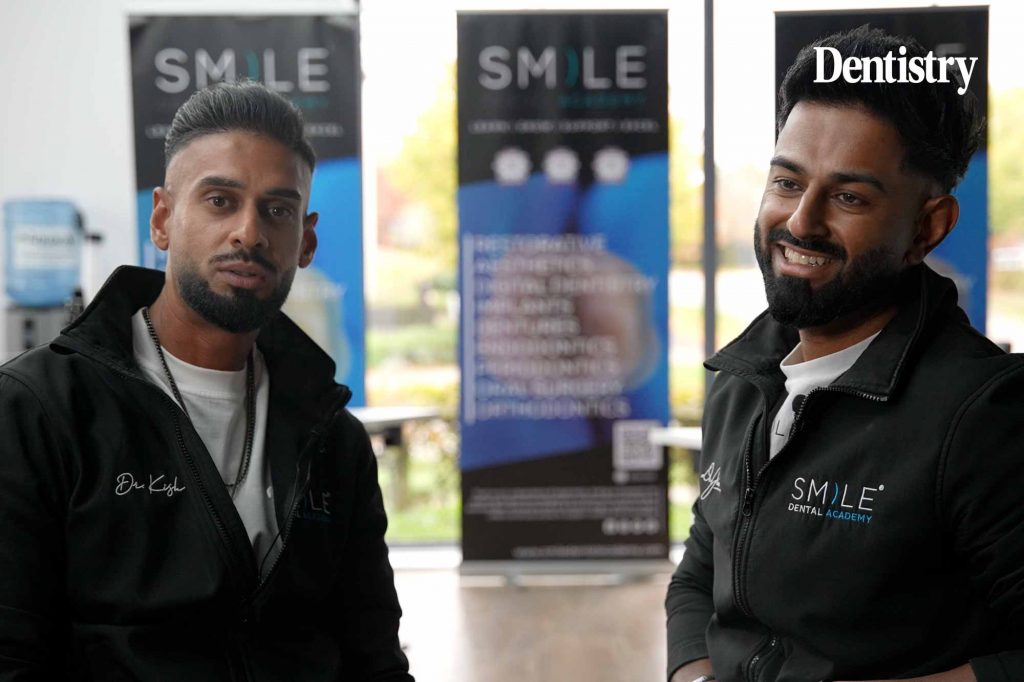
Jin Vaghela and Kish Patel discuss practice growth – and why it now depends more on foundations and workflows than spreadsheets.
At this year’s North of England Dentistry Show, Dr Jin Vaghela and Dr Kish Patel will explore how technology, AI and smarter systems are transforming the ‘back office’ of modern dentistry. In this conversation, they talk through the shift they’ve seen across their own 17-clinic group – and why growth now depends more on foundations and workflows than spreadsheets.
When Jin and Kish bought their first practice at 23, the back office looked very different. With a key reliance on people, scaling meant increasing admin headcount in line with ambition. But for Jin and Kish, whose Smile Clinic Group is rapidly expanding, that model no longer holds.
‘The whole landscape has changed – for groups and single practices alike. And one of the biggest drivers is tech and AI’
Jin Vaghela, co-founder of Smile Clinic Group & Smile Dental Academy
‘If you want good-quality growth, you simply can’t do it the way we used to,’ Jin explains. ‘The whole landscape has changed – for groups and single practices alike. And one of the biggest drivers is tech and AI.’
The pair argue that growth depends on adapting to the times: using technology to reduce admin at the centre while putting more trained people on the ground, where patients need them most.
‘We’re a healthcare business first,’ says Kish. ‘So everyone in a practice should be clinically trained and focused on patients. Tech should support that, not drag team members into spreadsheets and marketing admin they don’t need to do.’
Register for free now!
The North of England Dentistry Show will take place on 13 February at AO Arena in Manchester. Register your free place at www.dentistry.co.uk/noe.
Eight pillars and solid foundations
Before talking about specific tools, Jin and Kish insist on a more fundamental point: every practice, whether a single site or a 600-site group, needs strong foundations.
‘Everyone wants to build the empire and fly the flag,’ warns Jin. ‘But without solid foundations, that flag is going to collapse. The whole building is going to collapse!
‘That’s why we talk about the eight pillars of dental growth. They’re universal: every practice needs them.’
Those pillars are underpinned by the right systems – and importantly, someone who owns them. Early in their journey the pair were doing everything themselves: finance, operations, marketing, clinical oversight. But as they grew, the realisation was born that scale only becomes possible when:
- Systems are standardised
- The right tech is in place
- A named owner is responsible for each platform
- Everyone else is trained on it.
Connecting with others
Kish explains: ‘If you have that base in place, you can add four, five, 10 practices quickly because the model is already embedded. Without that, you’re just firefighting.’
But their model for building this base is admittedly unusual: they operate with no practice managers in the traditional sense. Instead, every site has a clinic lead – someone clinically trained, with strong people skills.
Kish agree: We realised when we looked at our practice managers, or clinic leads, there was a certain personality type that went with it. They’re often “yellow” personalities – “people people”. They want to be out there connecting with others.’
And when you put these individuals in front of a laptop manage finances, argue the pair, you’re wasting their skill sets – but keep them in front of people where they can put those skills into play, and the practice will thrive.
‘This is something we’re quite passionate about,’ admits Jin. ‘If you’re in the practice, you need to be clinically trained. What we found is that those most phenomenal practice managers always had a clinical background.’
Those without a clinical background are often moved into central support roles where their skills can be better used. It’s a system built on having the right people in the right roles, which in turn strengthens culture.
‘As a result of doing this, the culture within the team is a lot stronger,’ adds Kish. ‘The clinic leads take our culture, values and vision, and implement them on the ground. Without them, without our teams on the ground, all of this head office and support function would not be working.’
Choosing the right technology
There’s excitement around AI, but Kish and Jin also urge caution: enthusiasm shouldn’t outpace due diligence.
‘You need to be very careful about what kind of AI you implement,’ says Jin. ‘Take AI receptionists. Two or three years ago everyone rushed to roll them out, but most people didn’t look properly at GDPR or data security.’
Their message is simple: the tech you choose must be secure, must fit your business needs, and – critically – must integrate.
A CRM that doesn’t talk to your PMS is pointless. A compliance platform that isn’t linked to HR is inefficient. And if you have fifteen logins to complete a task? It’s the digital equivalent of fifteen staff members doing it manually.
‘What you need is one login, one ecosystem,’ explains Kish. ‘A system that communicates across platforms, giving you the data you need to make decisions.’
They’ve spent four to five years reviewing ‘every system and software out there’, feeding back to developers and adapting tools to fit dentistry. The result is a set of integrated, AI-supported workflows now proven across DSOs and corporates – and which they’ll be sharing at the North of England Dentistry Show.
The reasoning behind all this is: these workflows aren’t about shiny tech for its own sake. They’re about a seamless patient journey.
‘We’ve been through every single system,’ laughs Kish. ‘We’ve given feedback to a lot of the tech and AI companies out there. They probably loved us and hate us at the same time!
‘But we’re doing it for the better of the profession, so that whatever systems we use, we can shout about, talk about, and actually show what we’re doing with them.’
Embracing change
Asked what the biggest mistakes are in the current landscape, they don’t hesitate: leaders are too afraid of change.
‘If your business is doing well today, that might not be the case in five years,’ says Kish. ‘What we always say is, don’t be scared of change. Adapt to the change that your business will need – not now, but in five years’ time.’
‘Embrace it,’ agrees Jin. ‘What we see often is business leaders not changing: they’re not learning new skills, new techniques, new leadership skills.
‘But change is inevitable. The only time you’re not changing is when you’re dead – so it has to happen.’
They recall advice from US counterparts running 1,200 to 1,500 practices: start small, but start somewhere: ‘Once you start, there’s a chain reaction. Everything follows.’
Or, as they put it more bluntly: adapt or die.
Follow Dentistry.co.uk on Instagram to keep up with all the latest dental news and trends.