
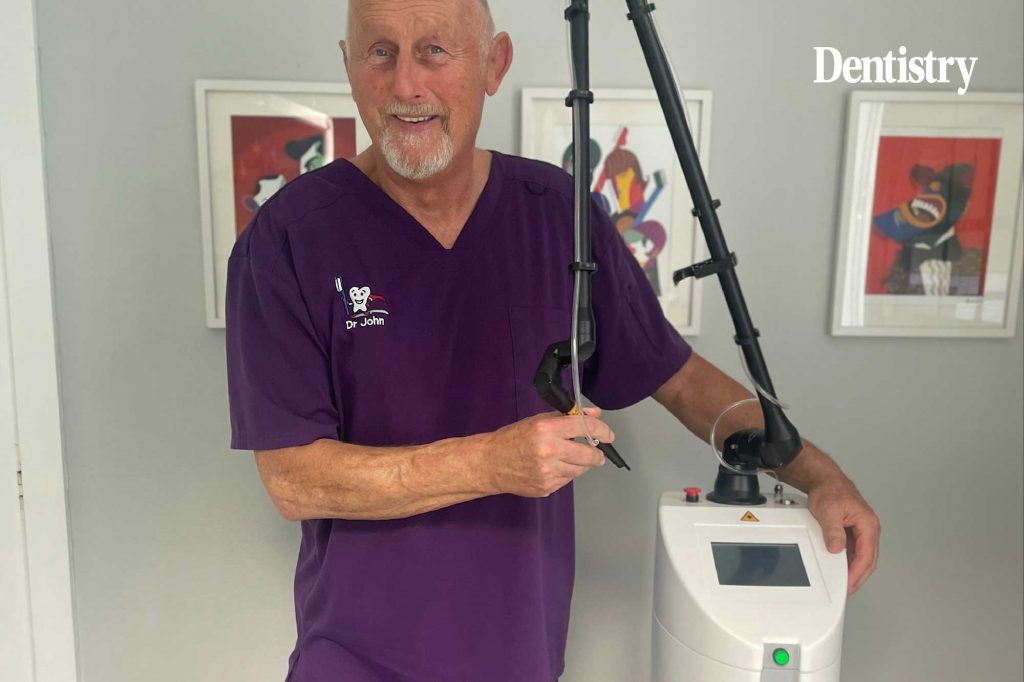
John Hutcheson reveals how he is transforming his 45-year approach to dentistry by integrating cutting-edge lasers into his practice.
Advances in dentistry are accelerating at a rapid rate, with lasers emerging as a central technology helping to transform modern-day dental practice. They enable a wide range of procedures – soft-tissue procedures and cavity removal, implant placement and periodontal therapy among them – to be performed more comfortably and efficiently. With an emphasis on treatments that support long-term health while preserving natural structures, lasers help clinicians align their delivery with patient expectations for an in-chair experience that includes faster healing, quicker recovery and less discomfort.
Dentist John Hutcheson graduated from the University of Edinburgh in 1980 and has dedicated over 45 years to providing exceptional general dental care. With extensive postgraduate knowledge in implant dentistry, orthopaedic orthodontics, restorative dentistry and advanced surgical techniques, he has never shied away from continually advancing his skills. He currently practises at Rosemount Dental Clinic in Aberdeen and last year expanded his impressive skillset by adding laser technology to his practice, acquiring an Ultrapulse CO2 Laser Surgical System ML030.
He complemented the investment with a specialised laser course supported by Dental Sky – and he hasn’t looked back. Just five months later, this innovation has profoundly transformed the clinic’s standing, marking a significant step forward in his own delivery of care and proving to be something of a game-changer.
Adapting to lasers in dentistry
Incorporating new tech often comes with a steep learning curve, but John’s previous experience with lasers, albeit in a limited capacity, coupled with the ‘exceptional hands-on course’, gave him fresh confidence.
‘It’s been both exciting and challenging,’ he says. ‘Often, interest in one area leads to another, so you develop what you wish to focus on within the discipline you want to pursue. My postgraduate education has led me to many clinical applications. When you do a lot of postgraduate study, it steers you in the right direction or adds another “leg” or “arm” to the picture, with knowledge always changing. However, my interest in lasers stemmed from outside dentistry, via a chiropractor colleague with whom I often collaborate.’
That collaboration stems from his focus on paediatric care, which is the heartbeat of his dentistry.
‘We have a major chronic illness problem in the UK. Oral health affects every system in the body, and the earlier we address it, the better. I have always wanted the best for children, and my mission is to make them healthier. While I might have experience in all elements of restorative and cosmetic dentistry, orthodontics and surgical care, it is paediatric dentistry that ticks the boxes.’
John believes that soft-tissue dysfunction, along with habits such as mouth breathing, incorrect tongue position and thumb sucking, are the main causes of malocclusion and poor craniofacial development. One factor affecting overall health is a small jaw, which can influence the entire body. Addressing this issue can give individuals a better start in life and is one step in the right direction.
A unique selling point
The Ultrapulse CO2 Laser Surgical System ML030 from SWOT is ideal for soft-tissue oral surgery, including frenectomies. It is frequently utilised in conjunction with orofacial myofunctional therapy (OMT) to address tongue-ties and other restrictive oral tissues, optimising patient functional outcomes.
Now, with his investment, John is offering laser frenectomy procedures – tongue-tie and lip-tie releases – to deliver superior precision, reduced bleeding and faster healing than the more traditional methods. It has transformed his paediatric care, enabling tailored adjustments and improved outcomes.
‘Early detection of incorrect development is common but often untreated,’ John says. ‘Parents used to bring their children in early for teeth straightening, but now, with increased health awareness, they are also seeking immediate solutions for sleep-breathing problems and concentration issues.’
And concerned parents are finding a dental home with John. As such, it is proving to be the clinic’s unique selling point.
‘We are the only myofunctional practice in Scotland,’ John proudly adds. A collaboration with an in-house myofunctional educator, along with referrals to the aforementioned chiropractor and other health professionals, also supports the care he provides.
Lasers as an adjunct
The Ultrapulse CO2 Laser Surgical System ML030 also has broader applications, to the point that John now uses it in his everyday dentistry.
‘Lasers are excellent adjuncts to all therapy. I use it every day – for gingival hypoplasia, enhancing periodontal treatment, addressing TMJ issues, and helping reduce pain post-ortho or RCT. Using a laser can significantly accelerate procedures. For instance, a lingual frenectomy now takes me only 10 to 15 minutes, reducing stress for the patient. The laser settings are highly adjustable, recognising that no two patients are exactly alike. This flexibility allows me to perform a lingual frenotomy on a baby and immediately fine-tune the settings for optimal results. Precision and adaptability are essential.
‘Whatever you are doing to reduce pain, improve healing, or both, the technology enhances perioperative outcomes and surgical procedures, making them quicker and bloodless. They ensure surgical precision in tissue removal whilst simultaneously promoting effective haemostasis and simply enhancing outcomes.’
John believes the Dental Sky course smoothed the path for him to integrate laser technology into his practice. It has helped him to operate more holistically, providing a patient-specific, minimally invasive toolkit that supports contemporary dentistry.
‘Learning from experienced instructors is essential,’ he says. ‘The hands-on element was crucial, providing detailed insights. It was both incredibly informative and practical. Lasers are a flexible piece of kit, but we must have a full understanding of how they work. Many clinicians overlook their immense potential, but Dental Sky’s course shone a spotlight on how this powerful tool can open new horizons, ensure patient comfort, improve outcomes, and add confidence to the way you practise – even after 45 years in dentistry.’
This article is sponsored by Dental Sky.


