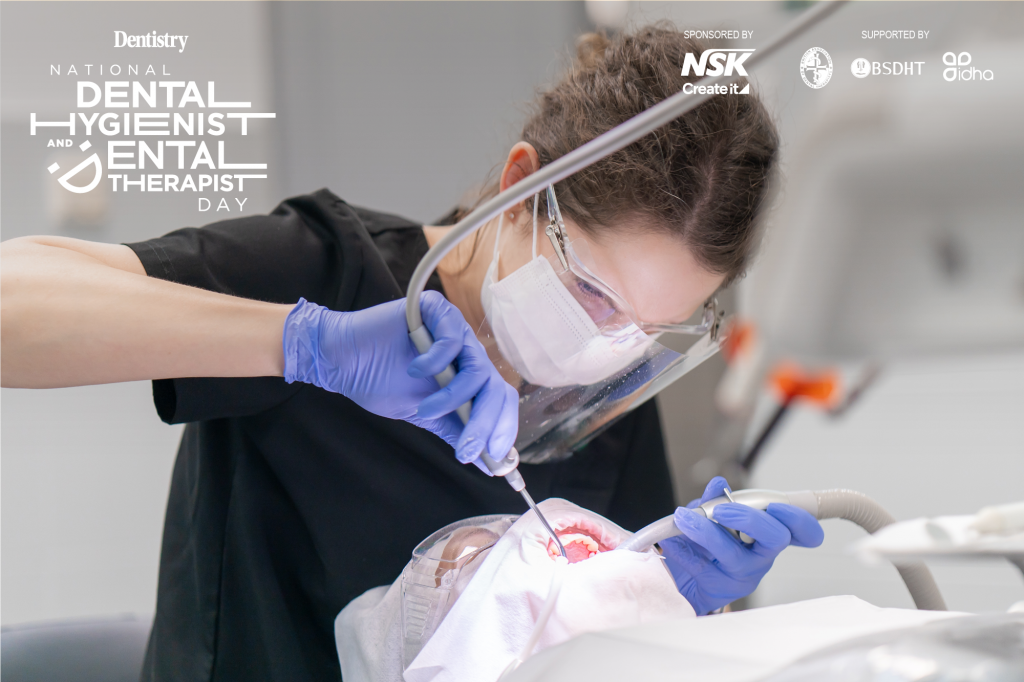
Kathryn Mayo shares insights from herself and her patient on the benefits of air polishing, particularly for those suffering with tooth sensitivity.
In practice, the latest evolution of ultrasonic and powder therapy benefits both clinicians and patients alike. In this article, hygienist Kathryn Mayo, a practised user of combined air polishing/ultrasonic devices, shares her perspectives, along with those of one of her patients. These insights support the value and practice-building capability of using the right equipment, along with appropriate patient communication, to optimise outcomes.
The professional perspective
This patient sought care after being advised to try air polishing with warm water. She asked me to apply a sensitive toothpaste before treatment, as she had always experienced severe sensitivity during previous procedures. Although she had previously undergone air polishing at another dental practice, she still found it uncomfortable and sensitive.
I explained that it was unlikely to be necessary, but I would test an area to see how it felt and would be happy to use it if sensitivity persisted.
Opening a discussion
I usually begin each appointment with indices, as I find this the most reliable way to open a discussion about oral and systemic health. Showing patients their scores, the visualisation of disclosed biofilm, and evidence of marginal bleeding can be very impactful. This starts a conversation about reducing inflammation and encourages patients to take responsibility for managing their biofilm at home daily.
Throughout the appointment, we work together towards common goals. The patient responded well to this approach and expressed interest in learning more.
We know that education alone doesn’t change behaviour. Still, it can serve as a catalyst – especially for this patient, who had previously sought hygiene treatments but hadn’t found what she was looking for, both in terms of treatment or engagement with a clinician who could support improvements and guide her towards stability.
Fine tuning
As with most patients, achieving stability has taken time, and while the indices score initially decreased significantly, oral hygiene did not become optimal immediately. At each visit, we have ‘fine-tuned’ the toothbrush technique and adjusted ID brush sizes. Seeing scores reduce is rewarding, knowing the patient now has the tools to achieve and maintain stability.
I believe units with heated water are not only effective for performing minimally invasive professional mechanical plaque removal but also an engagement tool that promotes regular attendance due to enhanced comfort, and it helps patients understand the importance of biofilm control and microbial balance for gingival health and periodontal stability. Incidentally, we have never needed to use a pre-treatment desensitiser!
The patient perspective
I have always struggled with stubborn plaque on the back of my front teeth. My dentist would scale this away during my check-up. This process was uncomfortable, and the cold water made my teeth very sensitive.
A friend told me about powder therapy as a more pain-free alternative to the dentist’s scaler. I visited a new practice that I thought offered this treatment, but it was still uncomfortable, so I researched again and found Kathryn.
This appointment was a departure from anything I had experienced before. I learned about my plaque and bleeding scores and what they indicated. Kathryn used the powder therapy machine, and it was truly comfortable with no sensitivity at all. Kathryn was the first dental professional to watch me brush my teeth and offered suggestions on how I could improve, including explaining how it would feel, so I knew I was cleaning all the right spots at home.
I left feeling informed and empowered to make a real difference, and I was especially pleased that the scaling was so comfortable.
Expanding oral hygiene knowledge
Through Kathryn, I continue to expand my knowledge on improving my home cleaning routines and now incorporate interdental brushes. I also recognise the reality that I had periodontal disease: although it is now stable, I will always remain a periodontal patient. This realisation is crucial because it motivates me to keep enhancing my home care.
This change has enabled me to receive treatment at the same practice to close some gaps between my front teeth. The results are fantastic, and I am now proud of my smile and confident in my ability to keep it healthy.
More dental professionals need to understand the benefits of powder therapy over traditional scaling. This understanding will encourage more patients like me to engage positively, take ownership of their oral health, and have the opportunity for a lifelong healthy smile.
Utilising the latest advancements in ultrasonic and powder therapy enables clinicians to provide care that is not only clinically effective but also patient-centred and comfortable. As Kathryn’s experience shows, when the right equipment is paired with clear communication, education, and ongoing support, patients become more engaged in enhancing and maintaining their oral health.
Read more from the National Dental Hygienist and Dental Therapist Day campaign:
- Prevention, policy and the power of teams
- Inclusive dentistry for neurodivergent patients
- From dental therapy to sports dentistry
- Educate and elevate dental hygiene with lifestyle medicine
- National Dental Hygienist and Dental Therapist Day countdown begins.
With thanks to our sponsor, NSK.
Follow Dentistry.co.uk on Instagram to keep up with all the latest dental news and trends.