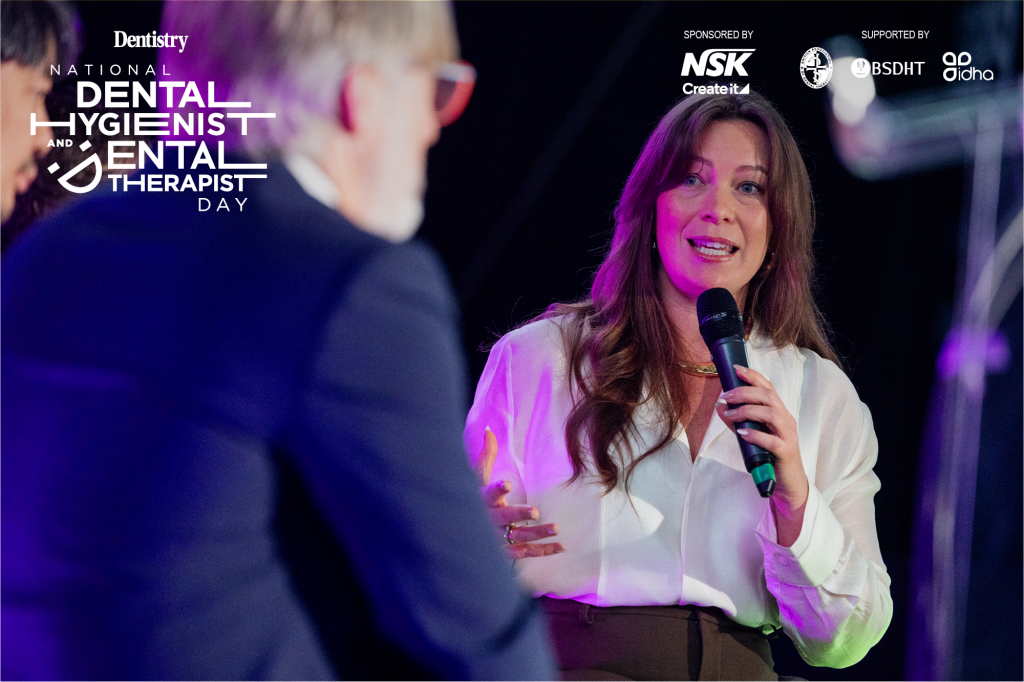
Dentistry shares insights on topics such as dentistry beyond the classroom, integrating skill mix and promoting prevention from the recent North of England Dentistry Show panel discussion with Cat Edney.
This year’s North of England Dentistry Show presented sessions that explored the innovations, mindsets and models shaping the profession’s future.
In a Future Health panel discussion, dental therapist Cat Edney offered a candid and thought-provoking perspective on prevention, workforce structure and the future of dental care. Drawing on 20 years in the profession, her contribution challenged traditional assumptions about where dentistry happens – and who it’s really for.
Dentistry beyond the practice
‘We often think dentistry belongs in the dental practice,’ Cat began. ‘But dentistry doesn’t only belong in the dental practice.’
Instead, she emphasised that meaningful improvements in oral health must start far earlier – and certainly long before a patient ever sits in the chair.
‘If we’re really looking at improving the public’s oral health, dentistry starts from the very beginning of childhood. From your very first midwife appointment, we should be talking about dentistry. We should be talking about prevention.’
For Cat, the issue is not a lack of conversation but where those conversations are happening, and who is included.
Breaking out of the echo chamber
A recurring theme throughout the discussion was the profession’s tendency to talk to itself.
‘We talk about these issues a lot, but we’re in an echo chamber,’ Cat said. ‘Associations will hopefully spread the message – but who are they spreading it to? Often, they’re spreading it to us.’
She called for a stronger public health approach, built around simple, clear messaging that resonates beyond dentistry: ‘How do we communicate that caries isn’t inevitable, that wobbly teeth aren’t just “normal” in old age, and that losing your teeth isn’t something you should simply accept? Your child doesn’t need to grow up with black teeth. Those are powerful, simple messages that are easy to communicate.’
At the same time, she highlighted gaps in education – particularly in schools, where oral health appears only briefly in the national curriculum and is not reinforced through consistent, joined-up care.
‘In the national curriculum, teeth come up twice,’ Cat said. ‘They appear briefly when children are younger, and then again around the age of 10, when they’re taught about eruption dates and the different types of teeth.
‘But we’re never really integrating that into regular, consistent care delivered by multiple voices – dentists, doctors, healthcare providers, social workers, parents, and community groups all working together.
‘For me, that’s the part we really need to focus on.’
Policy without a roadmap
The panel, comprising Cat, Avijit Banerjee, Jason Wong and Ben Atkins, also explored the changing role of dental therapists and the broader dental team. While acknowledging significant progress – such as direct access and therapists delivering NHS check-ups – Cat questioned how these changes are being implemented on the ground.
‘These are fantastic developments. But who is helping dental practices understand how to implement them?’ she asked. ‘We’ve been given policy changes, but we haven’t been given a blueprint for making them work in practice.’
She described a system still rooted in traditional models, even as ownership structures evolve: ‘Dentistry is still structured so that each dentist operates like a mini-business within a business.
The reality of skill mix
Despite ongoing discussions about multidisciplinary care, Cat suggested that true ‘skills mix’ remains elusive.
‘What that means is we don’t truly have skills mix. We work within our own defined roles, and we’re not always comfortable speaking openly with each other.’
She also pointed to cultural barriers within the profession, including imposter syndrome and differing clinical opinions: ‘Give 10 dentists the same patient and you’ll get 11 treatment plans. We have to accept that different treatment modalities are okay.’
What’s missing, she argued, is a clear framework for collaboration. ‘What we need is a clear communication blueprint: how we decide who does what, when something needs treating, and crucially, how we’re remunerated for that care.’
Untapped digital potential
While dentistry continues to embrace innovation, Cat questioned why some core processes remain outdated.
‘With all this incredible innovation and digital advancement, why are we still charting teeth in an analogue way?’
She highlighted the disconnect between advanced digital scanning and day-to-day clinical systems: ‘I have the ability to track changes in my patients’ mouths digitally, but that data is hidden within a scanner. It’s not integrated into my CRM system. No one else can see that tracking.’
This, she suggested, limits the profession’s ability to monitor long-term changes such as wear, recession and occlusion, which is particularly important in an ageing population.
The economics of prevention
Another key challenge discussed was the financial reality of preventive care.
‘Prevention doesn’t pay,’ Cat said bluntly. ‘The people delivering check-ups, hygiene appointments, and oral health education aren’t allocated significant funding. Their appointments are squeezed to be as short as possible.’
She cited examples of hygienists working in 15-minute appointments and questioned how meaningful prevention – or additional responsibilities like research – can be delivered under such constraints.
‘Sometimes, you have to make a decision to support the people in your team who are driving meaningful change… even if it doesn’t immediately translate into increased income.’
Structural barriers and missed opportunities
Cat also highlighted practical and systemic barriers that limit team-based care.
‘As a therapist, I can’t easily delegate. I can’t ask my dental nurse to apply fluoride – I’m not permitted to – so I have to involve the dentist again.’
These restrictions, she argued, are part of a wider issue around outdated frameworks and unequal progression opportunities: ‘Our scope of practice is still tied to a framework that originated in 1963.’
Meanwhile, dentists retain the ability to adopt new innovations freely, which creates an imbalance across the team.
A call for collaboration
Ultimately, Cat’s message returned to communication and inclusion.
‘If we’re truly talking about team-based care, why aren’t we gathering input from all members of the team when shaping policy?’
She emphasised the need for more open conversations within practices, better understanding of individual roles and capabilities, and a willingness to address the barriers that are often left unspoken.
‘These are real structural barriers to progression. And ultimately, we need to start speaking to one another more openly and work together to remove them.’
The NOE panel discussion made one thing clear: while dentistry is evolving, significant gaps remain between policy, practice and public health. As Cat’s insights underline, bridging those gaps will require not just innovation, but better communication, stronger collaboration and a genuine commitment to prevention at every level.
Read more from the National Dental Hygienist and Dental Therapist Day campaign:
- Inclusive dentistry for neurodivergent patients
- From dental therapy to sports dentistry
- Educate and elevate dental hygiene with lifestyle medicine
- National Dental Hygienist and Dental Therapist Day countdown begins.
With thanks to our sponsor, NSK.
Follow Dentistry.co.uk on Instagram to keep up with all the latest dental news and trends.