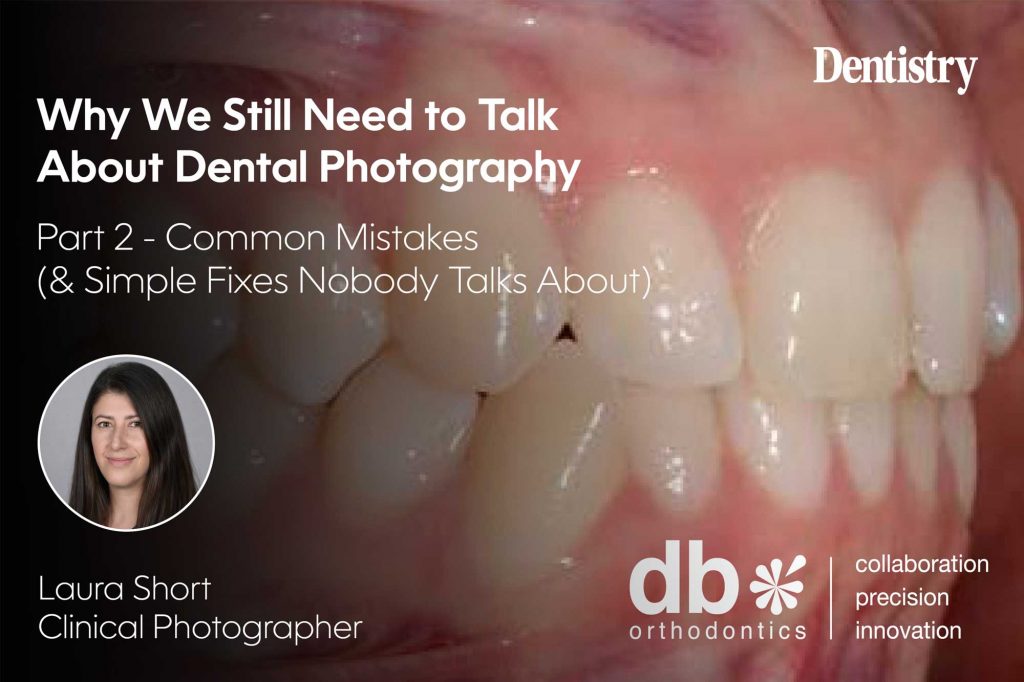
In part two of a three-part series, clinical photographer Laura Short reveals the common mistakes and simple fixes nobody talks about when it comes to clinical photography.
Dental photography is an essential tool for treatment planning, monitoring progress, and patient communication. Yet, despite its importance, I still see the same mistakes being repeated in clinics every day. If I had to summarise the most common dental photography mistake in one word, it would be compromise.
Compromising on positioning, compromising on retraction, compromising on tools – all these small shortcuts add up to inconsistent images that are difficult to use for clinical purposes. But the good news is that small adjustments can make a huge difference.
Here are the biggest offenders and the simple fixes that can transform your photography.
Mistake one: using the wrong retractors for the shot
One of the most common errors I see is clinicians using the same retractors for every view. The truth is that different views require different retraction techniques.
Anterior and lateral views
These shots require careful retraction, and starting with the right sizes can make all the difference. Rather than assuming large ends work for every patient, consider this approach:
- Anterior views: one large retractor for the upper lip
- Lateral views: a combination of small and large ends to accommodate cheek size and lip shape.
The curvature of the retractors naturally pulls the lips laterally, not vertically. Using the wrong combination – for example, only small retractors – almost always results in:
- Lip creep
- Soft tissue obscuring posterior teeth
- Inconsistent framing.
Horizontal and vertical retraction are not interchangeable, and the correct combination ensures consistent, high-quality images for treatment planning and patient records.
Occlusal and mirror views
For occlusal shots, two small retractors placed at 45 degrees work far better. This angle prevents the upper lip from covering the incisal edges – a mistake I see constantly in ‘before’ photos that never match the ‘after’. This small adjustment makes a huge difference in repeatability.
Why Gold Series retractors make a difference
After years of seeing retractors degrade, deform, or discolour, product quality stopped being a ‘nice to have’ and became essential. The Gold Series lip retractors from DB Orthodontics stand out because they:
- Do not deform, even after hundreds of autoclave cycles
- Retract effectively without excessive force
- Have a clear, refined design that looks exceptional in photographs.
Product user Clare Hutton from Suffolk Orthodontics summed it up perfectly: ‘These lip retractors are of lovely quality and retract the lips effectively, making them ideal for clinical use. They look beautiful in photos, as their clear design doesn’t obstruct the clinical view. They clean and autoclave beautifully, maintaining their integrity even after constant use. Highly recommend!’
This combination of clinical performance and photographic aesthetics is invaluable.
Mistake two: using the wrong size or type of retractors
Many clinicians default to a one-size-fits-all approach. DB’s retractors are designed to be adaptable to each patient, with small ends, larger ends, and V-shaped options. Using the wrong size can create two common problems:
- Larger ends may prevent the patient from biting down properly
- Smaller ends may fail to retract lips effectively.
Top tips
- V-shaped retractors help patients with bigger cheeks in lateral views
- Large metal retractors suit most adults
- Smaller metal or larger plastic retractors are gentler for children or patients with limited opening
- Plastic retractors are ideal for patients with mouth ulcers or sores.
Getting the size right is essential for optimal retraction, comfort, and image consistency.
Mistake three: poor mirror choice (and why handles don’t help)
Not all intraoral mirrors are created equal, and the wrong choice can ruin a shot. We use child and large palatal mirrors without handles deliberately.
Handles may seem convenient, but they introduce problems:
- Encouraging levering, which is uncomfortable for patients
- Causing the mirror to rest on molars, creating shadows
- Increasing the chance of fingers appearing in the frame.
A long-length, chrome-coated palatal mirror provides better access, avoids obstruction, and prevents steam or fingerprints from ruining high-resolution images. Warm the mirror before use to prevent fogging – a small step that pays off immediately in image definition.
Mistake four: trying to hold equipment while photographing
One of the biggest errors is trying to hold retractors or mirrors while taking photographs. Patients should hold retractors themselves where possible, freeing your hands to stabilise the camera for crisp images.
When patients cannot manage (due to age, disability, or communication barriers), an assistant should help. Crucially, the assistant should stand to the side of the patient, not behind, to ensure retractors pull forward rather than being pushed into the cheeks.
Important: Staff should place retractors themselves, not ask the patient to insert them. Patients cannot judge positioning accurately, which often results in compromised images.
Mistake five: minor details that make a big difference
Some small habits can ruin otherwise perfect images:
- Lubricating retractors: run them under a cold tap instead of asking patients to lick their lips
- Mouth opening: ensure patients open wide enough for mirror shots to capture occlusal planes flat and fully visible
- Assistant positioning: proper placement can transform retraction, especially for palatal or posterior views.
Attention to these details separates ‘good enough’ images from high-quality, clinically useful photography.
What are my top photography products to use?
Dental photography doesn’t have to be complicated, but it does require attention to detail. The most common mistakes are avoidable if clinicians focus on the right retractors, the correct mirror choice, proper patient and assistant positioning, and attention to small but critical details like mirror warmth and mouth opening.
Using quality, adaptable tools like Gold Series retractors and chrome-coated palatal mirrors, from DB Orthodontics, combined with correct technique, ensures consistently excellent images, easier treatment planning, and better patient communication.
When you remove compromise and commit to precision, dental photography becomes not just a record of treatment, but a powerful tool for clinical excellence.
Click here to view the full range of photography materials from DB Orthodontics.
Creativity has its place, but not at the expense of consistency.
In Part 3, I’ll break down why consistency matters more in clinical dental photography, and the simple techniques that take your images from good to great.