Research has found that universal adhesive can achieve durable, long-term bond strength across multiple luting composites without acid etching, making it a viable alternative for clinical practice.
Due to its favourable mechanical and aesthetic properties, lithium disilicate has become established as a material for crowns, veneers and inlays, among other things. However, a suitable adhesive protocol is necessary to ensure that the bond to the tooth substance is as long-lasting and reliable as possible. Pretreatment of the restorative material plays a central role in this.
In this context, the most recent study results from Japan show that the universal adhesive Universal Bond II is an attractive alternative to hydrofluoric acid – and this with a high level of compatibility with other adhesive systems.
Etching the inner surfaces with 5% hydrofluoric acid gel has established itself as the standard procedure for the pretreatment of lithium disilicate restorations. However, unlike with other glass ceramics, the etching time here is only 20 seconds (Hajto, 2012).
During this process, glass particles are dissolved out of the ceramic, creating a retentive etching pattern. This pattern forms the basis for the micromechanical anchoring between the ceramic and the luting composite (Manhart, 2019). In addition, subsequent silanization of the restoration surface improves the bond.
In addition to separate silane primers, universal adhesives with silane adhesion promoting agents can also be used for this purpose. These, in turn, are available in both one- and two-bottle versions. A current study from Japan looks at which of these two methods is preferable for achieving a long-term bond (Irie et al, 2024).
In addition to its compatibility with various luting composites, the scientists were also interested in whether such a universal adhesive could be used to pretreat lithium disilicate, as a substitute for potentially harmful hydrofluoric acid.
One study, nine luting composites
For their investigation, the researchers looked at the bond strength of nine different adhesive or self-adhesive luting composites as well as their corresponding adhesive system with lithium disilicate. To do this, they used three different pretreatment methods.
In addition to the classic hydrofluoric acid pretreatment (20 seconds at a concentration of 4.5%) and leaving out pretreatment with hydrofluoric acid, an exclusive pretreatment with a two-component universal adhesive (Universal Bond II, Tokuyama Dental) was employed.
The scientists then determined the shear bond strength values between the luting composite and lithium disilicate at three different times: after ageing in distilled water heated to 37 degrees celsius for one day, after 5,000 thermal cycles, and after 20,000 thermal cycles. This was intended to simulate two years of wearing the restoration.
Two-bottle adhesives have the advantage
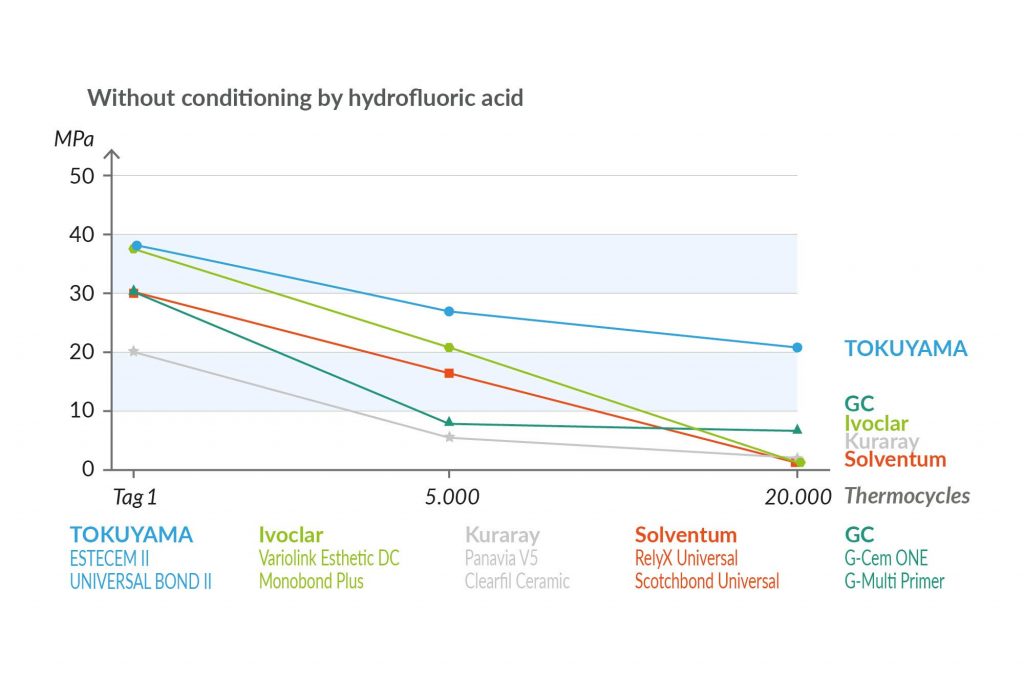
As a null hypothesis, the researchers had assumed that the bond strength would decrease significantly over time after pretreatment with a single-bottle adhesive only. The measurements confirm this assumption: if hydrofluoric acid is not used for pretreatment and only the adhesive system of the luting composite is used, the adhesion values approached the zero line in almost all cases at 20,000 thermal cycles. The only exceptions were the luting composites ESTECEM II (Tokuyama Dental) and Super-Bond Universal (SUN MEDICAL) with their respective adhesive systems.
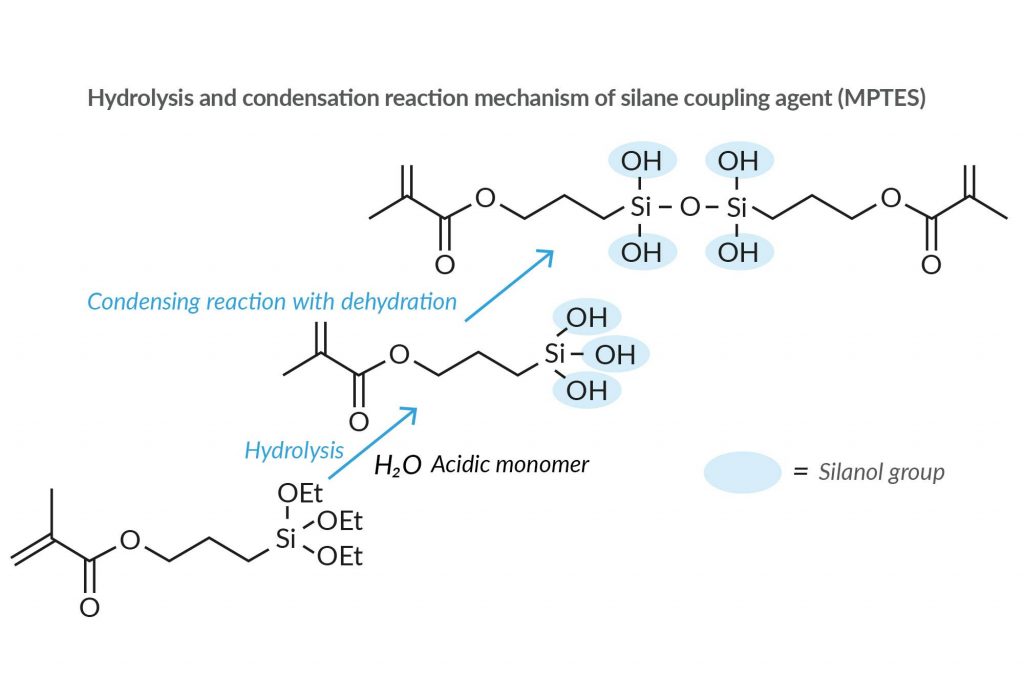
Even after 20,000 thermal cycles, they still demonstrated adhesion values in excess of 20MPa. Both systems have one thing in common: they are two-bottle adhesives. The reason for this significant difference, according to the research group, is that, in contrast to one-bottle adhesives, the silane adhesion promoting agent in two-component adhesives can only break down once both components have been mixed.
Wide compatibility and future potential
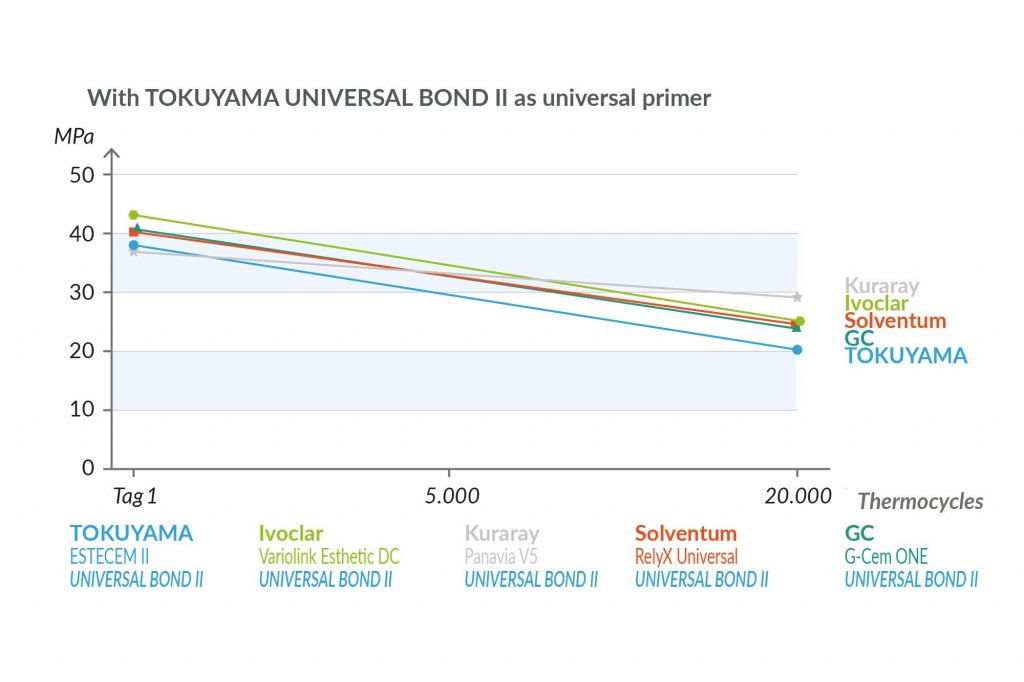
Yet another finding: when examining the third pretreatment mode, which involved exclusive pretreatment with the universal adhesive Universal Bond II (Tokuyama Dental), the scientists were able to determine good adhesion values in combination with luting composites from other manufacturers. After 20,000 thermocycles, the adhesion values were higher than those that could be achieved without hydrofluoric acid pretreatment with the respective recommended adhesive system.
These results show that Universal Bond II is highly compatible when used with other common luting composites – also including self-adhesive systems. From the scientists’ point of view, the universal adhesive qualifies as a viable alternative to pretreatment with hydrofluoric acid based on these results. Furthermore, the spectrum of applications for the product could possibly be extended in the future, even beyond the manufacturer’s recommendations, and the universal adhesive could be used quite generally as a pretreatment agent for bonding lithium disilicate and luting composites.
Conclusion for the dental practice
If adhesive bonding of lithium disilicate restorations is performed without pretreatment with hydrofluoric acid, a reliable and durable bond can nonetheless be achieved with two-component adhesive systems. A current study has confirmed that the universal adhesive Universal Bond II (Tokuyama Dental) is highly compatible when used with various adhesive and self-adhesive luting composites.
References
- Hajto J, Zeitgemäße Vollkeramik. Materialeigenschaft und klinische Anwendung. CME-Beilage in: Der Freie Zahnarzt 11/2012
- Manhart J, Intraorale Reparatur von Keramikeinlagefüllungen.ZMK, 2019. 35(3): S94-103
- Irie, M, Okada, M, Maruo, Y, Nishigawa, G, Matsumoto, T. Long-Term Bonding Performance of One-Bottle vs. Two-Bottle Bonding Agents to Lithium Disilicate Ceramics. Polymers 2024, 16, 2266. https://doi.org/10.3390/polym16162266
This article is sponsored by Tokuyama Dental.