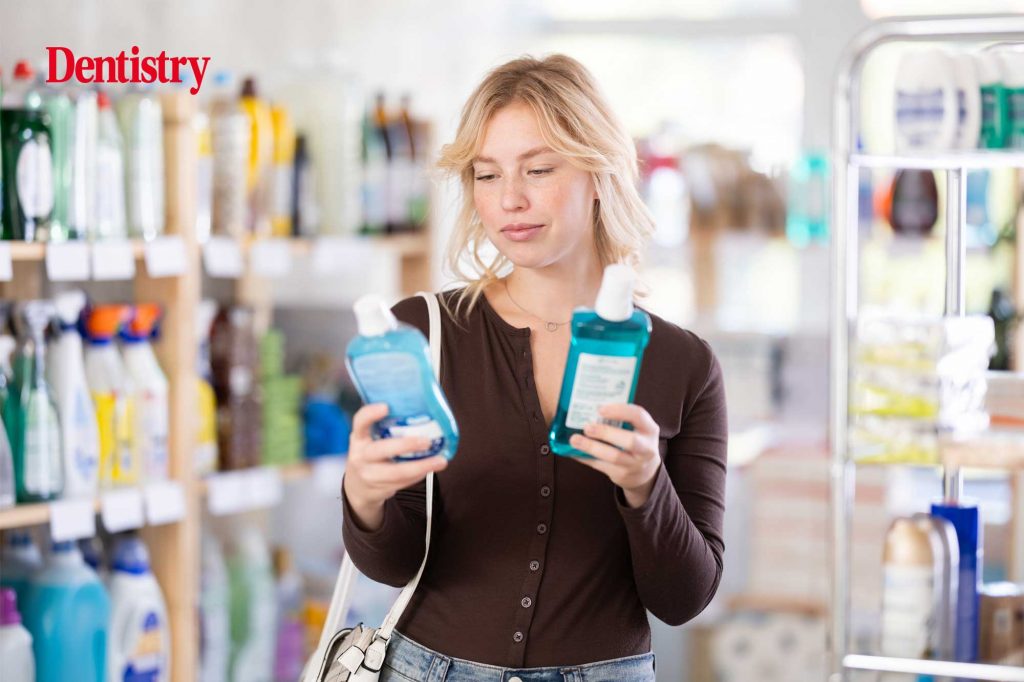
Elena Figuero explores the role of antiseptic mouthrinses in chemical biofilm control, and what current research tells us about their role in periodontal care.
When we talk about chemical biofilm control, there are two main types of application. Firstly, local application – that will be the subgingival application into the periodontal pocket, meaning a professional application. Secondly, supragingival application, by means of toothpaste or rinses (Figuero, 2023).
When we are going to this step, it’s really important to distinguish between two definitions: antiseptic agents and disinfectants. An antiseptic agent is any substance that prevents or arrests the growth or action of microorganisms by inhibiting their activity or by destroying them. The term is used especially for preparations applied topically to living tissue. This is the main difference with a disinfectant agent, which eliminates many or all pathogenic microorganisms except bacterial spores on inanimate objects.
Mouthrinses versus dentifrices
When we deal with antiseptics in this topical format, we need to consider two main delivery formats. On one side we have mouthrinses, and in the other one we have dentifrices. Mouthrinses are ideal from most point of views because (Figuero et al, 2023):
- They have more favourable pharmacokinetics
- They are independent of the ability of the patient to perform toothbrushing
- They are able to reach areas with difficult access, eg tonsils
- They are easy to use and really well accepted by patients.
On the other hand, there are a number of limitations with dentifrices:
- Pharmacokinetics is less predictable
- Sometimes toothbrushing cannot be performed
- Cannot reach difficult to access areas
- The formulation is difficult for some areas.
However, it’s important to consider that from a preventive perspective, dentifrices might be the ideal vehicle, but that is just because every patient uses toothpaste with their toothbrush.
The evidence
Now we have set the scene behind the concepts, let’s go to the evidence – why can we really recommend the use of chemical biofilm control?
In a 2019 systematic review by myself and others, we explored the efficacy of chemical biofilm control in the prevention and control of gingival inflammation. This review was an update on a previous one done in 2015 (Serrano et al, 2015). But in this systematic review, a workshop established that the best way to prevent periodontitis was to treat gingivitis. So, the basis for the treatment of gingivitis was established.
We knew that antiseptic agents were better than the placebos, but we didn’t know which agent was the best one, so we decided to update our previous systematic reviews and apply to the data a new statistical tool called network meta-analysis (Figuero et al, 2019; 2020). With this new technique, we were able to compare active agents against active agents, even though publications comparing both active agents directly might not exist in literature.
The results showed that, in terms of toothpastes, triclosan-copolymer and chlorhexidine had the greatest effect in terms of plaque control, although there were similar results in terms of gingivitis. For mouthrinses, the results were very clear in terms of plaque control, with essential oils, chlorhexidine and cetylpiridinium chloride (CPC) showing the greatest effects, compared with all the other active agents.
Evaluation
Therefore, during supportive periodontal care, we can consider the use of adjunctive measures in specific cases. In these cases, regarding mouthrinses, it is suggested to use essential oils, chlorhexidine and CPC (Figuero et al, 2019; 2020).
It is important to consider that every patient will need to use a toothbrush with a fluoride toothpaste in order to reduce caries, as well as interdental devices in order to prevent gingival inflammation. The decision will be whether to add any specific antiseptic agents in both toothpaste or mouthrinse formats in those cases in which the patient is not able to maintain good biofilm control with mechanical procedures.
Head to Dentistry.co.uk to complete the Digital Oral Hygiene Roadshow 2025.
References
- Chapple ILC et al (2015) Primary prevention of periodontitis: managing gingivitis. Journal of Clinical Periodontology 42(Suppl 16): S71-S76
- Figuero et al (2019) Efficacy of adjunctive anti-plaque chemical agents in managing gingivitis: A systematic review and network meta-analysis. Journal of Clinical Periodontology 46(7): 723-739
- Figuero E et al (2023) Supra and subgingival application of antiseptics or antibiotics during periodontal therapy. Periodontology 2000 doi: 10.1111/prd.12511
- Figuero E et al (2020) Efficacy of adjunctive therapies in patients with gingival inflammation: A systematic review and meta-analysis. Journal of Clinical Periodontology 47(22): 125-143.
This article is sponsored by Listerine.