
Dentistry
Dentistry’s guide to handpieces
Last updated: 15th September 2026

Contents
Overview and advancements in handpiece technology
The dental handpiece has long been an essential tool in all practices. Engineered to elevate precision in restorative, endodontic and surgical procedures, technological progress continues to meet the demand for more ergonomic, efficient and user-friendly handpieces.
High-speed versus slow-speed handpieces
A high-speed turbine is primarily used for cutting tooth structure and finishing restoration. Its main advantage lies in its ability to cut through tough materials quickly due to its high revolutions per minute (RPM). However, it typically operates with lower torque, making it more effective for tasks that require speed rather than force. It operates at speeds up to 400,000 RPM.
A slow-speed contra-angle is better suited for more delicate dental procedures, such as removing soft decay and preparing cavities. Although it operates at a lower RPM, it offers higher torque, allowing greater control and precision during intricate work. This makes it ideal for tasks that demand careful attention and accuracy. It operates at speeds up to 40,000 RPM.
Electric handpiece (speed increasing contra-angle): This offers significant advantages in dental procedures, particularly with their torque and speed control. This capability allows for more precise cutting, which is crucial for complex procedures. Their versatility means they can perform both high-speed and slow-speed tasks, reducing the need for multiple tools and making them suitable for a wide range of dental treatments.
Electric handpieces generate low noise levels, enhancing the patient experience by reducing anxiety and discomfort and creating a more pleasant working environment. Their precision is invaluable in challenging situations, such as working in tight spaces or with paediatric patients, where control and accuracy are paramount. Whilst the initial outlay is higher, their precision, versatility and patient comfort benefits often make them a worthwhile investment for dental practices.
Contra-angle handpiece: Commonly used with air motors or an electric micromotor, its ergonomic design allows improved access to posterior teeth. The angled head of the handpiece enables the dentist to work in the confined spaces at the back of the mouth more effectively, ensuring precise treatment even in challenging areas. This design is particularly beneficial when working with patients with limited mouth opening or accessing the molars, where direct visibility and access are often restricted.
Straight handpiece: This handpiece, characterised by its straight, non-angled design, is often used in lab work and is ideal for tasks that require precision and stability, such as adjusting prosthetics or performing intricate detail work. Its design allows for greater control and accuracy, making it indispensable when angled or curved handpieces are less effective.
Endodontic handpiece: This handpiece is designed explicitly for performing root canal treatments and is typically engineered to operate with either a reciprocating or rotary motion, allowing for effective root canal cleaning and shaping.
It also incorporates several ergonomic features that enhance control and comfort during lengthy procedures. They often come with adjustable speed settings and torque controls to accommodate different types of files and canal complexities, reducing the risk of damage to the surrounding tissues.
Surgical handpiece: Engineered to withstand the demands of surgical environments, where high torque and consistent performance are critical, this handpiece is often equipped with specialised attachments, such as surgical burs, which allow for intricate bone cutting and soft tissue management. The design also typically incorporates advanced cooling systems to prevent overheating during extended use, ensuring patient safety and comfort. The enhanced torque of these handpieces allows for efficient cutting through dense bone and other hard tissues, reducing the time required for surgical interventions. Their versatility is further enhanced by the ability to accommodate a variety of attachments, making them suitable for a wide range of oral and maxillofacial procedures.
Summary
Technological innovations have significantly transformed the dental handpiece market. Modern handpieces are designed to offer superior performance, enhanced ergonomics and outstanding durability. Advancements such as electric handpieces, improved turbine technology, and the integration of LED lights have revolutionised dental procedures, providing better precision, control and patient comfort. From noise reduction to advanced cooling systems, the evolution of handpiece technology is reshaping the future of dental care.
Top considerations when purchasing a dental handpiece
When choosing a handpiece, significant factors include ergonomic design, power source, compatibility with existing equipment and the frequently performed procedures. By making an informed decision, you can enhance your practice’s capabilities and provide superior care to your patients. Here, we explore some areas for consideration.
Trusted sources
The first consideration for any surgical equipment is its origin. Given the prevalence of online purchasing, due diligence is crucial to verify the reliability of suppliers. Reputable suppliers build trust through transparency and should readily answer questions such as:
- Is the device CE-certified for safety compliance?
- Is it from an ISO 13485-certified manufacturer?
- Does a UK-based provider supply it?
- Does it include a warranty?
Edmund Proffitt, chief executive of the BDIA, has previously warned of the risks of buying counterfeit dental equipment, suggesting that products such as handpieces are widely counterfeited and often sold through sites such as Amazon and Ebay.
‘The fakes are growing in sophistication. They appear to have CE marks, bar codes, serial numbers and holographic labels – all counterfeit. Even the accompanying documentation is expertly forged to be indistinguishable to the untrained eye,’ he warns.
The BDIA suggests it is essential to get to know suppliers. ‘BDIA members adhere to a strict code of practice, which can give dentists the confidence that the products they buy are guaranteed quality and provenance. The bottom line is to buy from reputable suppliers and know where your product is coming from. It is not worth risking your patients’ or staff’s safety or professional registration. Remember the adage: if the price is too good to be true – it probably is.’
Compare different handpieces on the market for their strength and longevity. Seek recommendations from colleagues who can provide invaluable insights and visit the manufacturers’ websites. Dental shows and exhibitions often offer opportunities to test out the latest advancements in handpiece technology.
Investing in genuine equipment guarantees the safe delivery of patient care and minimises interruptions caused by frequent breakages or replacements.
Ergonomics and practitioner comfort
Whilst personal preference plays a significant role in choosing dental equipment, practitioners should be mindful of their health and wellbeing. The ergonomics and weight of a handpiece are crucial to preventing repetitive strain injuries and musculoskeletal disorders. An ideal handpiece is a slim, lightweight one that reduces fatigue during lengthy procedures.
There are very few scientific studies on the impact of dental handpieces on user health. However, a 2014 paper emphasised the need for manufacturers of manual instruments to prioritise designs that accommodate clinicians’ variability. Instead of focusing on ‘refined colours’ and ‘attractive design,’ they write that developing tools based on specific characteristics tailored to each practitioner’s unique needs is crucial. This approach can help mitigate risk factors associated with improper grip.
Patient comfort
Whilst the dental environment comes with a degree of unavoidable noise, minimising impact for greater patient comfort is essential. As well as exacerbating anxiety in phobic patients, it is also widely accepted that noise during clinical dental practice creates negative emotions in the clinicians and dental staff, such as nervousness, loss of concentration and restlessness. High-torque electric handpieces work faster and more precisely, reducing chair time and noise levels – particularly beneficial for more anxious patients.
Technological advancements
Ease of use is vital for efficient and high-quality dentistry, so handpieces that are easy to install and operate appeal. Reliability and consistency in performance are also important factors. However, how manufacturers respond to the demand for more innovative solutions within dentistry can make the difference between good performance and great performance. A company that invests in new technology will consistently deliver for practitioners. Stay updated with the handpiece technology by reading about the topic. Research and apply any innovations that could enhance your practice and clinical delivery and set you apart.
Decontamination
Dental handpieces, like any dentistry equipment, require stringent cleaning to prevent cross-infection. High hygiene standards are necessary to ensure patient safety and compliance with regulations. The materials must endure frequent sterilisation without corroding or degrading, maintaining durability and performance. High-grade stainless steel and specialised polymers are standard for their resistance to wear. Proper maintenance should adhere to health standards and extend the handpiece’s lifespan, reducing downtime and enhancing cost-effectiveness for the practice.
After-sales service
Support and servicing are critical when selecting dental handpieces, as even the most durable require professional care to ensure longevity. Handpieces are precision instruments subjected to intense use, and without proper maintenance, performance can degrade over time. This can affect the quality of dental procedures and may lead to costly repairs or replacements. Therefore, check if the supplier offers a reliable repair service. Remember, efficient turnaround times are essential in minimising downtime.
A comprehensive warranty can also provide peace of mind. Check terms and conditions, such as what is covered and for how long, to help you make an informed decision. Beyond the initial purchase, good quality handpieces that are well-maintained can significantly reduce unnecessary expenses over time. Regular servicing and the supplier’s reputable repair centre ensure your investment remains in optimal condition for as long as possible.
Buying guide

W&H
W&H offers several dental handpieces in the UK, each designed for specific clinical applications.
Straight and contra-angle handpieces
Synea Power Edition: Designed for heavy-duty applications, such as removing decayed materials, cavities, fillings, crowns and bridges. These new high-speed contra-angle handpieces with a unique black push-button are built extra strong and durable. They are the optimal solution for advanced ceramic materials like zirconia, which is increasingly used in restorative dentistry.
Synea Vision: This premium instrument line in the Synea series offers innovation and long service life, guaranteeing excellent treatment results for restoration and prosthetics.
- Speeds, from 1:1 to 1:5, to meet your requirements, with two different head sizes for high speeds
- Optimum service life and quiet operation due to ceramic ball bearings and innovative gearing technology (WK-99 / WK-93)
- Easy to clean, comprehensive protection and long-term value retention thanks to new surface coating
- Excellent grip and ergonomics with optimised shank profile and monobloc design
- Compact glass rod for outstanding illumination of the treatment site
- Durable instrument construction with stainless-steel external parts
- Easy bur change
- Thermo washer disinfectable and sterilisable
- 36-month warranty.
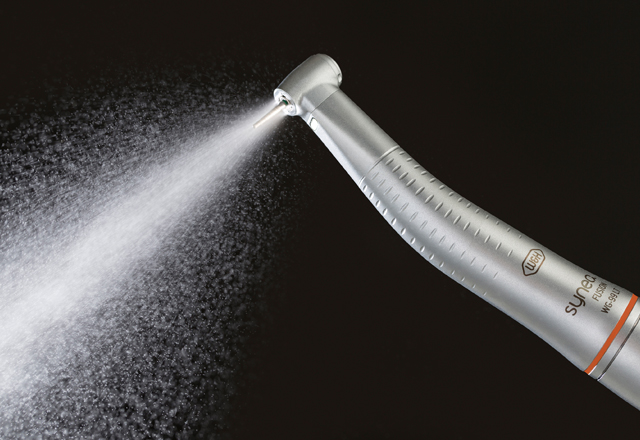
Synea Fusion: Offers uncompromising user comfort.
- Long life span and quiet running with ceramic ball bearings for model WG-99
- Optimum access, best view due to small head-sizes
- Safe cooling with 4 port spray for model WG-99
- Monobloc design for optimum hygiene and ergonomics
- Compact glass rod for constant light quality
- Optimised design for a secure grip and optimum hygiene
- Secure grip and easy bur changes
- Integrated maintenance-free spray filter for top water quality
- Can be connected to all ISO motors
- Thermo washer disinfectable and sterilisable
- 24-month warranty.
Surgical handpieces with mini LED+
The surgical handpieces with mini LED+ produce LED light independently. An integral generator supplies the LED in the handpieces with power.
- Natural reproduction of red tones
- Independent power supply with integrated generator
- Longer life compared with conventional halogen bulbs
- Fatigue-free working thanks to optimal ergonomics
- Durable and robust due to high-quality stainless steel and scratch-resistant coating
- Can be dismantled for thorough cleaning
- Thermo washer disinfectable and sterilisable.
- Surgical handpiece with lever chuck, mini LED+ and generator
Coupling system: ISO 3964 (DIN 13940)
- 1:1, angled, can be dismantled for surgical burs and cutters Ø 2.35 mm (also Stryker system), L = max. 45 mm, external spray, maximum drive speed 40,000 min-1
- Indications e.g. apical resection, osteotomy, apical trepanning and bone modelling.
- Surgical handpiece with lever chuck, mini LED+ and generator Coupling system: ISO 3964 (DIN 13940)
- 1:1, straight, can be dismantled, for surgical burs and cutters Ø 2.35 mm (also Stryker system), L = max. 45 mm, external spray, maximum drive speed 40,000 min-1
- Indications, e.g.: apical resection, osteotomy, apical trepanning, bone modelling.
Piezomed instruments
The W&H Piezomed range includes instruments for bone surgery, periodontology and extraction, retrograde endodontics, and lateral sinus lift. As soon as an instrument is inserted, Piezomed automatically detects it and assigns it to the correct power class.
Find out more about W&H’s handpieces
To learn more about W&H’s handpieces and find the right devices for your practice, click the button below.

BA International
BA International provides a comprehensive range of dental handpieces known for their precision, reliability and advanced technology. Its Optima range features some of the company’s top-selling products, with various types of handpieces to suit different requirements. The slow-speed handpieces in the Optima range are hygienic and modern. They provide a significant upgrade to BA’s older BA100 series, which included the popular BA101 contra-angle.
They also cover different types of dentistry. The BA25E and BA45E are suitable for general dentistry, and the 4:1 ratio BA65E and BA66E are perfect for prophylaxis.
The Optima range is thermos-disinfectable, as are all the Optima high speeds.
The high-speed handpieces – BA’s BA525 series – offer value-for-money trusted value turbines. They have a forged head, which is seven times stronger than the typical head of a turbine. Combined with a stainless steel body and ceramic bearings, they are highly durable and economical.
The BA525 series also offers quick connections for all major manufacturer-type couplings and an option for fibre optics. The series has two different head sizes. The ‘mini’ head (BA528) offers increased visibility and access to the treatment area.
BA25E Optima Contra-Angle
Latch-type contra-angle handpiece with 1:1 ratio.
- Thermodisinfectable and autoclavable
- Non-optic
- E-type fitting
- Manufactured in Japan
- Colour coded ratio (1:1).
BA695 Ultimate Turbine
High-speed turbine with light.
- Quadruple spray
- PVD coated body
- Smaller head size compared to previous generation handpiece
- Manufactured in Germany
- Optic or non-optic
- Thermodesinfectable and autoclaveable.
Ultimate Power+ Turbine
Top-of-the-range, high-speed handpiece.
- Light and ergonomic
- Fibre optics
- DLC-coated ceramic bearings
- Quadruple spray
- Titanium coated body
- Manufactured in Germany
- Thermodesinfectable and autoclaveable.
BA Optima 10
Light and compact cordless LED curing light.
- Light and compact with a curing output of 1200mW/cm²
- Three curing modes: full power, ramp and pulse
- Digital display
- Autoclavable light guide
- Wavelength: 420-480nm
- Includes battery, light guide, orange shield, power transformer and IFU
- Choice of 10 colours.

Dentsply Sirona
Dentsply Sirona’s product range caters to the comprehensive needs of dental professionals, ensuring they have the tools necessary for precise, efficient and comfortable patient care. Its portfolio includes high-speed turbines, low-speed motors, surgical handpieces and specialised units for endodontics.
Straight and contra-angle handpieces
The right instruments are necessary for optimum work results, though only lightweight and easily handled tools can achieve precise outcomes.
Whether you work with a high‐speed handpiece or a low‐speed instrument, Dentsply Sirona’s wide range of handpieces can be used for cavity and crown preparation, endodontics, prophylaxis, implantology and surgery.
Ergonomic comfort and precise results are ensured while always guaranteeing an optimum view. Dentsply Sirona uses super-plastic titanium forming technology to create instruments that are among the lightest in their class.
The four-nozzle spray ensures low noise, and handpieces can be sterilised and thermally disinfected. All Dentsply Sirona instruments have a long service life, with a warranty of at least 12 months and a reliable repair service, usually within 48 hours, exclusively with Dentsply Sirona spare parts.
T1 Line:
- Titanium sleeve
- Very quiet 4-nozzle spray
- LongLife Technology (DLC)
- Ceramic ball bearing
- Light
- Three-year warranty.
T2 Line/T2 S-Line:
- Titanium sleeve
- Very quiet four-nozzle spray
- Ceramic ball bearing
- Light
- Two-year warranty.
T3 Line/ T3 S-Line:
- Titanium sleeve
- Very quiet four-nozzle spray
- Ceramic ball bearing
- One-year warranty.
T4 Line:
- Robust steel sleeve
- One-nozzle spray.
Electric handpieces
The handpieces offer simplified handling, an easier-to-operate chuck system and lighter-weight materials to improve ergonomics. Optimising the gear design results in a quieter work environment and higher durability. The handpiece has a longer lifetime and comes with an extended warranty. The smaller head dimensions offer improved access and better sight of the preparation area. Meanwhile, sustainable packaging and paperless instructions help save natural resources.
T1 Energo:
- Titanium sleeve
- 4×2 nozzle spray
- DLC-coating for ball bearings
- Three-year warranty.
T1 Energo S:
- Titanium sleeve
- 4×2 nozzle spray
- Three-year warranty.
T2 Energo:
- Stainless steel sleeve
- 4×2 nozzle spray
- Two-year warranty.
T3 Energo:
- Stainless steel sleeve
- 4×2 nozzle spray
- One-year warranty
- No light.
Dentsply Sirona also offers a range of maintenance products and accessories to ensure its handpieces’ longevity and optimal performance. These include lubricants, cleaning devices, and maintenance kits for routine care and servicing.

KaVo
KaVo’s range of dental handpieces available in the UK caters to diverse clinical requirements, from high-speed cutting and polishing to precision surgery and prophylaxis. These handpieces are characterised by their durability, precision and ergonomic design.
Whether in a high-performance setting or a general practice, KaVo handpieces offer solutions that balance advanced technology with ease of use, ensuring high standards of patient care.
Handpieces and contra-angles
SMARTmatic: The straight and contra-angle handpieces of the KaVo SMARTmatic series boast innovative technology, high-quality materials and outstanding German-made workmanship.
- Extensive portfolio of straight and contra-angle handpieces with and without spray
- Suitable for instruments with different gear transmissions and reduction ratios for applications from prophylaxis to endodontics
- Premium German-made KaVo workmanship
- Ceramic sliders within the clamping system for enduring and secure tool-holding
- Rust-free stainless steel for long-lasting durability
- Lightweight for tireless working
- Optimum balance for precise treatment
- Internal spray transmission to the Sprayclip for a quick changeover of instruments on all motors (applies only to instruments S10 S and S20 S).
EXPERTmatic: The handpieces and contra-angles of the KaVo EXPERTmatic series perform impressively reliably and are outstandingly durable even with the most intensive continuous use. Whether you use the red high-speed, yellow, green or blue contra-angle – all handpieces and contra-angles in the KaVo EXPERTmatic series come with high-quality features and smart details. They are safe and durable thanks to the KaVo high-tech FG chuck with carbide guide bushing.
- Up to 30N retention power
- Reduced standard head dimensions for better visibility and accessibility even in preparation areas that are difficult to access (E25L)
- Proven, high-precision KaVo ceramic ball bearings Made in Germany for the smoothest running even during preparations requiring a lot of power
- Reduced volume of 57 dB(A) for relaxed working and elimination of unpleasant noise for patients and dentists
- Especially resistant stainless steel head
- Lowest manufacturing tolerances for the best price-durability ratio
- Choice of LUX/non-LUX ensures precisely the right instrument for the treatment unit motor
- EXPERTgrip surface for excellent grip
- Replaceable spray microfilter for effective and trouble-free spray cooling
- Glass rod light conductor with up to 25,000 lux
- Chuck retention force of up to 30 N for safe preparations
- Maximum work efficiency owing to tungsten carbide guide bushing
- Original KaVo ceramic ball bearings
- Significantly reduced head size
- The tough stainless steel head and narrowest manufacturing tolerances ensure a long service life
- Made in Germany
- New: 24-months warranty.
MASTERmatic: KaVo MASTERmatic handpieces and contra-angles mark the pinnacle of the KaVo instrument portfolio in terms of performance and comfort.
Thanks to the comprehensive selection of interchangeable heads, the right MASTERmatic instrument is always available for almost any application.
- KaVo Plasmatec coating for a perfect grip and excellent hygiene
- KaVo Triple Gear technology (M25L and M05L) for excellent, smooth running without disturbing vibrations
- Particularly long-lasting KaVo high-tech FG chuck with carbide guide bushing
- 32N retention power with centric, precise rotation for longevity and secure retention of the bur at all times
- The ergonomic head-knee angle combinations and the small head size ensure the best view and optimal clearance, even in preparation areas that are difficult to access, for example, when treating children and seniors
- Quiet, low-vibration running thanks to high-quality ceramic ball bearings Made in Germany
- Low volume (55 dB(A)) eliminates unpleasant noises for patients and dentists
- KaVo INTRA LUX interchangeable heads for maximum flexibility with an almost limitless range of uses.
MASTERmatic LUX M45 L – high-speed contra-angle
- Speed increasing 1:4.2
- Sophisticated head/knee angle combination
- CoolHead Technology
- Glass rod light conductor with up to 25,000 lux
- Ceramic bearings
- Speed range up to 168,000 rpm
- Pleasant running noise thanks to three-speed transmission
- Internally guided, separated cooling
- Optimised three-port spray
- Exchangeable spray filter
- Compatibility with burr lengths of up to 25 mm
- For FG drills (1.6 mm).
MASTERmatic M25 L – high-speed handpiece
- Speed increasing 1:5
- Glass rod light conductor up to 25,000 Lux
- Ceramic bearings
- Speed range up to 200,000 rpm
- Pleasant running noise due to three-fold
- Internally guided, separate cooling media
- Three nozzle spray
- Exchangeable spray filter
- For FG bur (1.6 mm).
INTRA LUX heads: 14 interchangeable heads for a large number of indications.
Unlimited versatility for KaVo MASTERmatic contra-angle handpieces and their predecessors: 14 different KaVo INTRA heads are available for practically all relevant indications – from classic restorations to prophylaxis, endodontics, surgery and much more. KaVo quick-action safety retention collar means the heads can be quickly removed from the shank and exchanged depending on the indication.
- Quick-action safety retention collar for simple and fast changes to suit the indication.
- Long-lasting stainless steel case with 65% higher material hardness (twice as resistant to deformation as titanium).
- Optimised head design without unnecessary corners and edges for easy maintenance and reliable hygiene.
- Maximum reliability thanks to top KaVo quality with a 2-year warranty.
- Thermo-disinfectable and sterilisable up to 135 °C.
- Limitless versatility. KaVo INTRA heads are available for virtually all indications: for classical restorations, prophylaxis, endodontics, surgery and much more.
- Highly flexible KaVo INTRA heads fit all KaVo MASTERmatic and older LN/LH/CN/CH shanks. Thanks to the KaVo quick-action safety retention collar, the heads can be quickly removed from the shank and exchanged.
- Highly ergonomic. The small heads offer an optimum view of the workspace.
- Simply safe. All heads can be sterilised at up to 135 °C and heat-disinfected.
- Maximum efficiency.

NSK
NSK is a well-renowned manufacturer of handpieces and small equipment, delivering innovative, high-performance products across all dental disciplines.
Optic turbines
- Ti-Max or S-Max optic turbines offer lightweight or stainless-steel construction, enhanced grip, long warranties and advanced features including high-power performance, quick stop, an enhanced chuck, 100° angled heads, four-hole spray and clean head system.
Non-optic turbines
- S-Max (superior power, four hole spray and two-year warranty) or Pana-Max2 (single hole spray, a 12 month warranty, and options for direct connection to the hose). Both are Stainless steel, have clean head system and the facility for DIY cartridge change.
Speed increasing contra-angles
- Ti-Max features a lightweight titanium body, narrower neck/head and three-year warranty versus S-Max’s stainless-steel construction and two-year warranty, while Ti-Max models offer standard and shorter lengths plus a unique two-way spray switch to reduce aerosols and, with the 45° Z45L, potentially reduce embolism risk during minor oral surgery.
1:1 direct drive contra-angles
- Ti-Max offers a lightweight, narrower-neck titanium design with internal water and a three-year warranty, while S-Max provides stainless-steel construction with internal water and a two-year warranty, alongside non-optic FX options.
Straight handpieces
- The S-Max M65 combines 1:1 direct drive, internal water, a stainless-steel body and superb grip with a two-year warranty, while the more economical FX65m offers a non-optic alternative.
Surgical straights
- Ti-Max surgical straight handpieces are designed for oral surgery with 1:1 direct drive and an external water/saline connection, available in optic or non-optic versions, with a two-year warranty.
Implant contra-angles
- NSK’s 20:1 implant contra-angles are designed for implant surgery with external water/saline connection, offering optic and dismantlable Ti-Max options alongside S-Max non-optic and a specialised zygomatic model with an angulated design for improved access and visibility.
Your next steps
Advanced dental handpieces are designed to deliver precision, reliability and efficiency, allowing you to perform procedures with greater accuracy and less fatigue. This improves the quality of care you provide and enhances the overall patient experience by reducing treatment times, minimising discomfort and ensuring smoother, quieter procedures.
Investing in a dental handpiece requires careful consideration of several factors to ensure you get the best value for your money. Key aspects to remember include the handpiece’s power source (electric or air-driven), speed and torque, maintenance requirements and warranty.
Navigating the purchasing process can be challenging, but by conducting thorough research, seeking peer recommendations and testing handpieces before purchase, you can ensure you invest in a handpiece that is best for you – and your clinical work.
Common pitfalls are prioritising price over quality, neglecting to check compatibility with existing equipment, and overlooking the importance of warranty and service agreements. By adhering to these guidelines, you can make a well-informed purchase that enhances your practice.
Stay updated with relevant information about this webinar